

News, Games
THE GREAT DIVESTMENT: Why the US Government Might Force Tencent Out of Gaming (And What It Means for You)
Mar
Welcome to the front lines of the US-China tech war, where your favorite video games are becoming the ultimate geopolitical bargaining chips. If you’re a gamer, a developer, or just a tech enthusiast in Pakistan, you likely interact with Tencent every single day. Whether you are climbing the ranks in League of Legends, securing a chicken dinner in PUBG Mobile, or building virtual worlds using the Unreal Engine, the Chinese tech giant’s footprint is massive. But right now, a high-stakes geopolitical battle is unfolding: the US Government is heavily considering forcing Tencent to divest its shares in some of the most profitable Western gaming studios in the world.
As we navigate through 2026, the Trump administration, backed by the Committee on Foreign Investment in the United States (CFIUS), is evaluating whether Tencent’s investments in American gaming companies pose a dire national security threat. This isn’t just bureaucratic noise; it’s a monumental shift in cross-border technology investment that could reshape the global gaming supply chain forever.
In this comprehensive deep dive, we will unpack the reasons behind the great Tencent gaming divestment push, explore the massive studios caught in the crossfire, and analyze what this technological decoupling means for you—the everyday Pakistani techie and gamer.
The Core Conflict: Why is the US Government Targeting Tencent?
To understand why the US Government is laser-focused on a company that makes video games, we have to look past the entertainment value and focus on the raw data. In the modern digital economy, data is the most valuable commodity on earth, and gaming platforms are absolute goldmines for it.
The CFIUS National Security Review
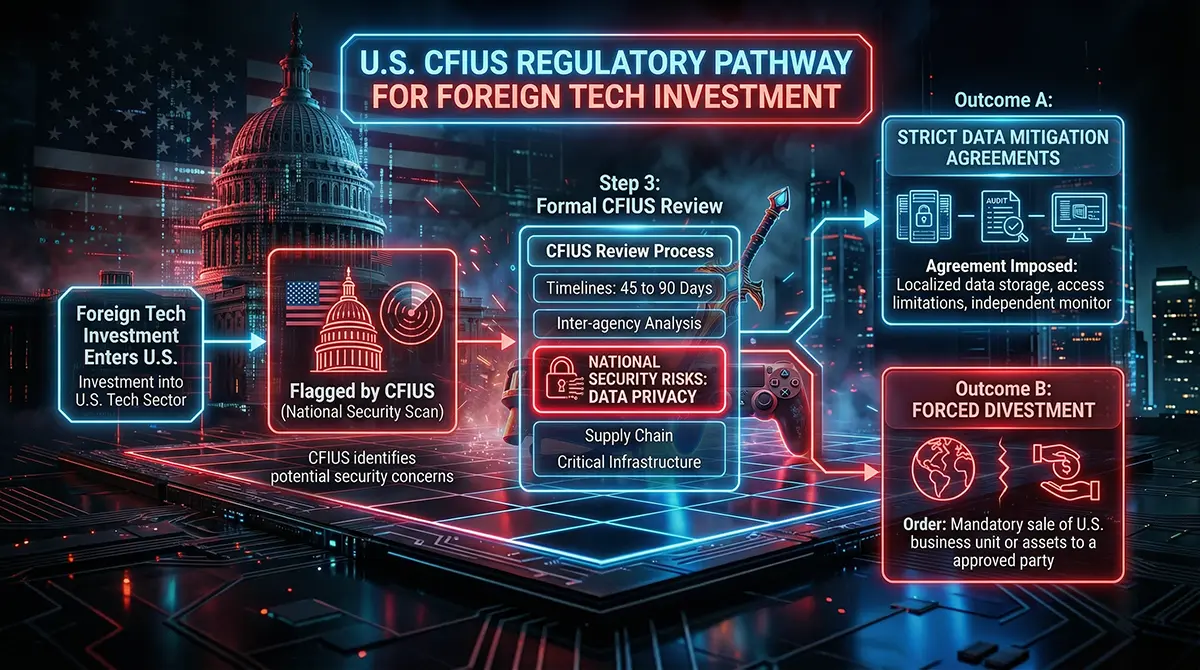
The scrutiny over Tencent isn’t completely new, but it has reached a boiling point ahead of President Trump’s scheduled meetings with Chinese President Xi Jinping. The Committee on Foreign Investment in the United States (CFIUS)—a Treasury-led interagency panel—has been investigating Tencent’s American assets for years. This has become one of CFIUS’s longest-running and most complex cases.
The debate within the US Government centers on two potential paths:
- Allow Tencent to keep its investments but force them to implement incredibly strict, third-party-audited data segregation protocols.
- Force a total divestment, meaning Tencent must sell its American assets to a US-approved buyer.
CFIUS has precedent here. A few years ago, they forced a Chinese company to sell the dating app Grindr over fears that the Chinese government could access the personal data of US military and intelligence personnel. Lawmakers are applying that exact same logic to gaming.
Data Privacy and Intelligence Concerns
Why are video games considered a national security threat? Think about the sheer volume of data a game collects. It’s not just your high score. It includes financial details from microtransactions, behavioral patterns, voice and text in-game chat logs, and deeply personal profiles.
Former US technology officials have voiced concerns that these gaming platforms could serve as significant intelligence collection sources. Furthermore, modern anti-cheat software (like Riot’s Vanguard) requires kernel-level access to your PC. This means the software has deep, foundational access to your operating system. The US fears that if a foreign government can legally compel a tech company to hand over that data—which Chinese intelligence laws allow—they can build incredibly detailed profiles on millions of citizens.
Unique Insight for Pakistanis: In Pakistan, we often think of data privacy strictly in terms of social media (like WhatsApp or Facebook). However, gamers freely install intrusive anti-cheat software without a second thought. The US Government‘s reaction is a wake-up call to tech-savvy Pakistanis about how deep gaming software embeds itself into our personal hardware.
What Gaming Giants Are Caught in the Crossfire?

When we talk about Tencent and the US Government, we aren’t talking about small indie developers. We are talking about the absolute titans of the global gaming industry. Tencent’s strategy has historically been to buy large stakes in successful Western companies, allowing them to operate independently while reaping the financial rewards.
Riot Games and the League of Legends Empire
Tencent doesn’t just own a piece of Riot Games; they own the entire company. Tencent first invested in the Los Angeles-based developer in 2008 and completed a full acquisition by 2011/2015. Riot Games is the powerhouse behind League of Legends, Valorant, and Teamfight Tactics.
If the US forces a divestment, Tencent would have to sell off one of the most successful eSports companies in history. Riot has repeatedly stated that it operates independently and has “industry-leading practices” to protect user data, but in the current geopolitical climate, promises of independence may not be enough to satisfy Washington’s security hawks.
Epic Games, Fortnite, and the Unreal Engine
Tencent also holds a massive 28% stake in Epic Games (diluted down from their original 40% purchase in 2012). Epic Games, based in North Carolina, is a crown jewel in the gaming world. While they are famous for Fortnite, their true value lies in the underlying technology they create: the Unreal Engine.
The Military Application of Unreal Engine

Here is where the national security concerns escalate rapidly. Epic Games is the creator of the Unreal Engine, a highly advanced 3D creation tool. The Unreal Engine isn’t just used to render cartoonish dances in Fortnite; it is widely utilized in Hollywood film production, architectural visualization, and crucially, military simulation and training.
The US Government and the Pentagon are deeply uncomfortable with a Chinese tech giant holding a 28% stake in a company whose proprietary engine is used by Western defense contractors to build flight simulators and tactical combat environments. The fear of espionage, backdoors, or technological theft in this arena is a major driving force behind the divestment talks.
The January 2025 Pentagon Blacklist: A Precursor to Divestment?
The regulatory pressure on Tencent has been mounting steadily, but a critical blow was struck during the final days of the Biden administration, effectively setting the legal stage for the current Trump-era policies.
The “Chinese Military Company” Designation
In January 2025, the US Department of Defense (the Pentagon) officially added Tencent to its list of “Chinese Military Companies” (the CMC list). This registry identifies companies operating in the US that the Pentagon believes have ties to China’s “military-civil fusion” strategy—a national strategy aimed at modernizing the Chinese military by leveraging civilian tech companies.
While being on the CMC list doesn’t immediately force civilian users to uninstall their games, it severely restricts the company’s ability to do business in the West. Specifically, the National Defense Authorization Act (NDAA) bans the Department of Defense from procuring goods or services from these designated companies starting in June 2026. This designation serves as a massive red flag to Western investors and provides the legal ammunition needed for a potential forced divestment.
Tencent’s Response and Market Reactions
Unsurprisingly, Tencent’s stock took a significant hit upon this announcement. The company released statements vehemently denying any ties to the Chinese military, calling the designation a “mistake” and pledging to work with the DoD to resolve the misunderstanding. They pointed out that their core businesses—video games, social media, and fintech—do not have clear military applications. Yet, to the US Government, any large Chinese tech conglomerate is subject to the data demands of Beijing, making their operational independence irrelevant.
The “TikTok Effect”: Technological Decoupling and the Great Divestment

What we are witnessing today is the rapid acceleration of the US-China tech war, moving beyond hardware (like Huawei 5G networks and semiconductor chips) and directly into software, entertainment, and digital culture.
Comparing Tencent to the ByteDance Saga
If this scenario sounds familiar, it’s because we’ve seen this exact playbook before. The US Government‘s scrutiny of Tencent is effectively a sequel to the ByteDance TikTok ban comparison. Just as lawmakers argued that TikTok could be used to manipulate algorithms or harvest data on American youth, they are now arguing that Tencent’s ownership of Epic Games and Riot Games poses the exact same risks.
The strategy is identical: identify a widely used digital platform with Chinese ownership, highlight the data privacy and national security risks, and use federal authority to force the parent company to sell its US operations to an American buyer, or face a total ban.
Splintering the Global Gaming Supply Chain
If Tencent is forced to sell off its stakes in Epic, Riot, and Supercell (the makers of Clash of Clans), it will cause a massive earthquake in the global gaming supply chain. We are looking at a new era of global technological decoupling, where the internet and digital services are split into distinct Western and Eastern spheres of influence.
Unique Insight: For a long time, video games were considered a neutral ground—a place where global cultures converged regardless of politics. The forced divestment of Tencent would signal the definitive end of that era. Developers will now have to choose which geopolitical bloc they are building for, heavily complicating cross-border technology investment, game publishing, and global eSports tournaments.
What This Means for Pakistani Gamers and the Tech Scene
So, how does Washington’s political maneuvering impact a gamer sitting in a cafe in Lahore, or a software developer working in Karachi? The ripple effects of the Tencent gaming divestment will absolutely reach our shores.
Will Your Favorite Games Be Banned or Sold?
The good news is that your access to games like Valorant, Fortnite, or League of Legends won’t suddenly vanish. If the US Government forces Tencent to divest, it means Tencent will have to sell its shares to a non-Chinese entity (likely an American conglomerate like Microsoft, or a consortium of Western investors). The games themselves are far too profitable to simply shut down.
However, the development and monetization strategies of these games might change. Tencent is known for heavily optimizing free-to-play mobile gaming monetization (battle passes, microtransactions) which resonates very well in Asian markets like Pakistan. A Western buyer might pivot the financial modeling of these games, potentially altering the free-to-play mechanics we are used to.
The Local eSports Ecosystem (PUBG Mobile & Beyond)
In Pakistan, Tencent is practically synonymous with PUBG Mobile, a game that has single-handedly built the local eSports ecosystem from the ground up. While PUBG Mobile is developed by Tencent’s Lightspeed & Quantum Studios (and licensed by Krafton), a broader US crackdown on Tencent could restrict the company’s ability to host global tournaments, secure Western sponsorships, or use American software infrastructure (like AWS or Google Cloud). If Tencent is globally sidelined, Pakistani eSports teams might find it harder to compete in unified, global leagues.
Funding Impact on Pakistani Game Developers
Pakistan has a booming IT and game development sector. Many local studios rely on the Unreal Engine to build their games, and some even seek publishing deals or venture capital from Chinese tech giants like Tencent.
For Pakistani tech developers looking for cross-border technology investment, this divestment push serves as a cautionary tale. If you build a startup and take Chinese venture capital, you might find yourself locked out of the lucrative US market in the future. The geopolitical alignment of your investors now matters just as much as the capital they provide. Local developers must now navigate a fractured global market, deciding whether to align with Western publishers or Eastern tech conglomerates.
Quick Takeaways
- Geopolitical Tug-of-War: The US Government (via CFIUS) is debating whether to force Tencent to sell its stakes in major Western game studios due to severe national security and data privacy concerns.
- The Big Targets: Tencent fully owns Riot Games (League of Legends, Valorant) and holds a 28% stake in Epic Games (Fortnite, Unreal Engine).
- Military Concerns: The US is particularly worried about Tencent’s connection to Epic’s Unreal Engine, which is actively used in Western military simulation and tactical training.
- The Blacklist: In Jan 2025, the Pentagon officially added Tencent to a list of companies allegedly affiliated with the Chinese military, legally restricting DoD business with them starting in 2026.
- The “TikTok Effect”: This push is part of a broader technological decoupling between the US and China, mirroring the forced divestment actions taken against ByteDance.
- Impact on Pakistan: While games won’t be banned locally, a forced sale could change how games are monetized, disrupt global eSports tournaments that Pakistani players rely on, and complicate venture capital funding for local game developers.
Conclusion
The showdown between Tencent and the US Government is much more than a corporate boardroom dispute; it is a defining battle in the 21st-century tech war. As we approach the crucial April 2026 meetings between US and Chinese leadership, the fate of the global gaming supply chain hangs in the balance. Whether Tencent is allowed to keep its investments under strict data-sharing mitigation measures or is forced into a historic divestment, the landscape of digital entertainment is forever altered.
For the Pakistani audience—whether you are an aspiring eSports professional, a casual mobile gamer, or a tech entrepreneur building the next big app in Karachi—this serves as a stark reminder that technology is never truly borderless. The games we play and the software we use are deeply intertwined with global geopolitics.
References
- Kotaku. (2026). The Trump White House Is Debating Whether To Kick Tencent Out Of U.S. Gaming.
- Investing.com. (2026). Trump admin considers allowing Tencent to retain gaming investments.
- The Times of India. (2026). Tencent’s stake in Fortnite and League of Legends makers: How Chinese tech giant may be ‘next TikTok’.
- CBS News. (2025). U.S. Defense Department says Tencent and other Chinese companies have ties to China’s military.
- Wikipedia. (2026). Epic Games – Corporate History and Tencent Acquisition.

China Starlink Killer: Inside the TPG1000Cs Microwave Cannon Threat
China has unveiled the TPG1000Cs, a mobile microwave cannon capable of frying satellite constellations. Discover how this "China Starlink Killer" changes electronic space warfare.
Feb

THE MOUSE BITES BACK: Disney Slams ByteDance with Cease & Desist Over “Seedance 2.0” Piracy
TikTok parent ByteDance faces a cease and desist from Disney over Seedance 2.0. Learn how artificial intelligence is threatening iconic characters.
Feb
Frequently Asked Questions (FAQs)
Yes. Through the Committee on Foreign Investment in the United States (CFIUS), the executive branch has the authority to review, block, or legally force the unwinding of foreign investments if they are deemed a credible threat to national security.
No. This specific geopolitical conflict is between the US and China regarding American assets. Pakistan sets its own telecommunications and digital policies. Your local access to games will remain unaffected unless the Pakistan Telecommunication Authority (PTA) steps in for entirely separate, local reasons.
Unreal Engine is an incredibly powerful 3D simulation tool used not just for video games, but by Western defense contractors for flight simulators, tactical training environments, and military simulation. The US fears a foreign entity could access proprietary data or build backdoors into these critical defense systems.
The Pentagon’s CMC list officially identifies entities operating in the US that supposedly aid China’s military-civil fusion strategy. Starting in June 2026, the US Defense Department is legally banned from procuring goods or services from companies on this list, crippling their ability to secure government or defense-adjacent contracts.
Both situations involve the US Government targeting widely popular consumer platforms owned by Chinese tech giants. In both cases, the primary argument is that the massive amounts of personal data collected by these platforms could be exploited by foreign intelligence, leading to a strict ultimatum: sell to an American company, or face a total ban.
What do you think about the US government’s push to force Tencent out of Western gaming? Will this ruin your favorite games, or do you think data security is more important? Let us know your thoughts in the comments below, and don’t forget to share this article with your squad on WhatsApp and Discord!
