

News
China Starlink Killer: Inside the TPG1000Cs Microwave Cannon Threat

Feb
For the last five years, the US strategy for space dominance has relied on one thing: Numbers.
SpaceX’s Starlink proved in Ukraine that you cannot shoot down a constellation of 6,000 satellites with expensive missiles. There are simply too many targets. But China may have just found the solution to the “Megaconstellation” problem.
According to new reports from state-linked researchers at the Northwest Institute of Nuclear Technology, China has successfully developed a compact High-Power Microwave (HPM) weapon component called the TPG1000Cs.
Unlike a missile that hits one target, this China Starlink killer is designed to be an “area of effect” mobile jammer that can fry the electronics of multiple satellites at once. The scariest part? It fits on a standard truck.
Here is the breakdown of the weapon that could turn Low Earth Orbit (LEO) into a graveyard.
The TPG1000Cs: A 20-Gigawatt Cannon in a Box
What makes the TPG1000Cs groundbreaking isn’t just its power; it is its size. This truck mounted weapon represents a massive leap in future technology for the PLA.
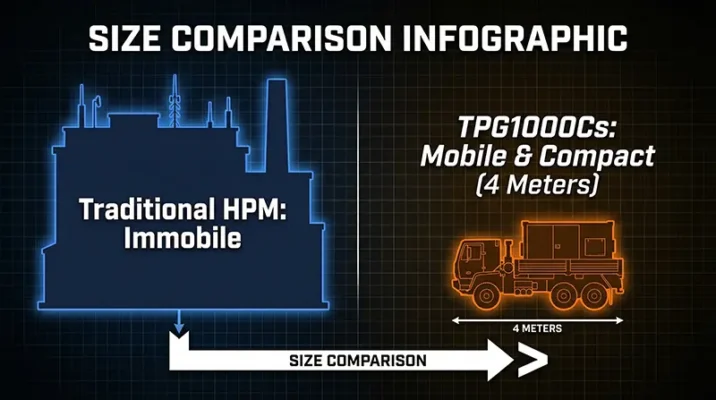
- The Power: The device reportedly generates a pulse of up to 20 Gigawatts. To put that in perspective, experts believe just 1 Gigawatt is enough to permanently damage the sensitive electronics of a LEO satellite. This weapon is effectively “overkilling” its targets by a factor of 20.
- The Size: It weighs just 5 tons and measures 4 meters long.
- The Endurance: Unlike previous HPM systems that could only fire for split seconds, the TPG1000Cs can reportedly sustain its firing for up to 60 seconds and deliver 3,000 pulses in a single session.
This compact size allows the China microwave weapon to be hidden in a shipping container, mounted on a warship, or driven around on a mobile launcher, making it nearly impossible for enemies to track and destroy before it fires.
Why Starlink is the Target
Chinese military researchers have openly described Starlink as a significant US military threat to national security, citing its potential to maintain communications during a conflict (like a potential blockade of Taiwan).

The SpaceX satellite vulnerability lies in the nature of the hardware. Starlink satellites are small, unarmored, and packed with sensitive electronics to maintain high-speed internet connections.
The “Area of Effect” Advantage
You don’t need to blow up a Starlink satellite to stop it; you just need to overload its circuits.
- Speed of Light: An HPM weapon attacks instantly.
- Sweeping Attacks: Because the TPG1000Cs can sustain a pulse for a minute, it can effectively “sweep” the sky, burning out the processors of dozens of satellites passing overhead in a single engagement.
- Clean Warfare: Unlike Russian “ASAT” missile tests that create dangerous debris fields, microwave attacks are “clean.” The satellite stays in one piece; it just stops working forever.
How the Technology Works: Dual U-Shape Design
How did Chinese engineers shrink a superweapon down to the size of a shipping container? The breakthrough lies in novel engineering and materials science.
- Dual U-Shaped Design: Traditional microwave weapons use long, linear energy storage tubes. The TPG1000Cs uses a “dual U-shaped” energy storage design. This folds the mechanism on itself, cutting the physical size in half while maintaining power output.
- Midel 7131 Insulation: The system utilizes a special liquid insulating material called Midel 7131, which allows for much higher power density without causing the machine to short-circuit or overheat.
- Aluminum Alloys: By replacing heavy steel components with advanced aluminum alloys, the team at the Northwest Institute of Nuclear Technology reduced the weight significantly, enabling it to be a truly mobile jammer.

Strategic Implications: The End of Space Invulnerability?
The unveiling of the TPG1000Cs is a clear message to the Pentagon. It signals that the era of “Space Invulnerability” is over.
If the US Military plans to rely on commercial satellites like Starlink or Starshield for wartime communication, China now has a mobile, cheap, and reusable way to turn those lights off. This electronic space warfare capability shifts the balance of power.
- Asymmetric Advantage: A Starlink satellite costs huge sums to launch and maintain. A microwave pulse costs the price of the diesel fuel used to power the generator.
- Denial of Service: In a Taiwan scenario, China could potentially create a “dead zone” over the Pacific where no LEO satellite can function, blinding US naval assets.
The Verdict: A New Era of Electronic Space Warfare
We are entering the era of electronic space warfare. The next major conflict won’t begin with explosions; it will begin with silence, as gigawatt-class microwaves quietly fry the mesh networks that modern armies rely on.
With the China Starlink killer now a reality, the US and SpaceX must race to harden their constellations against high power microwave attacks, or risk losing the ultimate high ground.
Resources
- IDN Financials: China develops compact “Starlink Killer” microwave weapon.
- Euro News: China develops compact microwave driver that could power a ‘Starlink-killer’ weapon.
- Space News: Russia, China target SpaceX’s Starlink in escalating space electronic warfare.
Frequently Asked Questions (FAQs)
The TPG1000Cs is a newly unveiled High-Power Microwave (HPM) weapon developed by China’s Northwest Institute of Nuclear Technology. Unlike traditional missiles, this truck mounted weapon is a compact mobile jammer capable of generating 20-gigawatt pulses to disable low-orbit satellite constellations like SpaceX’s Starlink.
The weapon uses a “Dual U-shaped” energy storage design to generate a sustained electromagnetic pulse. This pulse acts as an “area of effect” attack, frying the sensitive electronic processors of satellites without physically destroying them. This makes it a “clean” form of electronic space warfare that creates no debris.
Yes, SpaceX satellite vulnerability is a major concern because Starlink satellites are small, unhardened, and rely on commercial-grade electronics. A weapon like the TPG1000Cs can overload their circuits instantly, potentially disabling dozens of satellites in a single sweep as they pass overhead.
The US military threat posed by this weapon is significant because it is mobile, cheap to operate, and reusable. It challenges US space dominance by providing China with an asymmetric way to deny satellite communications (SatCom) during a conflict, such as a Taiwan blockade, without launching expensive missiles.
Because the system fits inside a standard 4-meter shipping container or on a truck, it is extremely difficult to distinguish from civilian cargo. This stealth capability allows it to be deployed as a mobile jammer almost anywhere, making pre-emptive strikes against it nearly impossible.
