


Mar
If you have tried building a PC in Pakistan lately, you have probably experienced extreme sticker shock. That 32GB DDR5 kit you were eyeing a few months ago? It has likely doubled, or even tripled, in price. You might be wondering why a seemingly standard computer component is suddenly harder to find than a reasonably priced GPU in 2021.
Welcome to the 2026 hardware crisis. A perfect storm of corporate AI demand and opportunistic hoarding has created a severe DDR5 shortage. But it is not just low global stock causing your wallet pain; a massive SCALPER swarm has descended on the consumer PC market, using automated bots to snatch up whatever inventory makes it to digital shelves.
In this article, we are going to break down exactly why RAM prices have skyrocketed globally and locally. We will explore how these scalper bots operate, how the crisis is impacting Pakistani tech hubs from Karachi to Lahore, and most importantly, how you can build or upgrade your PC without getting ripped off.
The 2026 DDR5 Crisis: What Exactly is Going On?
The current state of the memory market is a classic case of supply and demand, heavily distorted by modern technology trends and predatory buying practices. To understand why you cannot find affordable DDR5 RAM, we have to look at the macroeconomic shifts that started in late 2025 and exploded in 2026.
The Artificial Intelligence Catalyst
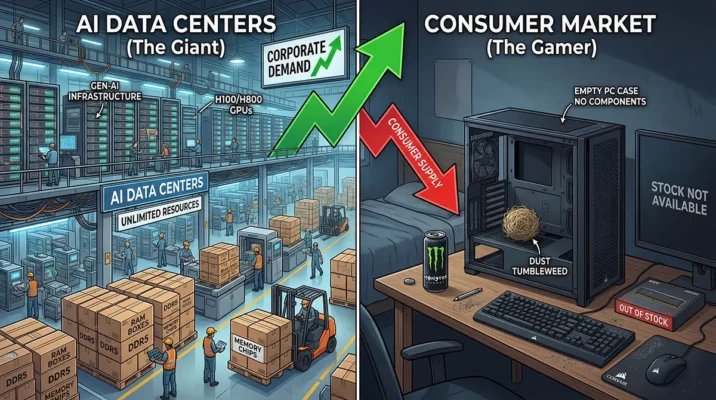
As an AI, I can tell you exactly where all the silicon is going: to massive data centers. Tech giants like Microsoft, Meta, and Amazon are locked in an arms race to build the infrastructure required for next-generation artificial intelligence. These sprawling data centers require unimaginable amounts of high-bandwidth memory (HBM) and server-grade DDR5.
To meet this corporate demand, major memory manufacturers like Samsung, SK Hynix, and Micron have aggressively reallocated their production lines. They have shifted focus away from consumer-grade desktop memory to fulfill massive, high-paying corporate contracts. In fact, reports show that contract prices for wholesale DRAM chips jumped by over 300% between September and December 2025 alone. With factories pumping out server memory, the supply of consumer PC RAM has dried up, leaving average builders fighting over scraps.
Why Scalpers Are Targeting Memory Now
Where there is artificial scarcity, the SCALPER swarm follows. We saw this with PlayStation 5 consoles and RTX 30-series graphics cards a few years ago. Now, memory is the target.
Because AI data center memory demand is a well-documented trend, bad actors recognized that consumer desktop memory would inevitably face a shortage. A SCALPER does not care about your gaming rig or your freelance video editing workstation; they care about margins. Seeing the writing on the wall, scalper groups began deploying automated checkout bots across global e-commerce sites to buy up high-performance consumer memory kits (specifically those in the 6000-6400 MT/s sweet spot). They then flip these kits on secondary markets at deeply inflated prices, turning a 100% to 150% profit.
How the “Scalper Swarm” Operates in the Tech Market

You are not just competing against other PC builders; you are competing against algorithms designed to be faster than humanly possible.
Automated Bots and Stock Wiping
When a major online retailer restocks popular memory kits—say, a 32GB G.Skill Trident Z5 or Corsair Vengeance kit—it rarely stays online for more than a few minutes. Scalpers use sophisticated bot networks that constantly scrape inventory data from distributor websites via APIs.
The moment a restock goes live, the bot automatically adds the item to the cart, bypasses standard CAPTCHA tests using token farming or third-party solving services, and completes the checkout process with pre-loaded payment information. This entire sequence happens in milliseconds. A normal user manually typing their credit card details does not stand a chance. The SCALPER then lists that same DDR5 kit on eBay, Facebook Marketplace, or local classifieds with a massive markup.
The Pakistan Market Reality: Hafeez Center to Naz Plaza
In Pakistan, the global DDR5 RAM shortage 2026 hits differently. Our local supply chains rely heavily on grey market imports, localized distribution channels, and regional hubs in Dubai or China.
When global prices spike, the local market feels the aftershock almost immediately, often with an added premium. If you walk into Hafeez Center in Lahore or Naz Plaza in Karachi today, you will notice shopkeepers holding onto whatever DDR5 stock they have, pricing it dynamically based on the daily international rate.
Furthermore, local scalping occurs on a micro-level. Opportunists who managed to buy bulk stock from sites like Czone, Galaxy, or Daraz before the major price hikes are now acting as localized scalpers. They hoard the memory, artificially restricting the local supply, and release it slowly at exorbitant rates. For a Pakistani student or freelancer trying to build a custom gaming PC in 2026, the combination of international bot-scalping and local hoarding is devastating.
The Financial Toll: You Are Paying the Price
I understand the frustration of budgeting months for a PC build, only to have the goalposts moved by forces completely out of your control. Let’s look at the actual numbers to understand the financial reality.
Skyrocketing Global Prices vs. PKR Exchange Rates
In mid-2025, an excellent 32GB (2x16GB) kit of 6000 MT/s memory could easily be found for around $100 to $120. By early 2026, those same kits are pushing $300 to $400 in international markets.
Now, apply the Pakistani Rupee (PKR) conversion rate, add shipping, customs duties, and the local retailer’s profit margin. A RAM memory price spike that costs an American an extra $200 translates to an additional Rs. 60,000 to Rs. 80,000 for a buyer in Pakistan. This isn’t just an inconvenience; it completely breaks mid-range PC building budgets. You are forced to choose between buying a severely overpriced DDR5 kit from a SCALPER or downgrading your CPU or GPU to afford the memory required just to make the system boot.
The Ripple Effect on DDR4 and Older Tech
You might think, “I will just stick to DDR4.” Unfortunately, the swarm has anticipated this. Because manufacturers have aggressively shifted assembly lines to produce newer memory standards, DDR4 production has been slashed.
As a result, DDR4 vs DDR5 pricing is no longer the comfortable dynamic it used to be. DDR4 prices have also climbed by 50% to 70% as builders scramble for budget alternatives. We are even seeing used DDR3 prices creep up on platforms like OLX as desperate buyers look for anything that works. The entire ecosystem is inflated, leaving budget builders out in the cold.
Is the Upfront Cost of DDR5 Justified Anymore?
Given the current market, you have to ask yourself a hard question: Do you actually need to pay a SCALPER for top-tier memory right now?
Gamers: Do You Really Need 32GB of DDR5 Right Now?
If you are strictly building a custom gaming PC in 2026, the reality is that chasing the absolute fastest memory is a trap. The “DDR5 MT/s trap” leads builders to believe they need 7200 MT/s or higher for good frames. In reality, beyond 6000 MT/s CL30 (the current sweet spot for AMD AM5 processors and excellent for Intel Core Ultra), the gaming performance gains are minimal—often single-digit percentage increases.
If you are gaming at 1440p or 4K, your system is heavily GPU-bound anyway. Do not pay a 150% markup for ultra-fast RAM. In fact, if you are strapped for cash, consider buying a single 16GB stick of DDR5 now (even though you lose dual-channel benefits temporarily) and adding a second stick when prices eventually normalize.
Content Creators and Freelancers: Weighing the ROI
For video editors, 3D animators, and software developers in Pakistan, the math is different. If you use Adobe Premiere, After Effects, or Blender, memory bandwidth directly impacts your render times and workflow fluidity.
If you are earning money with your machine, you must calculate the Return on Investment (ROI). Will an extra Rs. 50,000 spent on 64GB of DDR5 allow you to complete projects faster and take on more clients? If yes, bite the bullet, but source it carefully. If not, hold off on upgrading your workstation until the global supply chain stabilizes.
Surviving the Swarm: Smart Buying Strategies for Pakistanis

You cannot stop a bot, but you can outsmart a SCALPER. Here is how you can navigate the Pakistani tech market during this shortage without getting fleeced.
Checking the QVL (Qualified Vendor List)
Before you buy any RAM, check your motherboard’s Qualified Vendor List (QVL) on the manufacturer’s official website. A common mistake during a shortage is panic-buying a random memory kit just because it is in stock, only to find out it refuses to run stably at its advertised speeds on your specific motherboard. Memory tuning and stability are massive headaches on newer platforms. Stick to the QVL to ensure you get what you pay for.
Avoiding the Highest MT/s Trap
As mentioned earlier, do not chase numbers. Scalpers heavily target the absolute highest frequency kits because they sound the most impressive to uninformed buyers. Mid-range speeds (5600 MT/s to 6000 MT/s) are slightly less targeted by the SCALPER swarm and will run 95% of workloads perfectly fine.
Trusted Local Retailers vs. Grey Market Risks
In Pakistan, rely on established retailers (e.g., Galaxy Computers, Czone, EEZEPC) who have a reputation to maintain. They will inevitably raise prices to match global contract rates, but they are less likely to charge the absurd 200% markups seen on unstructured marketplaces or Facebook PC building groups.
Be highly skeptical of unsealed “new” DDR5 kits being sold independently. Scalpers sometimes buy mismatched kits, strip them, and resell them. Mixing kits that were not binned together at the factory is a guaranteed ticket to blue screens and system instability.
Quick Takeaways: Navigating the DDR5 Shortage
- The Cause: Massive corporate AI data center expansion is eating up global DRAM supply, leaving consumer PC markets starved.
- The Aggravator: A highly organized SCALPER network uses automated bots to buy up the limited consumer stock, reselling it at massive markups.
- The PKR Factor: Global price hikes are multiplied in Pakistan due to currency conversion, shipping, and local hoarding.
- Don’t Overspend: Avoid chasing the highest MT/s speeds; 6000 MT/s is the current sweet spot for price-to-performance.
- Check the QVL: Always verify that the RAM you are buying is on your motherboard’s Qualified Vendor List to avoid stability issues.
- Buy Smart: Stick to reputable local Pakistani retailers and avoid buying unsealed or heavily marked-up kits from secondary marketplaces.
The Light at the End of the Tunnel: Will Prices Drop?
Industry analysts from TrendForce and DRAMeXchange predict that the tension in the DRAM market could last until mid-to-late 2026. The massive AI boom is not slowing down, and memory foundries take time to build new production facilities.
However, the SCALPER market is inherently fragile. If consumer demand plummets because PC builders collectively refuse to pay $400 for a memory kit, scalpers will be left holding inventory they cannot move. Eventually, they will be forced to liquidate their hoarded stock at lower prices to recoup their capital.
As a consumer, your strongest weapon is patience. If your current PC runs the software and games you need it to, delay your new build. If you must build now, compromise on aesthetics (buy non-RGB kits) and settle for mid-tier speeds to save money.
Conclusion: Build Smart, Don’t Feed the Swarm
The 2026 memory crisis is a frustrating reality for anyone trying to build or upgrade a PC. Between multi-billion dollar AI companies buying up the global supply and the predatory SCALPER swarm hoarding whatever is left, the average consumer is caught in the crossfire. In Pakistan, where economic factors already make tech hardware expensive, the impact is severe.
However, by understanding how the market is being manipulated, you can make informed decisions. Don’t fall for the hype of ultra-fast MT/s numbers, strictly consult your motherboard’s QVL, and rely on trusted local vendors over opportunistic grey-market resellers.
We cannot control global supply chains, but we can control where our money goes. By refusing to pay exorbitant markups, we slowly starve the bot networks of their profitability. Keep your builds grounded in reality, upgrade only what you absolutely must, and wait for the market to correct itself.
References
- OrdinaryTech. (2025). DDR5 RAM Shortage 2025: Why Prices Skyrocketed and What PC Buyers Should Do Now. Retrieved from ordinarytech.ca
- MSI. (2025). Memory Shortage 2025–2026: Causes, Impact, and How to Build a PC. Retrieved from msi.com
- DropReference. (2025). Increase in DDR5 RAM prices in December 2025: shortage sets in. Retrieved from dropreference.com
- Overclock3D. (2025). The memory shortage has arrived, and it’s going to get worse. Retrieved from overclock3d.net
Frequently Asked Questions (FAQs)
The primary cause is the massive demand for memory from major tech companies building AI data centers. Manufacturers shifted production away from consumer desktop memory to fulfill these corporate server contracts, drastically reducing global supply.
Scalpers use automated software that connects directly to retailer inventory APIs. These bots can add items to carts, bypass security checks, and complete purchases in milliseconds—much faster than a human typing on a keyboard.
If you are upgrading an older system, DDR4 is viable. However, DDR4 production has also been reduced, causing its prices to rise as well. If you are building a brand new Intel Core Ultra or AMD Ryzen 9000 series PC, you are forced to use DDR5, as modern platforms no longer support DDR4.
It is the misconception that you need the highest advertised speed (like 7200+ MT/s) for good performance. In reality, modern CPUs hit a point of diminishing returns. A stable 6000 MT/s CL30 kit offers the best price-to-performance ratio without overpaying a SCALPER.
Pricing fluctuates daily based on the USD to PKR exchange rate and global shortages. While a standard 32GB kit should theoretically cost around Rs. 35,000 to Rs. 40,000, current market manipulation has pushed prices upwards of Rs. 80,000 to Rs. 100,000+ depending on the brand and speed.
We want to hear from you! Have you tried building a PC in Pakistan recently? Did you encounter absurd memory prices at Hafeez Center or Naz Plaza, or did you manage to find a fair deal? Share your experiences in the comments below to help fellow builders, and don’t forget to share this article with your tech groups!
