

News
Microsoft Copilot AI Strategy: The End of Physical Libraries?

Feb
In a move that feels ripped straight out of a dystopian sci-fi novel, Microsoft Copilot AI has officially displaced an age-old institution: the library. Microsoft has decided that books are now “legacy technology,” marking a pivotal shift in how the tech giant views knowledge acquisition.
According to internal memos and reports surfacing today, the company has quietly shuttered its physical libraries across its major global campuses—including Redmond, Hyderabad, Beijing, and Dublin. But the “modernization” didn’t stop at physical shelves. The company has also cancelled thousands of digital subscriptions to academic journals, research reports, and major news outlets.
Their replacement? A new, internal platform called the “Skilling Hub,” driven entirely by Microsoft Copilot AI.
Basically: Don’t read a book. Ask the bot.
Below, we analyze why this shift toward Microsoft Copilot AI might be a massive cultural gamble for the future of deep work.
The Purge: Why Books Are Now “Offline Data”
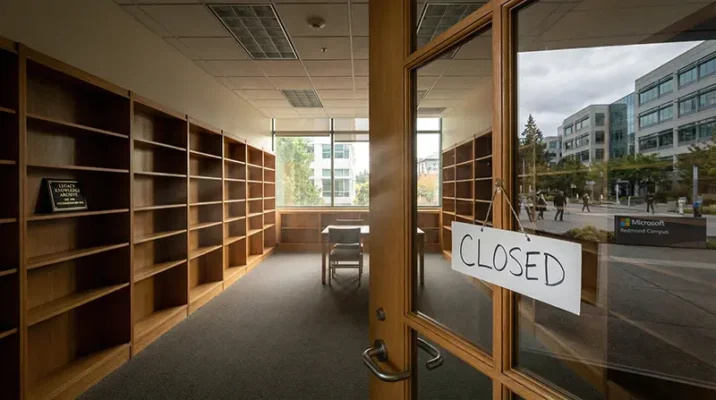
For decades, the library in Redmond was more than just a room with shelves; it was a legendary perk. It served as a sanctuary where engineers could think deeply, study complex O’Reilly technical manuals, or access expensive IEEE research papers to solve difficult coding problems.
However, the rise of Microsoft Copilot AI has rendered these spaces obsolete in the eyes of executives.
The Physical Closures
The quiet reading rooms in Redmond and Hyderabad are gone. The physical books have been removed, donated, or discarded. What was once a hub for silent contemplation is being repurposed for collaborative spaces or simply erased to cut real estate costs.
The Digital Blackout
This is the part that hurts engineers the most. Access to expensive subscriptions—like The Wall Street Journal, Harvard Business Review, and niche technical journals—has been slashed. The assumption is that Microsoft Copilot AI can synthesize this information without the need for direct access to the source material.
The Replacement: Skilling Hub and Microsoft Copilot AI
Microsoft argues that nobody reads “long-form” content anymore. In a statement to employees, the company framed this as a shift toward a “more modern, AI-powered learning experience.”
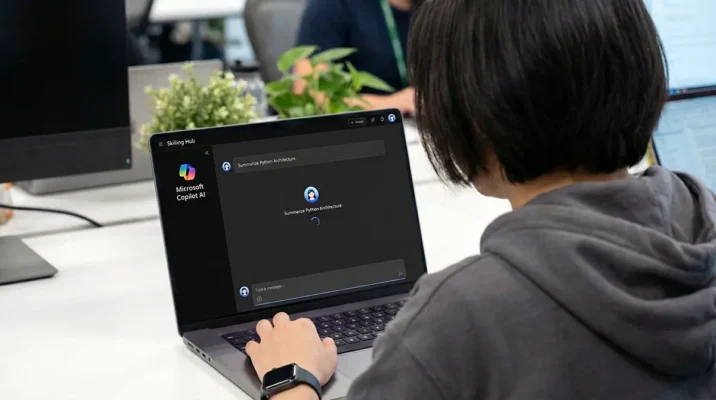
The new “Skilling Hub” is designed to provide “just-in-time” learning, heavily relying on Microsoft Copilot AI to deliver instant answers.
How the Skilling Hub Works
The workflow for gaining knowledge has fundamentally changed.
- Old Way: You read a 300-page book on Python architecture to understand the full scope of the language.
- New Way: You ask Microsoft Copilot AI to “summarize the best practices for Python architecture.”
This integration of artificial intelligence into the daily learning loop is meant to streamline workflows, but it fundamentally changes the nature of knowledge.
The Philosophy: Speed Over Depth in Learning
Microsoft is betting that summarized knowledge is more efficient than deep reading. By forcing the adoption of Microsoft Copilot AI, they are “eating their own dog food” so aggressively that some employees feel they are choking on it.
This strategy prioritizes speed. In the fast-paced world of technology, getting an answer in 30 seconds is seen as superior to spending three hours researching a topic. However, this approach ignores the nuance that comes from comprehensive study.
The Risks: Hallucinations and the Death of Deep Work
Critics inside the company—many posting anonymously on forums like Blind—are calling this a “cultural lobotomy.” Relying solely on Microsoft Copilot AI for technical truth introduces significant risks.
The Hallucination Risk
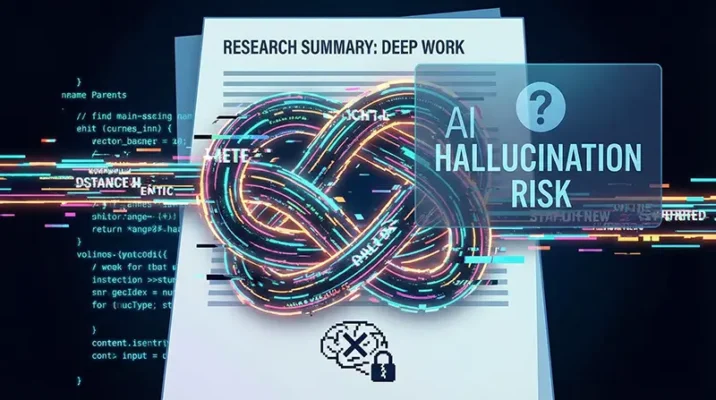
Replacing peer-reviewed journals with AI summaries introduces the risk of “confident errors.” If Microsoft Copilot AI hallucinates a coding standard or misinterprets a security protocol, an entire team might adopt bad practices without realizing the source is flawed.
Loss of Serendipity
You don’t “stumble upon” a great idea in an AI summary. You find it by browsing a library shelf or reading a research paper you didn’t know you needed. The serendipitous nature of browsing physical or digital libraries is lost when an algorithm dictates exactly what you see based on a specific prompt.
Cost-Cutting in Disguise
Let’s be real. While this is marketed as an innovation in learning, it is likely a strategy for cost-cutting. Saving millions on licensing fees for journals and real estate costs for libraries is a significant financial incentive, wrapped in the shiny marketing of Microsoft Copilot AI.
Microsoft Copilot AI and the Future of Corporate Training
This move signals a broader trend in corporate training. Microsoft is setting a precedent that other tech giants may follow.
If the creators of the technology believe that Microsoft Copilot AI is sufficient to replace foundational learning materials, we may see a global shift where books and digital subscriptions become luxury items rather than standard corporate perks.
For engineers in Pakistan and globally, this changes the landscape of professional development. The expectation is no longer to be a “scholar,” but to be an efficient operator of AI tools.
Conclusion: The Era of the Scholar Engineer is Over
Microsoft is signaling that in 2026, speed matters more than depth. They want employees to learn fast, not necessarily learn deep.
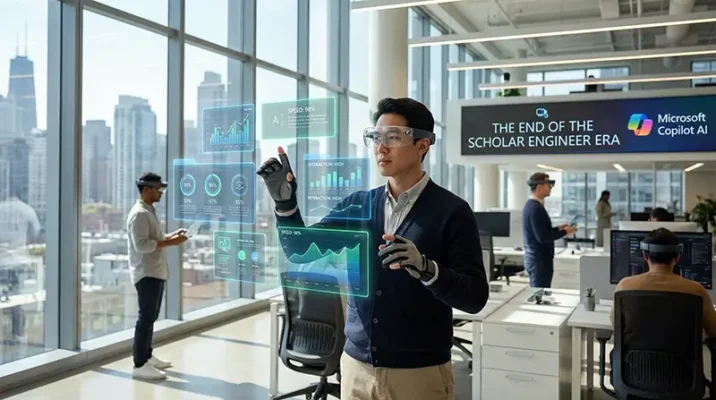
It is a bold bet on the future of work, but one thing is certain: The era of the “Scholar Engineer” at Microsoft is officially over. By going all-in on Microsoft Copilot AI, the company has decided that the library is closed, and the chatbot is open for business.
Resources
- Entrepreneur: Microsoft Closes Its Physical Libraries for AI-Powered ‘Skilling Hubs’.
- The Verge: Microsoft is closing its employee library and cutting back on subscriptions.
Frequently Asked Questions (FAQs)
Microsoft has officially designated physical books as “legacy technology.” The closures are part of a strategic shift toward AI-powered learning and cost-cutting. The company believes that storing “offline data” in books is inefficient compared to using digital, AI-driven summaries provided by Microsoft Copilot.
The Skilling Hub is Microsoft’s new internal learning platform that replaces traditional library access. Powered by Microsoft Copilot AI, it is designed to provide “just-in-time” learning. Instead of reading full technical manuals or books, employees are encouraged to ask the AI to summarize key concepts and coding standards instantly.
Yes. As part of this transition, Microsoft has cancelled thousands of digital subscriptions to academic journals, research reports, and platforms like O’Reilly. The company argues that deep work reading is less efficient than AI-generated summaries, forcing engineers to rely on the Skilling Hub for technical knowledge.
The primary risk is “hallucination,” where artificial intelligence confidently generates incorrect information. Critics argue that replacing peer-reviewed journals with AI summaries can lead to the adoption of bad coding practices (“confident errors”) and the loss of serendipitous discovery that comes from browsing physical or digital libraries.
Many industry analysts and employees believe so. By removing access to deep research materials and prioritizing speed over depth, Microsoft is signaling a cultural shift. The focus is now on rapid implementation using Copilot, effectively ending the tradition of the “Scholar Engineer” who dedicates time to deep study and research.
Related Blogs
Jensen Huang Shocking Prediction: AI Jobs Boom for Plumbers, Not Coders
Jensen Huang drops a bombshell at Davos 2026: The future of AI jobs isn't coding—it's plumbing. Discover why blue-collar trades are the new six-figure career path in the AI economy.
Jan
Google Genie AI: The Shocking End of Traditional Gaming? (2026 Review)
Google Genie AI is transforming the gaming industry. Discover how DeepMind’s new model creates playable worlds from images and the massive copyright risks involved.
Feb
Clawdbot (Moltbot) Explained: The ‘Claude AI’ Agent Taking Control of WhatsApp
Discover Clawdbot (Moltbot), the new open source Claude AI agent that connects to WhatsApp. Learn about its root access, automation capabilities, and the security risks involved.
Jan
Google Gemini Dominates the New AI Benchmark: Pokémon Blue (2026)
In the ultimate 2026 AI benchmark, Google Gemini crushes OpenAI and Claude at Pokémon Blue. Discover why this gaming victory proves Gemini is the future of Agentic AI.
Jan
YouTube AI Likeness Alert: Why Your Digital Twin Will Take Over Shorts in 2026
YouTube AI Likeness tool arrives in 2026. Discover how to generate infinite YouTube Shorts using a Digital Twin and avoid AI Slop.
Jan
