

News
Jensen Huang Shocking Prediction: AI Jobs Boom for Plumbers, Not Coders
Jan
For the last decade, the global mantra for career success was simple: “Learn to code.” We were told that Artificial Intelligence would automate manual labor first, leaving creative and logical tasks to humans. We were told that the path to a six-figure salary lay exclusively through Python scripts and JavaScript frameworks.
We were wrong.
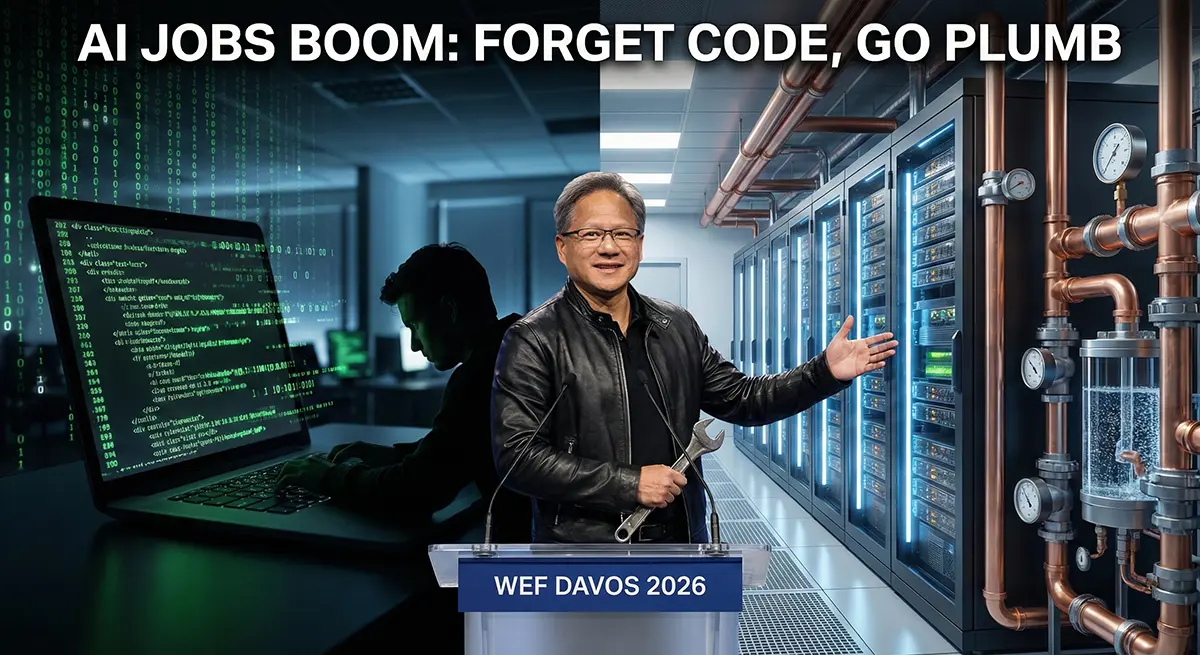
Speaking at the World Economic Forum in Davos this week, Jensen Huang, the CEO of NVIDIA, dropped a reality check that has the entire tech world buzzing. As the architect of the hardware driving the AI boom, Huang’s words carry weight. His message? The digital revolution has hit a physical wall, and the people who will fix it aren’t junior developers. They are plumbers, electricians, and steelworkers.
The “AI Age” is here, but the shovel-sellers this time aren’t just selling chips—they are pouring concrete and laying copper.
Jensen Huang’s Reality Check: The Physical AI Bottleneck
While chatting with BlackRock CEO Larry Fink, Jensen Huang made a bold prediction that flips the traditional hierarchy of the tech industry on its head. The AI revolution isn’t just about software anymore; it is sparking the “largest infrastructure buildout in human history.”
“It’s wonderful that the jobs are related to tradecraft – we’re going to have plumbers and electricians and construction and steelworkers and network technicians… Salaries have gone up nearly double. You don’t need a PhD in computer science to make a great living.” — Jensen Huang, Davos 2026

Why is this happening? Because Artificial Intelligence isn’t just code floating in the cloud. It is physical, heavy, and incredibly hot.
As companies race to build massive $100 billion data center projects to train models like GPT-6, they are encountering a massive problem: they are running out of humans to build them. The bottleneck for AI scaling in 2026 is not lack of silicon—it is a lack of skilled blue collar labor.
Why Plumbers Are the New Tech Elite
To understand why a plumber might out-earn a mid-level software engineer in 2026, you have to look at the hardware.
Modern AI chips, specifically the NVIDIA Blackwell and Blackwell Ultra series, run at incredible power densities—often exceeding 1,000 watts per chip. Traditional air conditioning cannot keep these chips from melting. They require complex, direct-to-chip liquid cooling systems.
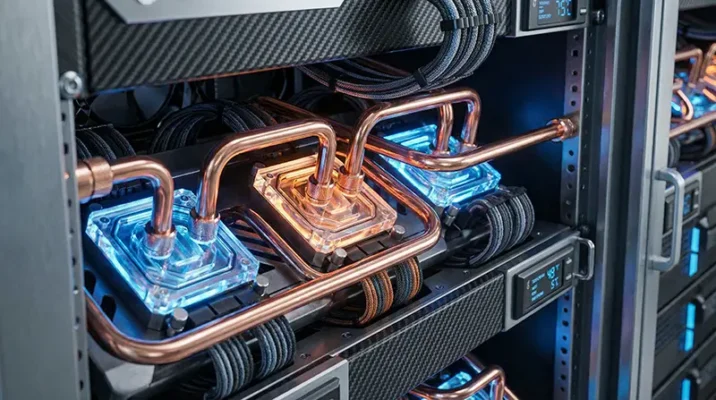
This isn’t your standard bathroom plumbing. This is high-stakes, precision engineering.
- The Cooling Problem: Thousands of miles of piping must be installed in server rooms to circulate coolant directly over the chips. A single leak could destroy millions of dollars of hardware.
- The Skill Gap: You cannot ask ChatGPT to weld a pipe or wire a high-voltage transformer. These are “zero-failure” physical tasks that require human hands and years of trade experience.
- The Wage Spike: Because these skills are scarce, jobs in specialized industrial plumbing and electrical work are seeing salaries double. In the US and Europe, these trades are commanding “six-figure” packages that rival Silicon Valley developers.
The Data Center Explosion: A Blue-Collar Gold Mine
We are currently witnessing the construction of “AI Factories.” These are not just warehouses with computers; they are power plants. A single hyperscale data center now consumes as much electricity as a small city.
This infrastructure boom requires a massive army of skilled workers:
- Electricians: To manage the gigawatts of power required for AI clusters.
- HVAC Techs: To manage the massive heat waste generated by generative AI training.
- Construction Workers: To build the physical shells of these massive facilities faster than concrete can cure.
Jensen Huang noted that this is a global phenomenon. Whether in the US, Europe, or Asia, the “infrastructure layer” of the economy is eating the “software layer.”
White-Collar “Bloodbath” vs. Blue-Collar Boom
The contrast at Davos 2026 couldn’t be sharper. While Jensen Huang was championing the trades, other tech leaders were quietly discussing “white-collar efficiency.”
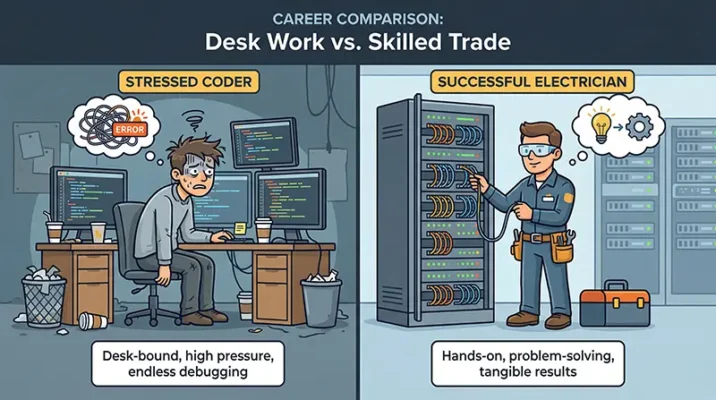
AI agents are now capable of writing basic code, debugging software, and handling routine freelance tasks like copywriting and basic graphic design. This has led to a stagnation in entry-level coding jobs.
| Career Path (2026) | Trend | Why? |
|---|---|---|
| Junior Developer | 📉 Declining | AI can write basic scripts faster and cheaper. |
| Industrial Plumber | 📈 Boom | AI chips need liquid cooling; robots cannot install pipes yet. |
| Electrician | 📈 Boom | Data centers need massive power grid upgrades. |
| Data Entry | 📉 Declining | Fully automated by AI agents. |
If you are a student sitting in a CS 101 class wondering if your degree will be worth it, Jensen Huang just gave you an alternative career path. The “safe” desk job is becoming risky, while the “risky” manual job is becoming the safest bet in the economy.
What This Means for Pakistan’s Workforce
For the Pakistani workforce, this shift presents both a challenge and a massive opportunity. Pakistan has historically focused on exporting software talent and freelance digital services. While those sectors remain vital, the global pivot to “Physical AI” opens new doors.
- The Rise of “Blue-Collar” Freelance: The definition of freelance work is expanding. It’s not just about Upwork gigs for logo design. There is a growing demand for remote support in construction planning, CAD (Computer-Aided Design) for liquid cooling systems, and electrical engineering schematics. Pakistani engineers who can design the infrastructure for data centers will be in high demand globally.
- Skilled Migration Opportunities: Countries like the USA, Germany, and Japan are facing critical shortages in trade labor. They need welders, electricians, and pipefitters to build their AI infrastructure. For Pakistani youth, vocational training (TVET) might now offer a faster route to international mobility and high salary careers than a generic MBA or CS degree.
- Local Data Center Growth: As artificial intelligence adoption grows within Pakistan, local jobs will mirror global trends. We will need our own “AI Factories” to process local data securely. This will create a domestic surge in demand for specialized construction and electrical talent.
Conclusion: Put Down the Laptop, Pick Up a Torch
The future of work is not what we thought it would be. Jensen Huang has made it clear: the AI revolution requires a physical body, not just a digital mind.
If you have skills that allow you to manipulate the physical world—to weld, to wire, to plumb, to build—you are the most valuable asset in the AI economy right now. The “Smart” money in 2026 isn’t betting on the next lines of code; it’s betting on the pipes that keep the code running.
Our Advice: If you are looking for career security in the age of artificial general intelligence, don’t just look at screens. Look at the infrastructure behind them.
Resources
- Fortune: Nvidia CEO Jensen Huang says ‘a lot’ of six-figure jobs in plumbing and construction are about to be unlocked because someone needs to build all these new AI centers.
- Yahoo Finance: Nvidia CEO Jensen Huang says ‘a lot’ of six-figure jobs in plumbing and construction are about to be unlocked because someone needs to build all these new AI centers.
Frequently Asked Questions (FAQs)
Not exactly. At the World Economic Forum in Davos 2026, NVIDIA CEO Jensen Huang clarified that while coding is still useful, it is no longer the only golden ticket. He emphasized that AI can now generate code, but it cannot build the physical infrastructure—like data centers and cooling systems—needed to run that AI. He suggests that skilled trades are currently a safer bet for high income than entry-level programming.
AI isn’t just software; it lives in massive physical data centers that consume gigawatts of electricity and generate immense heat. Electricians are needed to wire high-voltage grids, and plumbers are essential for installing complex liquid cooling systems required by modern chips like the NVIDIA Blackwell. Robots cannot yet perform these delicate, physical tasks.
Coding is not “dead,” but the bar has been raised significantly. Basic “code monkey” jobs (writing simple scripts) are being automated by AI agents. However, high-level software engineering—where you design complex systems and architecture—is still valuable. The shift is simply that junior developer roles are vanishing, while skilled trade roles are booming.
While you cannot plumb a US data center from Lahore, the “support economy” is digital. There is a massive surge in demand for BIM (Building Information Modeling) designers, electrical schematic drafters, and remote project managers who understand construction tech. Freelancers should pivot from “web development” to “engineering design” services.
The “Physical AI Bottleneck” refers to the fact that we have enough AI chips, but not enough power plants or data centers to house them. The speed of AI progress is now limited by how fast we can pour concrete and lay copper pipes, not by how fast we can write software.
