

News
Google Genie AI: The Shocking End of Traditional Gaming? (2026 Review)
Feb
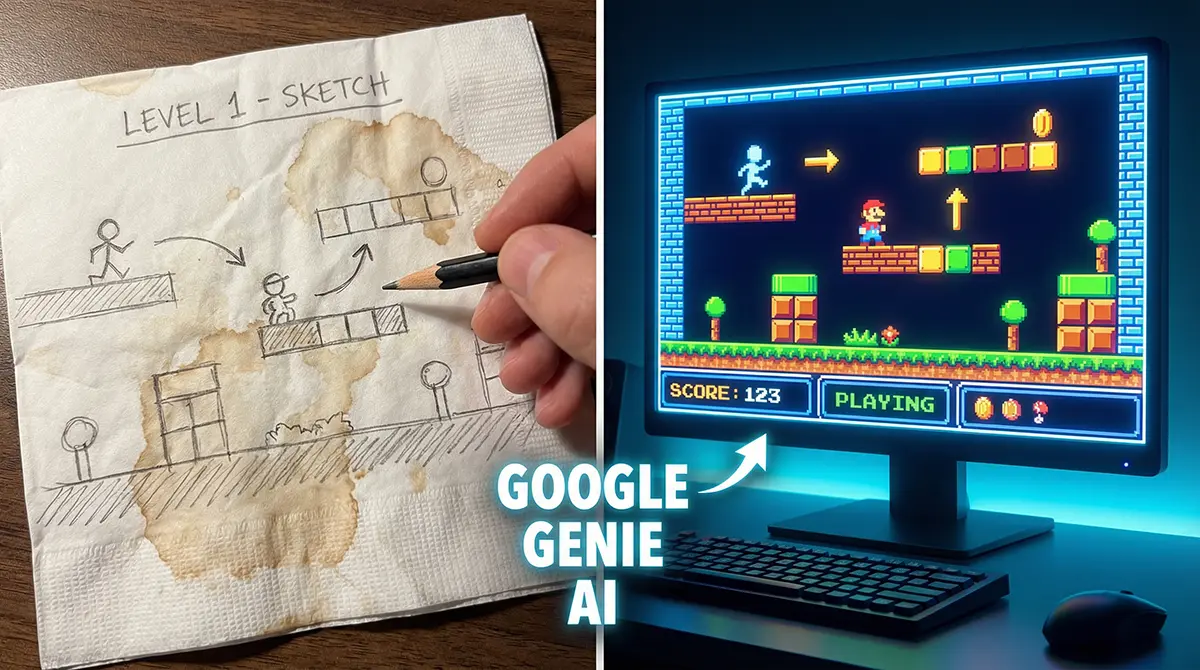
Imagine drawing a Super Mario level on a napkin, scanning it with your phone, and instantly picking up a controller to play it. No coding, no game engine, no rendering. Just pure imagination.
This is the promise of Google Genie AI, a revolutionary technology that is currently shaking the foundations of the global gaming industry. While text-to-video tools like Sora dominated the headlines in 2024, 2026 has ushered in the era of Generative Interactive Environments (GIE).
Google Genie AI doesn’t just make a video; it creates a “dream” you can control. But as we stand on the precipice of this new digital frontier, we must ask: Is this the democratization of creativity, or the death knell for traditional game development?
This article provides a deep dive into the technology that promises to change everything—and the massive legal and ethical problems it is about to create.
The Tech: How Google Genie AI Learned to “Dream”
At its core, Google Genie AI (Generative Interactive Environments) is technically classified as a “foundation world model.”
Unlike a traditional video game built on engines like Unity or Unreal, which follow strict, pre-written code logic, Genie “hallucinates” the game frame-by-frame based on your input. It creates a visual prediction of what should happen next, rather than calculating polygons and physics.
The 11-Billion Parameter Breakthrough
Developed by DeepMind, this model was trained on a staggering dataset of over 200,000 hours of 2D platformer gameplay videos. With 11 billion parameters, it predicts the next pixel based on the user’s action, maintaining the laws of physics (mostly) in a dream-like state.
This allows Google to offer an experience where the world itself is generated in real-time. In early 2026, the release of the “Genie 3” update further refined this, allowing for 720p resolution at 24 frames per second—a massive leap from the jittery prototypes of the past.
The Magic Trick: Latent Action Learning Explained
The most impressive feat of Artificial Intelligence in this project is how it learned to understand control.
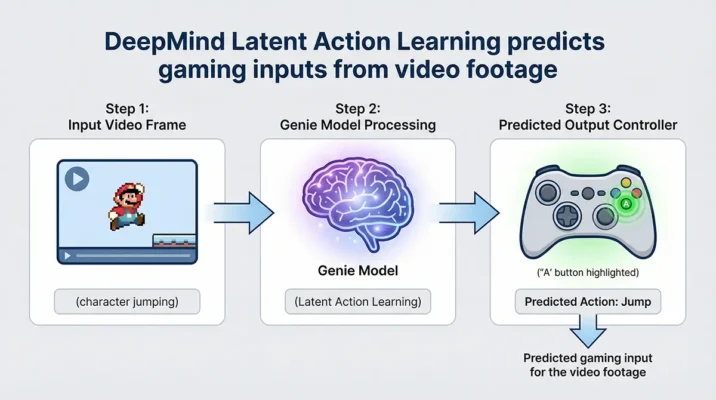
Crucially, the training data used by DeepMind did not include controller inputs. Genie did not know which button the player pressed in the video. Instead, it used a technique called “Latent Action Learning.”
- Observation: It watched a character on screen jump over a pit.
- Inference: It inferred that a specific “action” must have occurred to cause that movement.
- Result: It taught itself the concept of “left,” “right,” and “jump” purely by observation.
This means Google Genie AI understands the intent of gaming without ever seeing a line of code. It is an interactive system built entirely on visual intuition.
Infinite Content: The Uses of Generative Worlds
The implications for creators are staggering. By removing the barrier of coding, Google Genie AI democratizes game design in ways we never thought possible.
- Rapid Prototyping: Professional designers can sketch a boss battle or a level layout and play-test the “vibe” in seconds without writing a single line of C#.
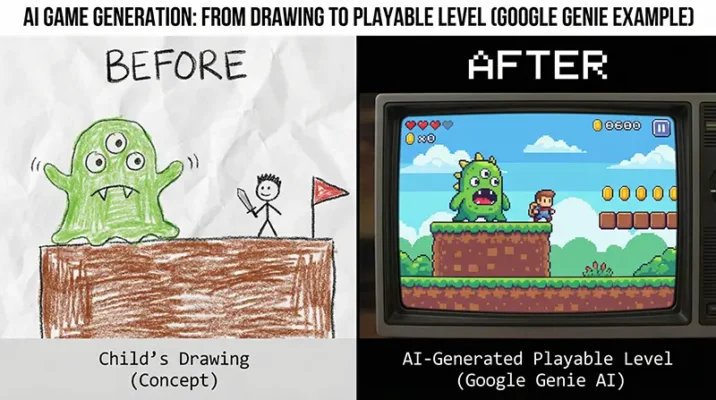
- The “Kid” Factor: Educationally, it allows children to bring drawings to life, fostering creativity and logic.
- AI Training Grounds: Researchers are using Genie to create infinite, procedurally generated worlds to train other AI agents (robotic brains) on how to navigate complex physical spaces.
The Market Impact: The “YouTube” of Gaming?
Google Genie AI represents a fundamental shift from rendering (calculating polygons) to generating (predicting pixels).
If Google integrates this technology into YouTube or the Play Store, we could see the rise of “Instant Games.” Imagine watching a gameplay trailer and clicking a button to instantly “step into” that video and control it.
Threat to Asset Stores
This is a direct long-term threat to asset stores and entry-level level designers. Why would a developer buy a generic “Forest Asset Pack” for $50 when Google Genie AI can hallucinate a unique, high-fidelity forest for every single player for free?
The Legal Minefield: A Copyright Nightmare
However, the technology is walking through a legal minefield. The biggest hurdle facing Google Genie AI is the “Nintendo” nightmare.
1. The Copyright Elephant
Genie was trained on massive amounts of internet gameplay footage.
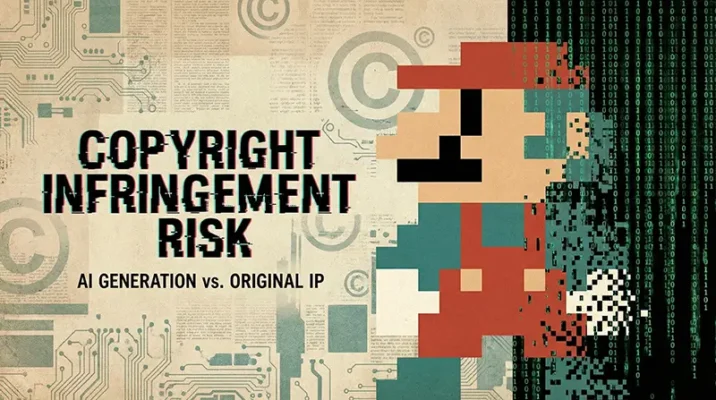
- The Problem: If Genie learns to “jump” by watching millions of hours of Super Mario Bros., and then generates a game that feels, looks, and plays exactly like Mario, is it copyright infringement?
- The Risk: Game publishers like Nintendo, Sega, and Sony are notoriously protective of their IP. Early users of the Genie prototype have already managed to generate levels that look suspiciously like Mario and Zelda. If Google regurgitates level designs or mechanics owned by these companies, they face a potential legal firestorm.
The Risks: Hallucinations and Quality Control
Because the game is being “dreamed” in real-time, it lacks the stability of traditional code.
2. The “Hallucination” Bug
Inconsistency is a major issue. Objects might vanish when you turn around. The “physics” can break if the Artificial Intelligence gets confused. Currently, it is suitable for dream-like 2D platformers, but it cannot yet handle the strict logic required for a competitive shooter or a complex RPG.
3. The “Junk” Flood
Just as AI flooded the internet with spam articles, Google Genie AI risks flooding app stores with millions of low-effort, clone games. This could lead to a “market saturation” where it becomes impossible for human indie developers to get noticed amidst a sea of machine-generated content.
Conclusion: The Midjourney Moment for Games
Google Genie AI is undoubtedly the “Midjourney moment” for video games. It is magical, messy, and legally dangerous.
While it offers incredible tools for creativity, it also poses an existential threat to traditional workflows. One thing is certain: the line between “watching” a game and “playing” a game has just been erased. As we move deeper into 2026, the industry must adapt or risk being “generated” out of existence.
Resources
- The Verge: Google’s AI helped me make bad Nintendo knockoffs.
- Mashable: Meet Project Genie from Google, a ‘world model’ it calls a stepping stone to AGI.
Frequently Asked Questions (FAQs)
Yes, but with restrictions. As of February 2026, Google Genie AI (powered by the Genie 3 model) is available as an experimental research prototype. It is currently exclusive to Google AI Ultra subscribers in the United States who are 18+.
The latest update, Genie 3, has introduced the ability to generate interactive 3D worlds. While the original 2024 paper focused on 2D platformers, the 2026 model can create navigatable 3D environments at 720p resolution and 24 frames per second, though it is still more “dream-like” than a traditional game engine.
Latent Action Learning is the breakthrough that allows Genie to learn without code. By watching over 200,000 hours of gameplay videos without controller data, the AI learned to infer that a specific visual change (like a character moving up) corresponds to an invisible action (like pressing “Jump”). It effectively reverse-engineered the concept of a game controller.
Currently, no. Google Genie is a research prototype, and the terms of service for the AI Ultra plan generally restrict commercial use of experimental tools. Furthermore, because the AI was trained on copyrighted data (like Mario or Zelda), selling the output could lead to severe copyright infringement lawsuits.
No. Google Genie AI does not use polygons, textures, or rendering engines. It is a “World Model” that predicts the next pixel in a video sequence based on your input. It is essentially hallucinating a video that you can control in real-time, rather than “running” a game code.
Related Blogs
Clawdbot (Moltbot) Explained: The ‘Claude AI’ Agent Taking Control of WhatsApp
Discover Clawdbot (Moltbot), the new open source Claude AI agent that connects to WhatsApp. Learn about its root access, automation capabilities, and the security risks involved.
Jan
Google Gemini Dominates the New AI Benchmark: Pokémon Blue (2026)
In the ultimate 2026 AI benchmark, Google Gemini crushes OpenAI and Claude at Pokémon Blue. Discover why this gaming victory proves Gemini is the future of Agentic AI.
Jan
Google Gemini Powered Siri: Why Apple’s New Deal Changes Everything (2026)
It’s official! Apple partners with Google Gemini to revolutionize Siri on iPhone 17 and iOS 20. Discover how this massive AI deal impacts privacy, features, and users in Pakistan.
Jan
