

News
Nvidia 6G AI: The Blueprint for a Physical AI World

Mar
Welcome to the next massive leap in global connectivity. If you thought the jump from 4G to 5G was impressive, strap in. Nvidia, the undisputed king of artificial intelligence computing, has just announced a groundbreaking alliance with the world’s biggest telecom operators. Their goal? To completely rewrite the rules of telecommunications and lay down the definitive 6G blueprint designed specifically for an AI-first world.
For the tech-oriented community in Pakistan—a demographic hungry for innovation and startup growth—this isn’t just distant Silicon Valley news. It is a fundamental shift in how networks will operate, moving away from rigid hardware to dynamic, software-driven platforms. At the recently concluded Mobile World Congress (MWC), Nvidia revealed that 5G is simply not equipped to handle the upcoming explosion of machine-to-machine communication. Instead, they are pioneering an AI-native 6G infrastructure that will act as the nervous system for what they call “Physical AI.”
In this deep dive Nvidia 6G AI, we will unpack what Nvidia’s 6G and AI vision entails, how the new AI-RAN architecture actually works, why global telecom giants are jumping on board, and most importantly, what this technological revolution means for the future of digital Pakistan.
The Era of “Physical AI” and 6G Connectivity
To understand why Nvidia is making such a massive play in the telecom space, we first have to look at the limitations of our current infrastructure. When 5G was being designed, modern generative AI didn’t even exist in the public consciousness.
Why 5G Isn’t Enough for Tomorrow’s Tech
Current 5G networks were built primarily for human consumption—streaming high-definition videos, scrolling through social media, and facilitating basic data transfers. However, Ronnie Vasishta, Nvidia’s Senior Vice President of Telecom, recently pointed out a harsh reality: “The networks of today simply aren’t ready for the use cases of tomorrow.”
As the world transitions to an era where billions of devices need to “think” and communicate simultaneously, 5G’s bandwidth and latency limits are being severely tested. Nvidia’s 6G strategy is built on the premise that the next generation of wireless technology needs to handle hundreds of thousands of times more traffic. This isn’t just about faster download speeds for your smartphone; it’s about building AI-driven telecom networks that can dynamically route traffic, optimize energy use in real-time, and handle continuous data streams from complex machines without dropping a single packet.
Defining Physical AI for the Pakistani Tech Scene

So, what exactly is “Physical AI”? In simple terms, it is the integration of artificial intelligence into the physical world. Instead of AI just writing code or generating images on a screen, Physical AI empowers autonomous machines, robotics, drones, and self-driving vehicles to perceive, reason, and act in real-world environments.
For Pakistan’s burgeoning tech scene, this concept is incredibly relevant. Imagine a network so fast and intelligent that agricultural drones in Punjab can analyze crop health in real-time, instantly communicating with automated irrigation systems. Or picture a scenario in Karachi where traffic lights and autonomous delivery vehicles communicate continuously to eliminate gridlock. Physical artificial intelligence requires a network that can function as a distributed brain, and that is exactly what the Nvidia 6G AI blueprint aims to deliver.
Decoding AI-RAN: The Heart of Nvidia’s Strategy
At the core of Nvidia’s strategy is a radical departure from how telecom networks have traditionally been built. The magic word here is AI-RAN (Artificial Intelligence – Radio Access Network).
Alt Text for Image: A conceptual diagram showcasing Nvidia’s AI-RAN architecture, illustrating the shift from traditional cellular hardware to cloud-based GPU processing, edge computing, and AI-driven 6G networks.
Software-Defined Networks vs. Traditional Hardware
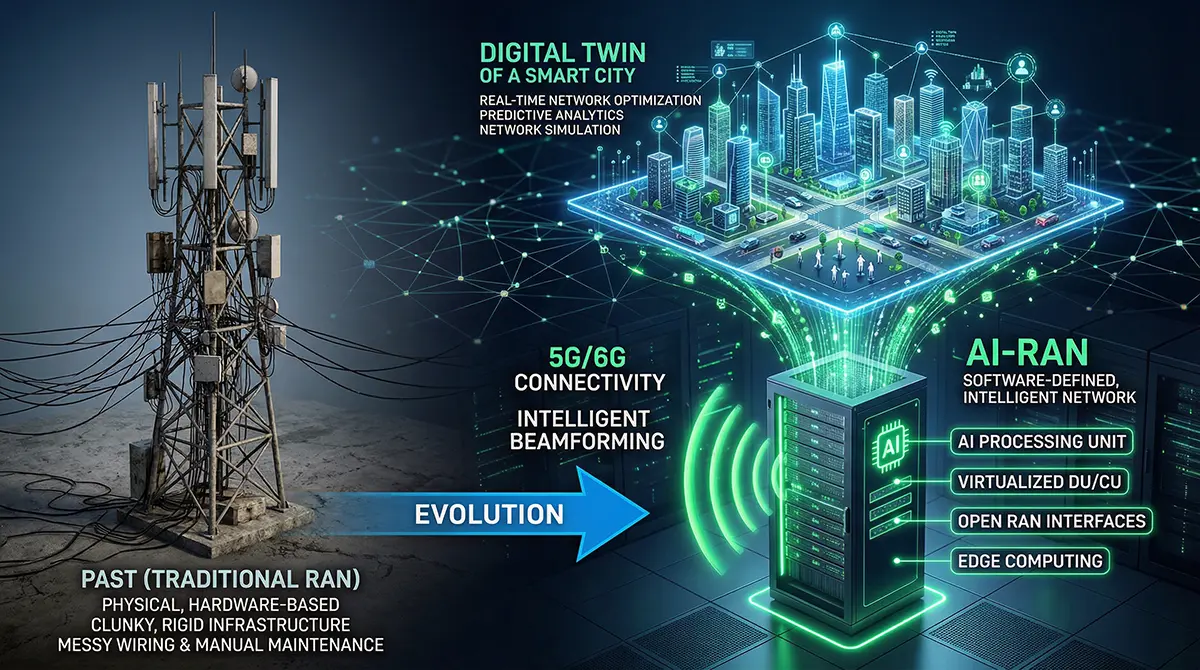
Historically, telecom operators have relied on custom, proprietary hardware boxes from a few massive vendors (like Ericsson or Huawei) to run their cell towers. This approach creates silos, making it incredibly expensive and slow to upgrade networks. Nvidia is flipping this model on its head by championing software-defined networking.
Instead of custom radio hardware, Nvidia envisions a network where the radio access network runs on general-purpose computers powered by their monstrous GPUs (like the Grace Hopper Superchips). Because the network is run by software rather than hardwired circuits, it can learn, adapt, and upgrade itself over the air, much like how your smartphone updates its operating system. This Nvidia AI-RAN architecture ensures that as AI models get smarter, the telecom network gets more efficient without needing physical parts replaced.
The Aerial AI Platform and Omniverse Integration
To bring this to life, Nvidia has launched its Aerial AI platform, an accelerated computing framework designed specifically for telcos. It allows operators to run both traditional cellular routing and advanced AI workloads on the exact same server.
High-Performance Compute at the Edge
A unique insight into Nvidia’s approach is their use of the Nvidia Omniverse Digital Twin. Before a single physical 6G tower is built, telecom engineers can simulate entire cities—down to the exact placement of buildings, trees, and weather patterns—inside a digital replica. They can train the AI to perfectly optimize the radio waves for that specific environment in the digital twin, and then deploy that software to the real world. By pushing high-performance compute directly to the edge (the cell towers), Nvidia is drastically reducing latency, ensuring that generative AI in telecom is lightning-fast and highly reliable.
The Telecom Giants Joining Nvidia’s Alliance
Nvidia isn’t building this future alone. They have successfully rallied the titans of the global telecommunications industry to form an unprecedented coalition.
Global Players: T-Mobile, Nokia, SoftBank, and More
At the recent MWC, Nvidia announced its collaboration with heavyweights like Nokia, T-Mobile US, SoftBank, Deutsche Telekom, SK Telecom, and Cisco. The sheer scale of this global telecom leaders alliance is staggering. Notably, Nvidia poured a massive $1 billion investment into Nokia to co-develop commercial-grade AI-RAN products. Nokia’s CEO, Justin Hotard, declared that AI is the “new workload reshaping networks,” signaling a full pivot away from legacy systems toward AI-native 6G infrastructure.
By testing these systems live—such as T-Mobile running commercial 5G traffic, AI queries, and live video captioning simultaneously on a single Nvidia server—the alliance is proving that software-defined networks are no longer just theoretical.
How This Coalition Rivals Traditional Telecom Monopolies
Why are these legacy telecom companies so eager to partner with a graphics chip manufacturer? Survival and economics. Traditional telecom infrastructure requires massive capital expenditure with painfully slow returns. By adopting Nvidia’s open, AI-driven blueprint, telcos can transform their cell sites into mini-data centers.
When network traffic is low (say, at 3:00 AM), the GPUs powering the cell tower can dynamically switch gears to process local enterprise AI workloads, opening up entirely new revenue streams. This open approach also lowers the barrier to entry, meaning we could soon see the birth of “new telecom unicorns”—agile startups that rent cloud space to provide hyper-localized, ultra-fast 6G services without needing to lay millions of dollars of copper wire.
Impact on Pakistan’s Digital Infrastructure
While the U.S. and Europe are laying the groundwork, what does the Nvidia 6G AI blueprint mean for the future of telecom in Pakistan? Historically, developing nations have had to wait years for infrastructure to trickle down. However, the software-defined nature of 6G presents a unique opportunity.
Alt Text for Image: A futuristic rendering of a smart city in Pakistan, featuring autonomous vehicles, delivery drones, and IoT sensors all seamlessly connected by an invisible, AI-native 6G wireless technology grid.
Leapfrogging Tech: Can Pakistan Adopt 6G Quickly?
Because AI-RAN relies on standard cloud computing servers and software rather than highly specialized, proprietary radio hardware, countries like Pakistan could potentially “leapfrog” traditional infrastructure hurdles. If local telecom operators like Jazz, Zong, or PTCL invest in GPU-accelerated data centers, they could deploy AI-native networks much more affordably. By virtualizing the network, Pakistani IT startups could rent network slices to test their AI applications without needing their own massive hardware setups.
Use Cases: Autonomous Vehicles, Smart Cities, and Robotics
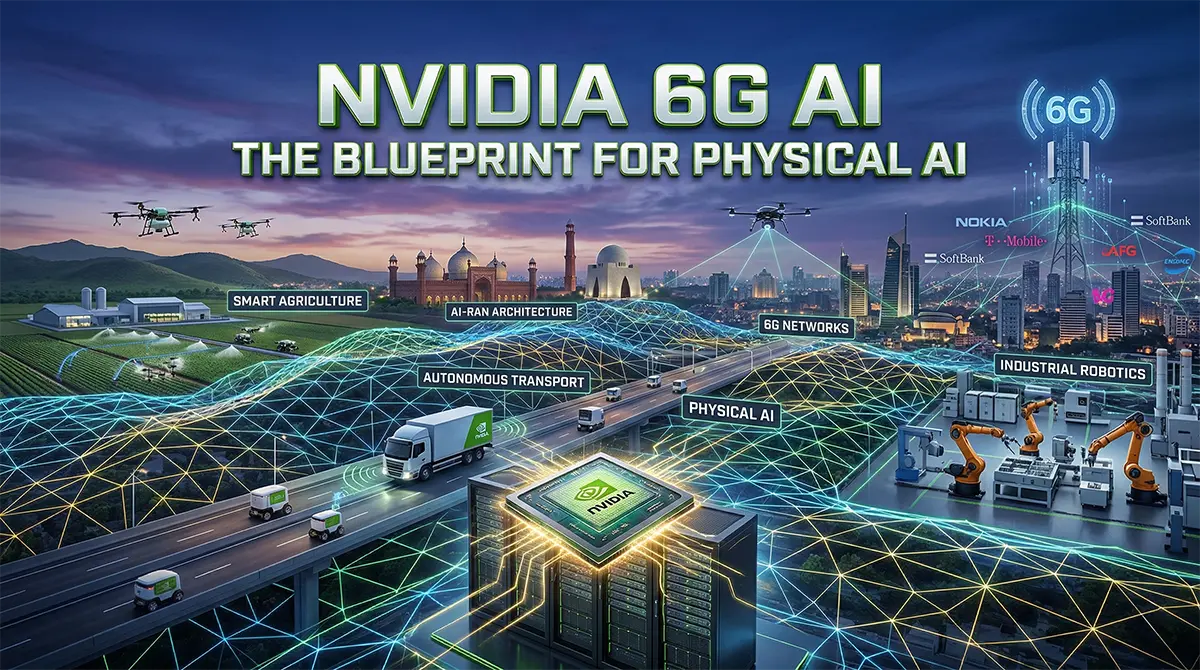
The integration of smart cities and 6G networks could solve uniquely Pakistani challenges.
Revolutionizing Agriculture and Urban Planning
Consider the agricultural sector, the backbone of Pakistan’s economy. With 6G wireless technology, thousands of inexpensive IoT sensors can be deployed across vast farmlands in Sindh and Punjab. These sensors, communicating with cloud AI in milliseconds, can dictate precise water and fertilizer usage, combating water scarcity and increasing yields. In chaotic urban centers like Lahore, Physical AI could manage power grids dynamically, distributing electricity exactly where it is needed in real-time to mitigate load shedding, while AI-powered surveillance grids can drastically improve public security and emergency response times.
The Road to 2030: Timeline and Challenges
Despite the immense promise, the transition to an Nvidia 6G AI world is not going to happen overnight. The telecom industry operates on decade-long cycles, and there are significant hurdles to clear before you see a “6G” logo on your device.
Security, Interoperability, and Supply Chain Resilience
The biggest challenge facing autonomous machines and sensors on a global scale is security. When a network is responsible for steering self-driving cars and managing remote robotic surgeries, a cyberattack or a split-second network drop is not just an inconvenience—it’s catastrophic. Nvidia and its partners are heavily focused on building “trust” into the network layer.
Furthermore, running thousands of AI models at the edge requires an astonishing amount of electricity. As AI data centers already consume massive amounts of power, the industry must develop ultra-efficient cooling and energy management systems to make 6G sustainable. Lastly, supply chain resilience is critical; the world is highly dependent on a few chip manufacturers, and any disruption could stall global 6G rollouts.
When Will We Actually See 6G?
The telecom industry expects initial 6G trials to begin around 2028, with full-scale commercial launches targeted for 2030. Right now, Nvidia is doing the heavy lifting—establishing the standards, proving the concepts with the world’s biggest telecom providers, and ensuring that when the hardware is ready, the AI software is already ten steps ahead.
Quick Takeaways
- The 5G Bottleneck: Current 5G networks are built for human data consumption and cannot handle the immense, real-time data loads required by modern AI and autonomous machines.
- Physical AI is the Goal: Nvidia’s 6G blueprint is designed to be the nervous system for “Physical AI”—allowing robots, cars, and smart cities to interact seamlessly with the real world.
- AI-RAN Architecture: Nvidia is replacing rigid, proprietary telecom hardware with flexible, software-defined networks powered by high-performance GPUs.
- Global Alliance: Telecom giants like Nokia, T-Mobile, and SoftBank are partnering with Nvidia to co-develop these open, AI-native networks, breaking traditional telecom monopolies.
- Opportunity for Pakistan: The shift to software-based telecom infrastructure could allow developing tech hubs in Pakistan to deploy advanced networks cheaper and faster, revolutionizing local agriculture, smart cities, and IT startups.
Conclusion
The intersection of Nvidia, 6G, and AI is setting the stage for the most significant technological infrastructure overhaul in human history. We are moving from networks that merely transmit our text messages and videos to intelligent, autonomous systems capable of reasoning, adapting, and powering the physical machines that will run our future.
For the tech enthusiasts, developers, and entrepreneurs in Pakistan, this is a clear signal to start thinking beyond mobile apps. The future lies in hardware-software integration, edge computing, and AI-native applications. As global standards are locked in over the next few years, those who understand how to leverage AI-RAN and Physical AI will be the architects of tomorrow’s digital economy.
Are you ready for the 6G revolution? I’d love to hear your thoughts! What specific 6G use case do you think will impact Pakistan the most—smart agriculture, autonomous traffic management, or something else entirely? Drop a comment, share this article with your network, and let’s get the conversation started!
References
- Seeking Alpha (Mar 2, 2026): Nvidia, telecom firms vow to build 6G on open, AI-native platforms.
- EE Times (Mar 2, 2026): Nokia Bets the Network on Nvidia in AI and 6G Pivot.
- TelecomTV (Mar 1, 2026): MWC26: Nvidia, leading telcos make open, secure, AI-native 6G pledge.
- The News International (Mar 1, 2026): Nvidia teams up with telecom firms for AI driven 6G.
Frequently Asked Questions (FAQs)
While 5G was designed primarily for faster human communication (like video streaming and mobile browsing), the proposed 6G wireless technology is being built natively with AI from the ground up. It is designed to handle the massive data requirements of machines, autonomous vehicles, and real-time AI processing with near-zero latency.
AI-RAN stands for Artificial Intelligence – Radio Access Network. Nvidia is pushing this architecture because it replaces traditional, rigid telecom hardware with software running on standard GPUs. This allows telecom networks to be updated instantly via software and dynamically allocate resources using AI.
By moving to software-defined AI-driven telecom networks, Pakistan can potentially lower the cost of infrastructure deployment. It will empower sectors like agritech through real-time drone monitoring, improve smart city initiatives for traffic and power management, and provide local startups with access to high-speed edge computing.
Physical AI refers to artificial intelligence that interacts with the real, physical world. Instead of just generating text or images, Physical AI powers autonomous machines and sensors, robotics, and self-driving cars, allowing them to perceive their environment and make instant decisions.
The global telecom industry anticipates that initial 6G testing and trials will begin around 2028. Widespread commercial availability is expected to roll out starting in 2030, giving the industry time to finalize security protocols and hardware standards.
Related Blogs

Anthropic Claude AI: The Stunning Discovery of 500+ Zero Day Exploits
Discover how Anthropic Claude AI is revolutionizing bug hunting by uncovering 500+ zero day exploits in open-source software, acting as an automated cybersecurity shield.
Feb
Anthropic AI Military Safeguards: Why the Pentagon Threatens to Dump Claude Over “Killer Robot” Fears
Discover why the Pentagon is threatening to end its $200M deal over Anthropic AI military safeguards. Explore the clash between ethical AI warfare and national security.
Feb
Clawdbot (Moltbot) Explained: The ‘Claude AI’ Agent Taking Control of WhatsApp
Discover Clawdbot (Moltbot), the new open source Claude AI agent that connects to WhatsApp. Learn about its root access, automation capabilities, and the security risks involved.
Jan

AI Automation Crisis: Microsoft CEO Warns White-Collar Jobs Will Vanish by 2027
Microsoft AI CEO Mustafa Suleyman predicts AI automation will replace most white-collar work within 18 months. Read the full analysis and survival strategies here.
Feb

Jensen Huang Shocking Prediction: AI Jobs Boom for Plumbers, Not Coders
Jensen Huang drops a bombshell at Davos 2026: The future of AI jobs isn't coding—it's plumbing. Discover why blue-collar trades are the new six-figure career path in the AI economy.
Jan
