

News
AI Automation Crisis: Microsoft CEO Warns White-Collar Jobs Will Vanish by 2027

Feb
If you are waiting for a clear sign to take AI automation seriously, this is it. The comforting argument that artificial intelligence is “just a hype cycle” officially died this week.
In a stunning interview with the Financial Times that has sent shockwaves through the global tech industry, Mustafa Suleyman, the CEO of Microsoft, dropped a timeline that is far more aggressive than anyone anticipated. He didn’t say “in a decade.” He didn’t say “someday.”
He explicitly stated: “White-collar work, where you’re sitting down at a computer… most of those tasks will be fully automated by an AI within the next 12 to 18 months.”
Let that sink in. Lawyers, accountants, marketers, and project managers—Suleyman believes we are less than two years away from human-level performance on most professional tasks. This article analyzes the data behind this prediction and offers critical strategies to survive the coming shift.
The 18-Month Countdown: A New Reality
The prediction from Mustafa Suleyman is not just CEO bluster; it is a calculation based on the exponential growth of artificial intelligence. The timeline for widespread AI automation has compressed significantly.
We are no longer looking at a distant future of work. We are looking at a radical transformation of the workforce by mid-2027. Suleyman’s warning implies that the era of being paid simply to process information at a desk is coming to an abrupt end.
For countries with large freelance and remote work populations, such as Pakistan, this warning is particularly critical. The “knowledge work” that drives the digital economy is exactly what these new models are learning to replicate.
The Flywheel Effect: How AI is Building AI
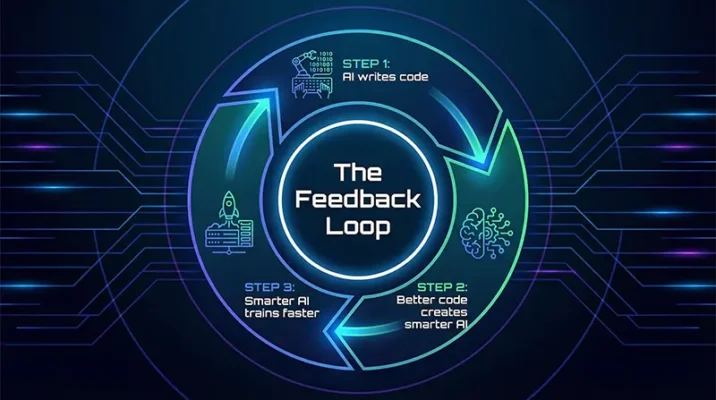
Why the sudden acceleration in AI automation? As explained in a viral analysis by tech expert Matt Wolfe this week, we have crossed a critical threshold: AI is now building the next generation of AI.
The Feedback Loop
The latest models, such as GPT 5.3 (Codeex), were explicitly used to debug, manage, and accelerate their own training. This creates a self-reinforcing cycle:
- Smarter AI writes better code.
- Better code creates smarter AI.
- The cycle repeats at a pace human engineers cannot match.
The Metric of Progress
According to data from Meter, the length of tasks AI can handle autonomously is doubling every 7 months.
- 2022: AI could handle a 36-second task.
- 2024: It could handle a 20-minute task.
- Feb 2026: Models like GPT 5.3 and Claude Opus 4.6 are completing complex, multi-step workflows that take human experts 6 to 17 hours.

If you project this trend out another 18 months—aligning with Suleyman’s prediction—we arrive at autonomous AI agents capable of working for weeks without human intervention.
The “It’s Already Happened” Reality
Viral tech writer Matt Schumer recently argued that for software engineers, the replacement has technically already occurred.
“I’m no longer needed for the actual technical work of my job,” Schumer wrote. “I describe what I want built in plain English… and I come back 4 hours later to find the work done better than I would have done myself.”
Suleyman is simply applying this logic to the broader market. What happened to coding in 2025 is about to happen to law, finance, and administration in 2027. The capabilities of these autonomous AI agents are expanding beyond code into reasoning, strategy, and complex decision-making.
Economic Impact: No Safety Net for Job Displacement
The scariest part of this transition is that, unlike the Industrial Revolution, there is no obvious “next job” waiting.

The Old Way vs. The New Problem
- Historical Shift: When farming was automated, workers moved to factories. When factories were automated, workers moved to offices (white-collar work).
- Current Crisis: If AI automation takes over the office, where do we go?
As Wolfe points out, “AI isn’t leaving a convenient gap to fall into.” It is getting better at everything simultaneously—creativity, logic, empathy, and strategy.
This raises serious concerns about job displacement. Even Dario Amodei, CEO of Anthropic, is on record predicting that 50% of entry-level jobs could vanish, potentially leading to significantly higher unemployment rates if we do not adapt our economic models quickly.
Survival Guide: How to Pivot in the Age of AI
Suleyman’s warning is clear, but it doesn’t mean you are obsolete—only your current workflow is. To survive this shift and protect your career, you must adopt new strategies.

Here is the survival guide for the next 18 months:
- Stop Using Free AI: If you are still using the free version of ChatGPT or Claude, you are using technology that is a year behind. Pay the subscription. You need to see what the real models, like GPT 5.3, can actually do.
- Don’t Ask, Do: Stop asking AI questions. Start asking it to perform white-collar jobs. Don’t ask “How do I write a contract?” Upload the terms and command it: “Draft the contract.”
- Be the Pilot: The person who walks into a meeting and says “I did this 3-day analysis in 20 minutes” becomes the most valuable person in the room. You must transition from being the doer to being the manager of AI agents.
Conclusion: The Clock is Ticking
The countdown to 2027 has begun. Microsoft and Mustafa Suleyman have given us a clear window of opportunity. You have approximately 12 to 18 months to figure out how to be the pilot before the plane flies itself.
The future of artificial intelligence is not just about technology; it is about adaptability. Those who embrace AI automation today will define the future of work tomorrow.
Resources
- Toms Hardware: Microsoft’s AI boss says AI can replace every white-collar job in 18 months — ‘We’re going to have a human-level performance on most, if not all, professional tasks’
- Tech Radar: ‘I think we’re going to have a human-level performance on most, if not all, professional tasks’: Microsoft AI chief thinks AI will replace most white-collar work in the 12 to 18 months – so is this the end for human workers?
- Business Insider: Microsoft AI CEO predicts ‘most, if not all’ white-collar tasks will be automated by AI within 18 months.
- News Australia: Microsoft AI boss warns most white-collar jobs will be fully automated soon.
Frequently Asked Questions (FAQs)
According to Microsoft AI CEO Mustafa Suleyman, roles that primarily involve “sitting at a computer” are the most vulnerable. This includes law, finance, accounting, project management, and entry-level marketing. Jobs involving repetitive data analysis, document drafting, and routine coordination are expected to see the highest levels of job displacement as autonomous AI agents become more capable.
While critics argue that full displacement takes time due to regulation, the technical “flywheel” suggests the timeline is credible. With models like GPT 5.3 and Claude 4.6 already handling multi-hour professional workflows, the jump to full autonomy is closer than many think. Suleyman’s warning is backed by the fact that AI is now used to build and train the next generation of artificial intelligence, accelerating progress exponentially.
Unlike a standard chatbot (like the free version of ChatGPT) which requires a prompt for every answer, autonomous AI agents can be given a goal (e.g., “Manage this 3-month project”) and will execute multi-step tasks independently. They can browse the web, use software, and communicate with other agents to complete white-collar workflows without constant human intervention.
AI is rapidly gaining ground in logic and strategy; however, “Humanist Superintelligence” (a term used by Suleyman) suggests that the most successful professionals will be those who act as “Pilots.” While AI can generate a 50-page strategy document in seconds, the human “Pilot” is still needed to provide the ethical oversight, final decision-making, and high-level empathy that autonomous AI agents currently lack.
For the Pakistani workforce, staying competitive means moving away from low-level data processing and toward AI management. To survive the AI automation shift, professionals should invest in paid AI tools to stay ahead of the curve, learn to build custom AI workflows, and focus on high-value niche skills that require local context and human relationship management.
Related Blogs
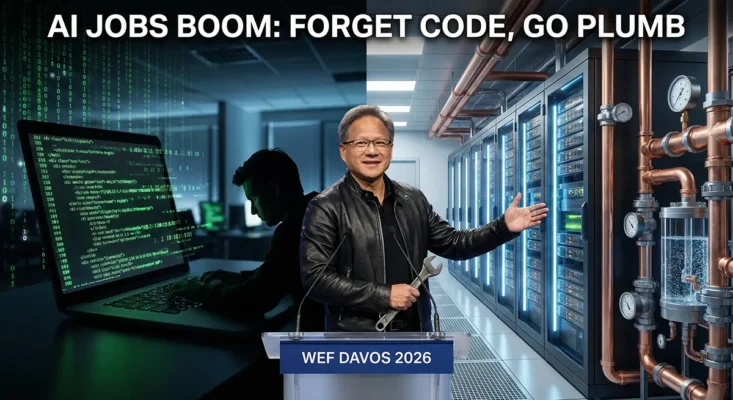
Jensen Huang Shocking Prediction: AI Jobs Boom for Plumbers, Not Coders
Jensen Huang drops a bombshell at Davos 2026: The future of AI jobs isn't coding—it's plumbing. Discover why blue-collar trades are the new six-figure career path in the AI economy.
Jan

AI Chatbot Hallucinations: The £6,400 Error Terrifying Business Owners
An AI chatbot hallucination recently cost a business £6,400 in a viral prompt injection attack. Learn how to protect your business security from legal liability and social engineering risks.
Feb

Sony AI Podcast Patent: Will Kratos Be Your Next YouTuber? (Revolutionary Feature)
Discover the new Sony AI Podcast Patent! See how Generative AI turns game characters like Kratos into hosts. Is this a revolutionary PS6 feature or a controversy?
Feb
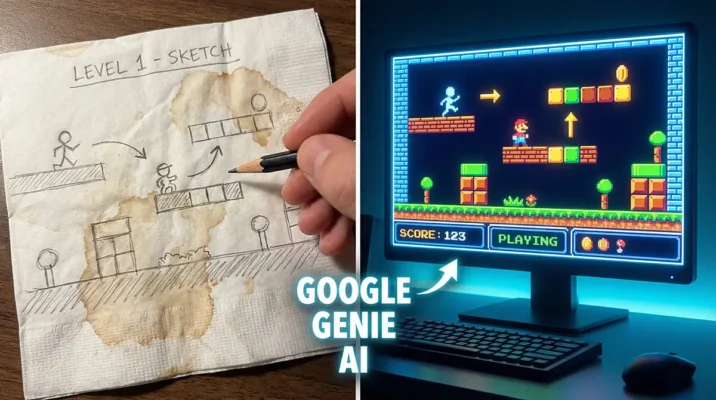
Google Genie AI: The Shocking End of Traditional Gaming? (2026 Review)
Google Genie AI is transforming the gaming industry. Discover how DeepMind’s new model creates playable worlds from images and the massive copyright risks involved.
Feb
Clawdbot (Moltbot) Explained: The ‘Claude AI’ Agent Taking Control of WhatsApp
Discover Clawdbot (Moltbot), the new open source Claude AI agent that connects to WhatsApp. Learn about its root access, automation capabilities, and the security risks involved.
Jan
