

News
THE STUTTER CURE: Nvidia, Intel, and AMD Unite Behind Microsoft to Kill “Compiling Shaders” Forever

Mar
Every PC gamer in Pakistan knows the ultimate frustration. You wait hours, perhaps even days, on a 10 Mbps connection to download a massive 100GB game. You excitedly boot it up, hoping to jump straight into the action, but instead, you are held hostage by a dreadful progress bar: “Compiling Shaders.” Or worse, the game lets you play immediately, but the moment you enter a new area or trigger an explosion, your frame rate violently hitches. This stutter has been the absolute bane of modern PC gaming. However, a monumental shift has finally arrived. Tech giants Nvidia, Intel, AMD, and Microsoft have forged an unprecedented alliance to eradicate this issue forever.
Unveiled recently at GDC 2026, a revolutionary technology called Advanced Shader Delivery (ASD) is fundamentally changing how games interact with your hardware. Rather than forcing your CPU to sweat through real-time shader generation, games will now ship with precompiled assets. Whether you are gaming on a premium rig or a budget setup sourced from Hafeez Center or Naz Plaza, the collaboration between Nvidia, Intel, AMD, and Microsoft promises a buttery-smooth future. In this comprehensive guide, we will break down what shader stutter is, how this united technology works, and why it is the ultimate PC gaming cure we’ve all been waiting for.
The Nightmare of “Compiling Shaders” on PC
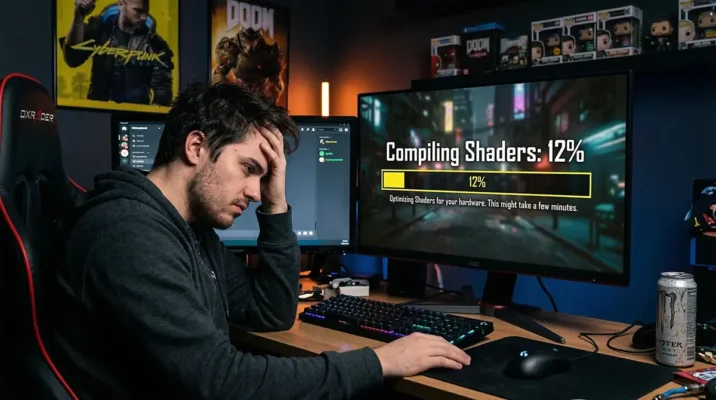
To truly appreciate the cure, we must first understand the disease plaguing our systems. Whenever you play a 3D game, the game engine must instruct your graphics card on exactly how to draw every pixel, shadow, reflection, and texture. These complex graphical instructions are called “shaders.” The problem arises because PC hardware is incredibly diverse. A shader written by a game developer needs to be translated—or “compiled”—into a specific language that your exact GPU and driver combination can understand.
The Console Advantage vs. PC Fragmentation
Console gamers rarely experience this pain. Because every PlayStation 5 or Xbox Series X has the exact same internal hardware, developers can completely pre-compile all the shaders before the game even ships. You download the game, and the console already knows how to read the instructions perfectly. On PC, however, the endless combinations of Nvidia, Intel, and AMD hardware, mixed with various Windows 11 versions, make this impossible to do out of the box. If this translation happens while you are actively trying to aim down sights or drive a car at high speeds, the sudden intense calculation spikes your CPU usage to 100%. The result? The game freezes for a split second. This is known as shader compilation stutter, and it is the leading cause of sudden frame rate drops in PC games.
Why Modern Game Engines Struggle with Traversal Lag
With the rise of incredibly complex engines like Unreal Engine 5, the sheer volume of shaders required for modern games has skyrocketed. Dynamic lighting, dense geometry, and ray tracing add massive overhead. Traditional PC gaming stutter fixes usually involve gamers resorting to community patches, disabling features, or just tolerating the lag. But as games get heavier, the “compile on the fly” approach has completely broken down, forcing the entire tech industry into action to find a permanent fix.
Enter Microsoft’s Master Stroke: Advanced Shader Delivery (ASD)
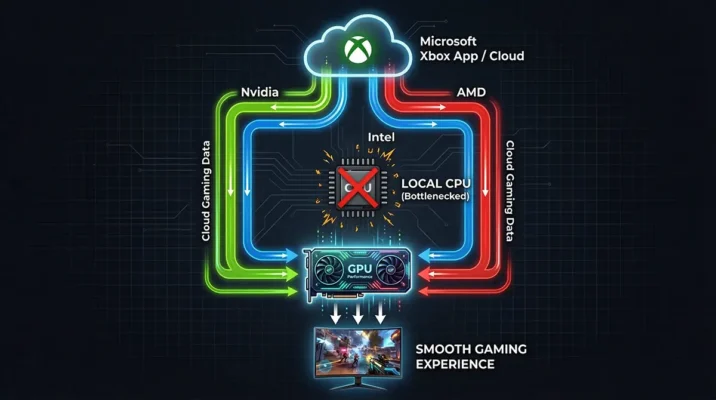
Recognizing that the PC ecosystem was suffering, Microsoft stepped up to create a standardized software bridge. Enter Advanced Shader Delivery (ASD), a headline feature heavily showcased at GDC 2026. This technology flips the script by allowing game developers to pre-package and deliver fully compiled shaders directly to the user’s PC, effectively mimicking the console experience on a desktop computer.
The Magic of State Object Databases (SODB)
To make this possible, developers use the new DirectX 12 Agility SDK to package pipeline state objects into a State Object Database (SODB). Hardware vendors then use offline compilers to convert these into a Precompiled Shader Database (PSDB). Instead of your PC doing the heavy lifting locally, the calculation is done beforehand in the cloud. When you download a game via supported platforms, the system identifies your specific hardware configuration. It then reaches into a cloud database and fetches the exact precompiled shaders your system needs.
Bypassing the CPU Bottleneck
The game engine is fed ready-to-use instructions, bypassing the CPU bottleneck entirely. According to Microsoft, this method has already reduced the initial loading times of games like Obsidian’s Avowed by an astonishing 85%. You no longer need a 24-core processor just to parse through a game’s main menu. By unifying Nvidia, Intel, and AMD under one standardized API, developers only have to submit their game data once, and the Xbox PC app (and eventually other storefronts) handles the distribution of the correct shaders to the correct gamer.
Nvidia’s GeForce RTX Commitment to the Stutter Cure
When it comes to dominating the dedicated PC gaming market share, Nvidia is the undisputed king. For Advanced Shader Delivery to actually succeed on a global scale, their full backing was absolutely non-negotiable. Thankfully, Nvidia has fully pledged its support to this Microsoft-led initiative, ensuring that millions of gamers won’t be left behind.
Henry Lin, Director of Product Management at Nvidia, recently confirmed that they are working closely with Microsoft to launch ASD for GeForce RTX consumers later this year. For local gamers, this means future driver updates will natively hook into the ASD ecosystem. If you are running an RTX 3060, 4070, or even eagerly awaiting the RTX 50-series, your upcoming GeForce RTX driver updates will allow games to snatch pre-baked shaders instantly.
Preserving NVMe SSD Lifespans
A unique and highly overlooked insight here is the reduction in wear-and-tear on your storage drives. Compiling massive shader caches locally involves writing gigabytes of temporary data to your SSD over and over again. Every time you update your graphics drivers, that cache has to be wiped and rewritten. By fetching perfectly optimized, compressed shaders directly from the cloud, Nvidia and Microsoft are inadvertently preserving the read/write lifespan of your high-speed NVMe drives. This is a subtle but highly valuable financial bonus for PC builders who want their storage to last for years.
Intel’s Lunar Lake and Panther Lake Hardware Strategy
While Intel is somewhat newer to the dedicated GPU space with its Arc graphics cards, they are massive players in integrated graphics and mobile computing. Intel clearly recognized that frame rate drops in PC games severely hurt the perception of thin-and-light gaming laptops. If a laptop is already thermally constrained, forcing its processor to compile heavy Unreal Engine 5 shaders on the fly results in rapid overheating and battery drain.
Lisa Pearce, Vice President of the Software Group at Intel, announced that they are actively releasing drivers supporting ASD on their new Lunar Lake and Panther Lake platforms. Because Intel has a smaller matrix of dedicated GPUs compared to its rivals, they actually have a slight logistical advantage in rolling out precompiled databases quickly. By joining forces with Microsoft, Nvidia, and AMD, Intel ensures that their users enjoy a premium, stutter-free experience. Intel Lunar Lake gaming laptops will be able to punch well above their weight class because the CPU won’t be choked by background compilation tasks. This reserves more power and thermal headroom for pushing raw frames and maintaining high clock speeds.
AMD’s Crucial Role and The ROG Ally Testing Ground
You simply cannot talk about the genesis of Advanced Shader Delivery without acknowledging AMD‘s pioneering role in this technology. In fact, before Microsoft brought this to the wider desktop ecosystem, ASD was first extensively tested and proven exclusively on AMD hardware.
Proving the Concept with Handhelds
Before going mainstream, Microsoft needed a controlled, console-like environment to test ASD in the real world. They found it in the Asus ROG Ally and Ally X—handheld PCs powered entirely by AMD APUs. Because the hardware in the ROG Ally is identical across all devices, it was the perfect testbed for delivering Precompiled Shader Databases.
The results from this trial run were phenomenal. The AMD ROG Ally performance metrics showed a massive reduction in battery drain and the complete elimination of traversal stutters. By proving that the concept worked brilliantly on AMD silicon, it laid the concrete groundwork for Microsoft to scale the technology up to the incredibly diverse desktop PC market. Now, AMD is working diligently to expand this feature beyond handhelds to their full lineup of desktop Radeon RX graphics cards and Ryzen processors, solidifying their commitment to open gaming standards.
Why This is a Game-Changer for Pakistani Gamers
For the general and tech-oriented community in Pakistan, the end of shader stutter is more than just a luxury—it’s an essential quality-of-life upgrade that directly impacts how we play.
Surviving Loadshedding and Budget Hardware Limits
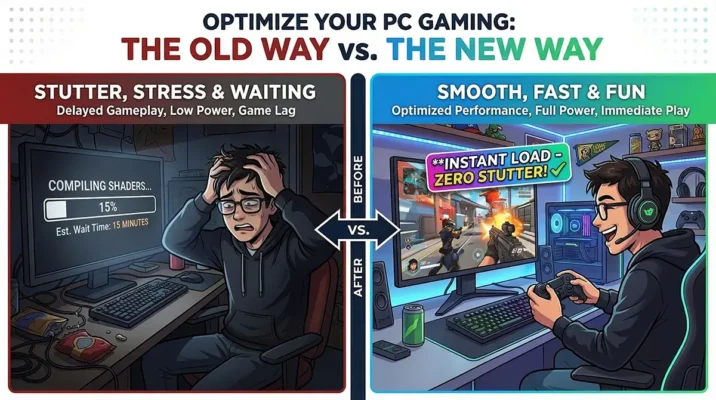
Building a robust gaming PC in Pakistan is an increasingly expensive endeavor. Due to fluctuating import taxes and currency inflation, many gamers rely on mid-range or older hardware components. When an older quad-core or hexa-core CPU is hit with sudden shader compilation, the whole system crawls to a halt. ASD completely offloads this heavy computing requirement. This means older CPUs will have a much longer viable lifespan, allowing you to eliminate in-game traversal lag without having to spend over a lac rupees upgrading your processor and motherboard.
Furthermore, we all know the harsh reality of loadshedding. When you only have a precious one-hour window of UPS backup or uninterrupted grid power to play your favorite multiplayer game, you absolutely do not want to spend 15 minutes of it staring at a “Compiling Shaders” screen. Instant loading means maximizing your actual gameplay time.
The Machine Learning Era: DirectX Linear Algebra
While fixing shader stutter is the massive headline, the technical collaboration between Nvidia, Intel, AMD, and Microsoft goes much deeper into the future of gaming. At the exact same time ASD was announced, Microsoft also introduced DirectX Linear Algebra.
This is a massive step into the future, providing a unified programming model for Machine Learning (ML) directly inside the graphics pipeline. With AI upscaling features like DLSS, XeSS, and FSR becoming practically mandatory to run modern games smoothly, standardizing how AI mathematics are handled at the API level is crucial. By working together, these tech giants are ensuring that game developers don’t have to write completely different AI code for Nvidia, Intel, and AMD graphics cards. It unifies the ecosystem, reduces developmental friction, and ultimately leads to better-optimized games with faster fix slow loading times PC solutions.
Quick Takeaways: The Death of Shader Stutter
- The Core Problem: Compiling shaders locally causes massive CPU spikes, leading to annoying in-game stutters, micro-freezes, and extremely long initial loading screens.
- The Unified Solution: Advanced Shader Delivery (ASD) pre-compiles these complex shaders in the cloud and downloads them instantly to your PC alongside the game.
- The Grand Alliance: Nvidia, Intel, AMD, and Microsoft have all officially committed to supporting ASD at the foundational driver and operating system level.
- The Proof of Concept: The tech was successfully tested on the AMD-powered ROG Ally handheld, cutting game initial loading times by up to 85%.
- The Local Impact: For Pakistani gamers, this means vastly smoother gameplay on budget or mid-range hardware, and no more wasting precious loadshedding-free hours staring at a loading screen.
Conclusion: A United Front for the Ultimate Gaming Experience
For years, PC gamers have had to grit their teeth and accept that a certain level of stutter and jank was just the “price of admission” for playing on a highly customizable, open platform. But the era of accepting poor optimization is finally drawing to a close. By uniting to heavily support Advanced Shader Delivery, Nvidia, Intel, AMD, and Microsoft have proven that they are willing to set aside their intense competitive differences to solve the biggest systemic issue in the video game industry.
This remarkable technology bridges the gap between the plug-and-play comfort of living room consoles and the high-fidelity freedom of desktop PC gaming. Whether you are running a cutting-edge GeForce RTX rig or trying to get the absolute most out of an affordable Intel Arc setup, the permanent death of the “Compiling Shaders” screen is a massive win for everyone. As this feature rolls out across Windows 11 and the Xbox app later this year, it is safe to say that the future of PC gaming has never looked—or played—smoother.
References
- Microsoft DirectX Developer Blog (2026). Advanced Shader Delivery: What’s New at GDC 2026.
- PCMag (2026). Hate Waiting for Compiling Shaders? New Microsoft Gaming Tech Might Kill It Off.
- Wccftech (2026). Microsoft DirectX Gears Up For ML Era On Windows, Advanced Shader Delivery Solves Game Stutter & Load Times.
- Sportskeeda (2026). Nvidia and Intel team up for Advanced Shader Delivery, purging the “compiling shaders” nightmare.
- VideoCardz (2026). NVIDIA, Intel join Microsoft for Advanced Shader Delivery, confirmed for Lunar/Panther Lake and GeForce RTX 50.
NVIDIA DLSS 4.5 Leak: Massive 6x AI Frame Gen & Performance Revolution
Verified leaks reveal NVIDIA DLSS 4.5 ahead of CES 2026! Discover the new 6x Dynamic Frame Gen, AI upscaling, and what this means for your gaming PC.
3 Comments
Jan
AMD AI Roadmap: Why RDNA 3.5 Graphics Are Here to Stay Until 2028
A massive AMD AI roadmap leak reveals RDNA 3.5 will power mainstream gaming laptops until 2029. Discover what this means for your next budget premium device.
Feb
AMD RDNA 5 Release Date: Rumored Delay to 2027 Could Be Disastrous for Gamers
New reports suggest the AMD RDNA 5 release date may slip to 2027, arriving after the NVIDIA RTX 60 series. Here is why "Medusa" might be too late.
Jan
Frequently Asked Questions (FAQs)
While initial rollouts target newer architectures like GeForce RTX 30/40/50 series, Intel Lunar/Panther Lake, and recent Radeon GPUs, the overarching goal of Microsoft is to support a wide Windows ecosystem. However, support for very old legacy hardware might be limited due to outdated driver infrastructure.
No, it does not. ASD specifically targets PC gaming stutter fixes related strictly to shader compilation and traversal stutter. If your PC is running out of physical RAM or graphics VRAM, you will still experience performance bottlenecks that require hardware upgrades.
Absolutely not. This is a deep API-level integration handled seamlessly behind the scenes by Microsoft, Nvidia, Intel, and AMD. It will be delivered to you automatically via standard game updates and routine graphics driver installations.
It is a similar concept, but with vastly different execution. Steam’s caching relies heavily on peer-to-peer sharing and focuses largely on Vulkan and OpenGL APIs. ASD is a standardized, industry-wide integration built natively into DirectX 12 by the hardware creators themselves, making it much more efficient and universal.
Actually, it might save you space! Because you are downloading the exact State Object Database (SODB) needed for your specific GPU, your system doesn’t have to generate and keep a bloated, unoptimized local GPU shader cache that takes up gigabytes of hidden folder space.
Join the Conversation!
Are you as excited as we are to finally say goodbye to the dreaded “Compiling Shaders” screen and reclaim your gaming hours? Let us know what game gave you the absolute worst stuttering experience in the comments below! If you found this article helpful, please share it with your gaming squad on WhatsApp or Facebook so they know that smooth frame rates are finally on the horizon.
