

Hardware
AMD RDNA 5 Release Date: Rumored Delay to 2027 Could Be Disastrous for Gamers

Jan
If you are a loyal member of “Team Red” waiting for the definitive flagship killer to finally dethrone the NVIDIA RTX 5090, you might want to get comfortable. New reports suggest you will be waiting a very, very long time.
According to a concerning new report from TechSpot and Wccftech, the AMD RDNA 5 release date may have slipped significantly. The highly anticipated “clean sheet” architecture, often referred to as “Medusa,” is now rumored to arrive potentially after NVIDIA launches its next-generation RTX 60 Series in late 2027.
In a market where high-end GPU pricing has already spiraled out of control, this timeline shift could seal NVIDIA’s dominance for the next two years. Here is everything you need to know about the rumor and why it spells trouble for PC enthusiasts.
The Leak: AMD RDNA 5 Release Date vs. NVIDIA RTX 60
Historically, Advanced Micro Devices (AMD) and NVIDIA have traded blows within months of each other, keeping the market competitive. However, fresh reports indicate that their release schedules are desynchronizing in a way that heavily favors NVIDIA.
-
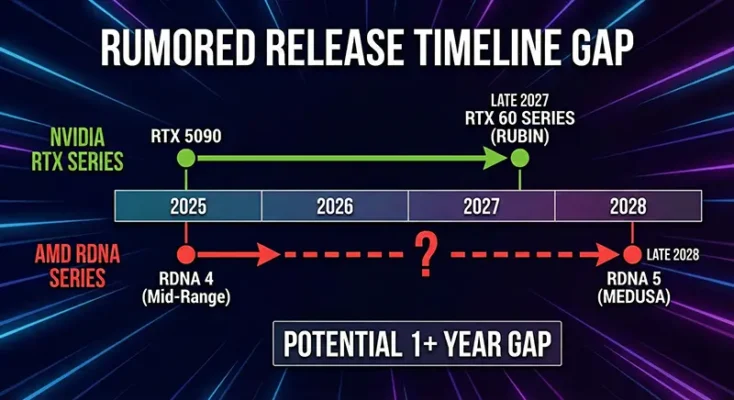
NVIDIA RTX 60 Series: Expected to follow the standard 2-year release cadence, landing in late 2027 with the new “Rubin” architecture.
-
AMD RDNA 5: Originally hoped to be the “Zen moment” for Radeon, rumors now place the AMD RDNA 5 release date in late 2027 or even early 2028—potentially after NVIDIA’s next drop.
This timeline gap is critical. If RDNA 5 arrives months after the RTX 60 series, it risks appearing outdated on Day 1, fighting a defensive battle against NVIDIA’s newest AI-driven features rather than setting the pace.
What is Project “Medusa”? The RDNA 5 Architecture Explained
Industry insiders have been calling the RDNA 5 architecture “Medusa”. Unlike the current generation, this is not just a refresh; it is a total architectural rebuild.
The current RDNA 4 generation (Radeon RX 9000 series) was a strategic retreat. AMD intentionally exited the ultra-enthusiast race to focus on the mid-range segment and cut costs. Fans accepted this “pause” only because of the promise that Medusa would return to the high-end market with a completely new design to crush NVIDIA.
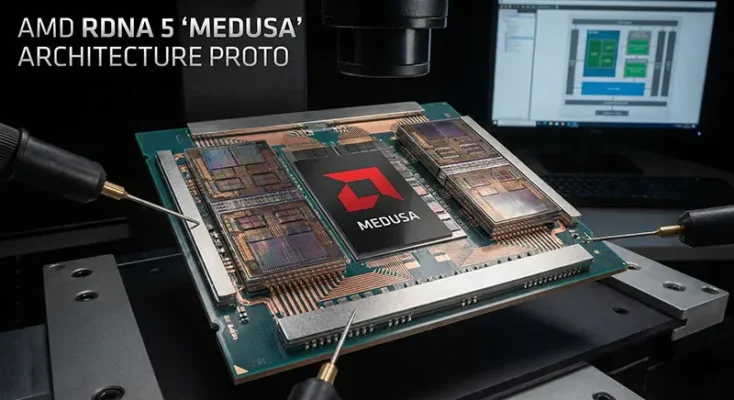
Rumored Technical Specs for Medusa:
-
UDNA Unification: Rumors suggest AMD might unify its gaming (RDNA) and data center (CDNA) architectures into a single “UDNA” framework.
-
Process Node: Likely utilizing TSMC’s advanced N3P node for superior efficiency.
-
Performance Targets: Early leaks hint at massive compute unit (CU) counts, potentially exceeding 96 CUs, designed to handle native 4K ray tracing without relying heavily on upscaling.
Taking extra time to perfect Medusa might be a smart engineering move, but commercially, it leaves the door wide open for NVIDIA to monopolize the entire high end graphics cards market for another two years.
NVIDIA RTX 60 Series: The “Rubin” Threat
While AMD regroups, NVIDIA is not standing still. The RTX 60 series is rumored to be based on the “Rubin” architecture, named after astronomer Vera Rubin.
If the AMD RDNA 5 release date slips to 2028, it will be competing against NVIDIA GeForce cards that utilize:
-
Next-Gen AI Neural Rendering: Moving beyond DLSS to potentially fully AI-generated frames.
-
GDDR7 Memory: Standard across the entire lineup.
-
Rubin Architecture: Optimized specifically for AI workloads and path tracing.
If NVIDIA releases the RTX 6090 before AMD has an answer to the RTX 5090, the performance gap could become insurmountable.
Why This Delay is a Nightmare for High-End Pricing
We are already living in a difficult market where the RTX 5090 costs upwards of $5,000 in some regions because NVIDIA has zero competition at the top.
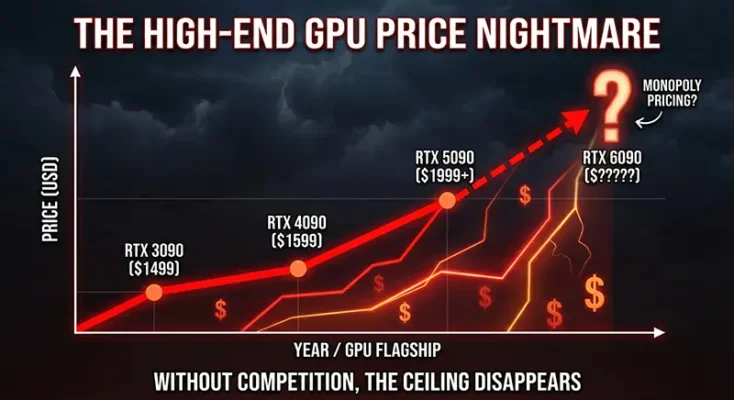
Without AMD pushing for the performance crown, the “price ceiling” for GPUs ceases to exist.
-
Monopoly Pricing: If RDNA 5 is absent, NVIDIA can price the RTX 60 flagship at whatever they desire—perhaps even $6,000 this time.
-
Mid-Range Stagnation: Without a flagship halo product, the “trickle-down” tech that usually benefits cheaper cards (like the RX 580 successors) slows down.
Gamers are desperate for a release date that brings sanity back to pricing, but this report suggests relief is years away.
Impact on the Market in Pakistan
For PC enthusiasts in Pakistan, this news is particularly disheartening. The local market is highly sensitive to price-to-performance ratios.

-
The Legend of the RX 580: To this day, the RX 580 remains one of the most popular cards in the local market due to its incredible value. Pakistani gamers have been waiting for a modern equivalent—a high-end card that offers premium performance without the “NVIDIA Tax.”
-
The Unobtainable RTX 5090: With the RTX 5090 importing at astronomical rates (well over 1.5 Million PKR), the lack of a high-end AMD alternative means wealthy enthusiasts have no choice, while the majority are stuck with aging hardware.
-
Availability: Even when AMD Radeon cards launch, availability in local markets like Karachi and Lahore often lags behind global release dates. A 2027 global launch could mean RDNA 5 doesn’t appear on local shelves until 2028.
Conclusion: The Wait Continues
For now, Team Red users are stuck with the mid-range RDNA 4 or the aging RDNA 3 cards. If this report holds true, 2027 won’t be the year of the “Red Comeback”—it will be another year of “Green Dominance.”
The AMD RDNA 5 release date is the single most critical factor for the future of PC gaming economics. Let’s hope the engineers at Advanced Micro Devices Inc can pull a rabbit out of the hat and speed up the timeline.
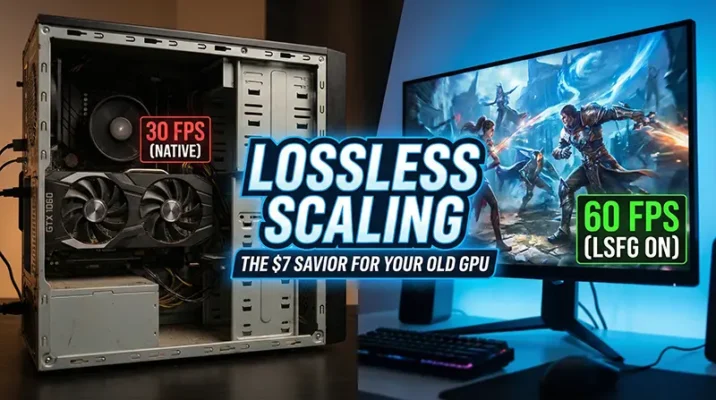
Until then, we rely on tools like Lossless Scaling to keep our frame rates high.
Games
Lossless Scaling Review: The Ultimate $7 Savior for Low End PC Gaming
Discover how this $7 Steam tool boosts FPS on any low end PC. The ultimate budget savior for 2026 gaming.
Jan
Frequently Asked Questions (FAQs)
Current leaks and reports from Wccftech suggest that the AMD RDNA 5 release date has been pushed back to late 2027 or potentially early 2028. This timeline would place its launch after the expected arrival of NVIDIA’s RTX 60 series.
“Medusa” is the internal codename for AMD’s next-generation RDNA 5 architecture. Unlike a simple refresh, Medusa is rumored to be a complete “clean sheet” redesign that may unify AMD’s gaming (RDNA) and data center (CDNA) technologies into a single framework.
It is too early to tell, but the delay is concerning. If RDNA 5 launches after the RTX 60 series, it will be competing against NVIDIA’s mature “Rubin” architecture. Historically, launching later makes it harder to claim the performance crown, though AMD may compete aggressively on price.
AMD decided to focus the RDNA 4 generation (likely the Radeon RX 9000 series) entirely on the mid-range market to capture the highest volume of gamers. They exited the “enthusiast” race against the RTX 5090 to reduce costs and restructure their engineering for the massive RDNA 5 overhaul.
The delay is bad news for pricing. Without a high-end competitor from AMD, NVIDIA has a monopoly on the flagship market. This means cards like the RTX 5090 and future RTX 6090 will likely remain extremely expensive in Pakistan (potentially exceeding 1.5 Million PKR), forcing most local gamers to stick with budget options like the RX 580 or mid-range RDNA 4 cards.
