

Feb
The PC building crash is no longer a looming threat; it is our current reality. If you felt like absolutely nobody was building custom gaming rigs last month, your instincts were entirely correct. The numbers for January 2026 have officially been released, and they paint a catastrophic picture for hardware enthusiasts around the globe.
According to recent sales data, desktop CPU sales on major retail platforms haven’t just experienced a mild dip—they have entirely collapsed. We are witnessing a “black swan” event that threatens the very foundation of the hobby.
Analyzing the Amazon CPU Sales Decline
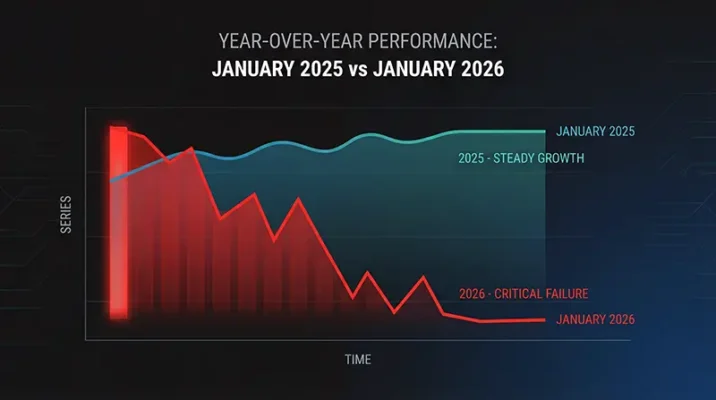
To understand the severity of this PC building crash, we have to look closely at the Amazon CPU sales data. For a market segment that typically enjoys steady, predictable growth or mild seasonal fluctuations, the year-over-year figures are staggering:
- January 2025: ~63,840 units sold.
- January 2026: ~26,100 units sold.
This represents a colossal ~59% decline. This is not a slight market correction; a 60% drop signifies that the hobby of building your own desktop PC has practically ground to a halt. Enthusiasts and everyday consumers alike are voting with their wallets and stepping away from the checkout cart.
It’s Not the Processors: AMD and Intel Are Thriving
The bitter irony of this situation is that the processors themselves are actually fantastic right now. We are living in a golden age of CPU performance. Both the Intel Core Ultra (Arrow Lake) processors and the newest AMD Ryzen gaming processors (Ryzen 9000 series) are incredibly powerful, highly efficient, and widely available on store shelves.
The processors are not the bottleneck. The fundamental issue is that a state-of-the-art CPU is essentially a paperweight if you cannot afford the memory and storage required to run it.
The Core Issue: The AI Tax on Components
The massive drop-off in DIY builds is directly tied to what industry insiders are calling the AI tax on components. As we have warned for weeks, enterprise artificial intelligence data centers are systematically devouring the global supply of essential memory chips.
NVIDIA GPUs and the HBM Priority
The insatiable NVIDIA GPUs demand for enterprise-grade AI accelerators is causing a massive ripple effect in the supply chain. Global memory manufacturers, primarily Samsung and SK Hynix, are halting traditional consumer manufacturing lines to prioritize High Bandwidth Memory (HBM). HBM yields incredibly high profit margins when sold to AI data centers, leaving consumer-grade desktop memory as an afterthought.
The DDR5 Memory Shortage
Because fabrication plants are focused on enterprise HBM, the consumer market is now facing a severe DDR5 memory shortage. The law of supply and demand has taken over, causing the retail prices of standard 32GB and 64GB DDR5 kits to skyrocket out of reach for the average consumer.
NAND Flash and SSD Price Hikes
Storage is suffering the exact same fate. NAND Flash shortages, deeply exacerbated by high-capacity enterprise data center demand, have pushed storage costs to unprecedented heights. Today, the cost of a standard 2TB NVMe drive is up by nearly 80% to 100% compared to this exact time last year.
The Builder’s Math: PC Component Prices in 2026
When you sit down to calculate PC component prices 2026, the “Builder’s Math” simply no longer makes sense. Let’s look at the financial reality facing a standard consumer:
- In 2025: You could build a high-tier, highly capable 1440p custom gaming rig for roughly $1,200.
- In 2026: That exact same tier of performance now costs over $1,800.
This $600 price hike is not because the CPU or the motherboard is vastly more expensive. It is because your 32GB of DDR5 RAM and your 2TB NVMe SSD now collectively cost as much as a mid-range graphics card used to. Faced with these exorbitant prices, gamers are doing the only logical thing: they are refusing to upgrade. Millions of users are content to hold onto their older Ryzen 5000 or Intel 12th Gen systems and simply wait for this economic storm to pass.
The Dark Age of the Pre-Built PC Cost
This crash in standalone component sales points toward a highly disturbing shift in consumer computing. When the pre-built PC cost starts to undercut the DIY route, the market has fundamentally flipped.
As retail component prices spiral out of control, large system integrators and Original Equipment Manufacturers (OEMs) like Dell, HP, and Lenovo hold a distinct advantage. Because these corporate giants purchase hardware in volumes of millions, they secure priority enterprise pricing on RAM and SSDs that you, the individual DIY builder, simply cannot access.
We are rapidly entering a dark age where it is legitimately cheaper to buy an off-the-shelf pre-built PC than to source the parts and assemble it yourself—a depressing reality that hardware enthusiasts have successfully fought against for decades.
The Verdict: When Will the DIY Computer Market Recover?
The retail data is overwhelmingly clear: the DIY computer market is currently in a coma.
Until the great AI memory squeeze finally eases up and fabrication plants allocate resources back to consumer-grade DDR5 and NAND flash, the situation will remain dire. Market analysts suggest this supply chain normalization likely won’t happen until mid-to-late 2027. Until then, attempting to avoid the PC building crash by building a custom rig is going to be a luxury pursuit, reserved strictly for those willing to pay the heavy “AI Tax.”
Resources
- TechSpot: Amazon sold 60% fewer CPUs than a year ago, pointing to a stalled PC refresh cycle.
- NeoGaf: Amazon CPU sales have dropped 60% YoY.
- Tech Sportskeeda: Amazon US reportedly shows a sharp 59% YoY decline in desktop CPU sales as memory prices soared 200–300%.
Frequently Asked Questions (FAQs)
The PC building crash is primarily caused by skyrocketing memory and storage costs, rather than the processors themselves. Enterprise data centers are buying up the global supply of memory to power artificial intelligence, creating an “AI Tax” that has made building a DIY computer unaffordable for the average consumer.
The AI tax on components refers to the inflated retail prices of DDR5 RAM and NVMe SSDs. Manufacturers are prioritizing the production of High Bandwidth Memory (HBM) for enterprise servers to meet massive NVIDIA GPUs demand. This shift has caused a severe consumer DDR5 memory shortage, driving up prices by nearly 80% to 100%.
No. Surprisingly, the processors are not the issue. Both Intel Core Ultra and AMD Ryzen gaming CPUs are widely available and competitively priced. The massive drop in Amazon CPU sales is strictly because consumers cannot afford the expensive RAM and motherboards required to support these otherwise excellent processors.
Currently, yes. Due to out-of-control PC component prices in 2026, large system integrators have a distinct advantage. Because they buy parts in bulk, the overall pre-built PC cost is often hundreds of dollars cheaper than sourcing the exact same components yourself, fundamentally shifting the DIY computer market.
Related Blogs
The OpenAI “Success Tax”: Is Your Startup Ready for the New AI Business Model?
OpenAI is shifting from a utility provider to a value-sharing partner. Discover why the "OpenAI Success Tax" and new IP licensing models in 2026 could cost your business its equity.
1 Comment
Jan
Samsung Memory Shortage Crisis: Why No One Can Escape the 2026 AI Tax
Samsung CEO TM Roh warns of an unprecedented Samsung memory shortage caused by OpenAI's Stargate project. Learn how this crisis will hit electronics prices in Pakistan and what you can do before [...]
Jan
Digital Storage Shortage: Why the Devastating 2026 Sellout Impacts You
The Western Digital storage shortage is here. With HDDs entirely sold out for 2026 due to artificial intelligence data demands, discover why the era of cheap storage is ending.
Feb
Zotac’s Doomsday Warning: GPU Shortage 2026 Threatens Market Survival
Zotac issues a doomsday warning as the GPU shortage 2026 looms. Discover why AI demand and component scarcity threaten the graphics card market survival.
Feb
GPU Shortage 2.0? NVIDIA Reportedly Cutting Consumer Production by 40%
Is GPU Shortage 2.0 imminent? We break down explosive reports that NVIDIA is slashing consumer production by 40% heading into 2026. Discover why the company is shifting priority to AI, which RTX [...]
Dec
