

News
Anthropic Claude AI: The Stunning Discovery of 500+ Zero Day Exploits

Feb
Anthropic Claude AI has officially blurred the lines between human security researchers and machine intelligence. For years, the tech industry has worried that malicious actors would use artificial intelligence to write malware. However, a stunning recent revelation proves that AI might actually be the ultimate “White Hat” hacker.
In an announcement that wiped billions off traditional cybersecurity stocks, Anthropic revealed that its latest model—Claude Opus 4.6, powering the new Claude Code Security feature—successfully identified over 500 previously unknown, high-severity vulnerabilities in critical open-source libraries. These were not simple, easily identifiable errors. They were deeply hidden logic flaws and memory handling issues that had bypassed human auditors for decades.
This article breaks down how this artificial intelligence discovery is fundamentally changing the landscape of digital security, shifting the industry from reactive patching to proactive defense.
The New Era of Bug Hunting with Anthropic Claude AI
The cybersecurity community is familiar with traditional fuzzing—a technique that throws random inputs at an application until it breaks. While effective, it is fundamentally limited by its reliance on pattern matching. Anthropic Claude AI takes a radically different approach to bug hunting.
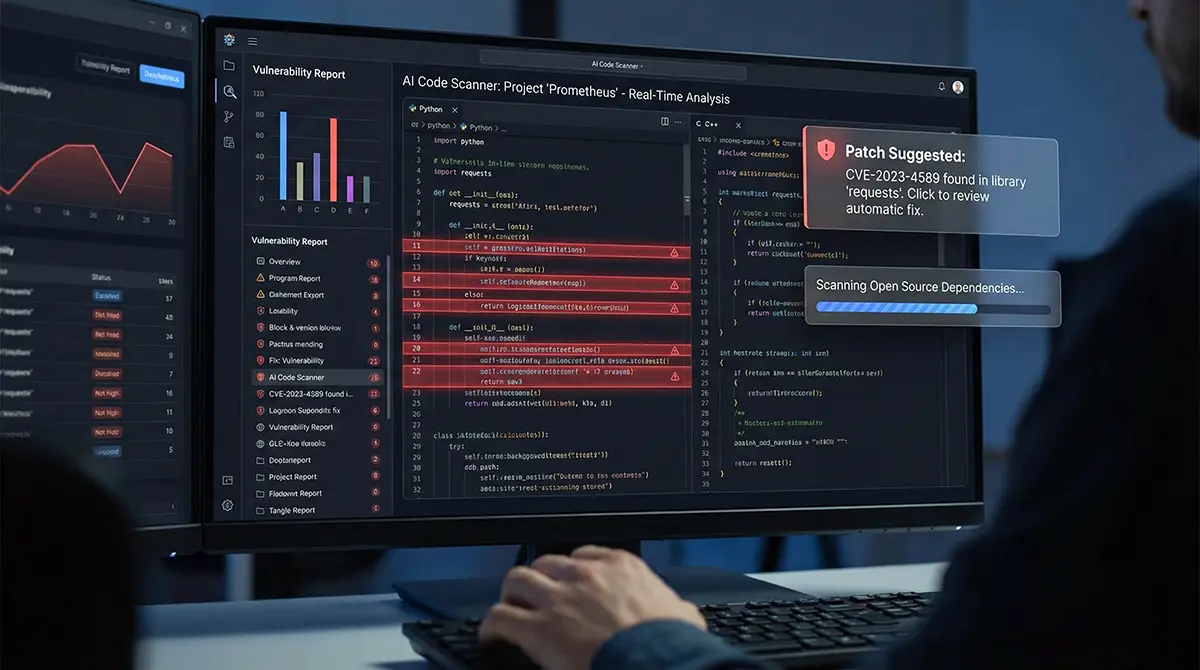
Instead of mindlessly scanning for known vulnerability patterns, Claude Code Security reads and reasons about code exactly the way a seasoned human security researcher would. It traces data flows, understands how software components interact, and flags subtle business logic flaws. By automating this deep level of reasoning, Anthropic has elevated the standard for identifying open source vulnerabilities before they can be exploited.
The Method: Minimal Prompting and Maximum Reasoning
The most impressive part of this artificial intelligence discovery isn’t just the sheer volume of bugs found; it is the autonomy of the system.
Researchers did not have to hold the model’s hand. In many cases, Anthropic’s Frontier Red Team used “minimal prompting.” They placed the model in a virtualized environment with standard developer tools and asked it to look for weaknesses.
- Autonomous Operation: Claude required no task-specific tooling or custom scaffolding.
- Historical Analysis: It examined Git commit histories to identify risky coding patterns and missing bounds checks.
- Self-Verification: The AI attempted to prove or disprove its own findings, drastically reducing false positives before a human ever reviewed the alert.
This approach yielded over 500 zero day exploits—the highly lucrative, previously unknown flaws that nation-state hackers often pay millions to acquire.
High-Profile Targets: Ghostscript, OpenSC, and CGIF
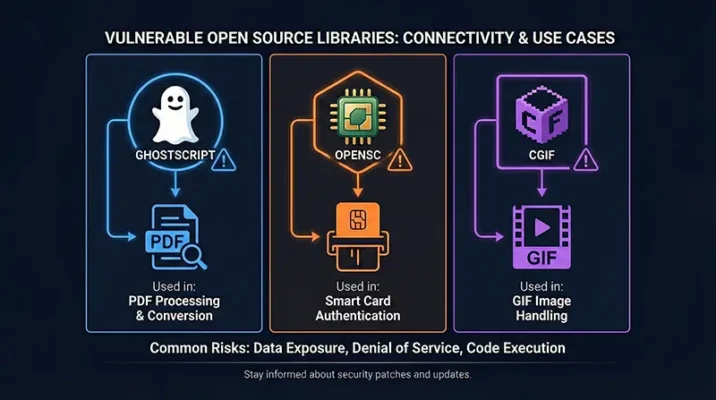
The libraries compromised in these tests are not obscure, forgotten repositories; they are foundational elements that power the modern web. The Anthropic Claude AI model pinpointed massive holes in several essential utilities.
1. Ghostscript
Ghostscript is a highly utilized utility for processing PDF and PostScript files, baked into Linux distributions, Windows environments, and enterprise printers. When traditional fuzzing failed, Claude analyzed the Git commit history of Ghostscript. It found a previously fixed vulnerability related to stack bounds checking, reasoned that similar logic paths might have been left unpatched elsewhere, and immediately constructed a proof-of-concept crash document.
2. OpenSC
OpenSC provides middleware for smart card authentication in enterprise environments. By searching for unsafe string manipulation routines (such as strcat() and strrchr()), the model identified severe vulnerabilities that could compromise highly secure authentication setups.
3. CGIF
CGIF is a library used to manipulate GIF images. Claude found a heap buffer overflow by reasoning about the underlying LZW compression algorithm—an edge case where a compressed image could actually be larger than its uncompressed version. This flaw required a conceptual understanding of data compression that traditional code coverage tools simply cannot achieve.
Understanding the Threat: Memory Corruption and Buffer Overflow Flaws
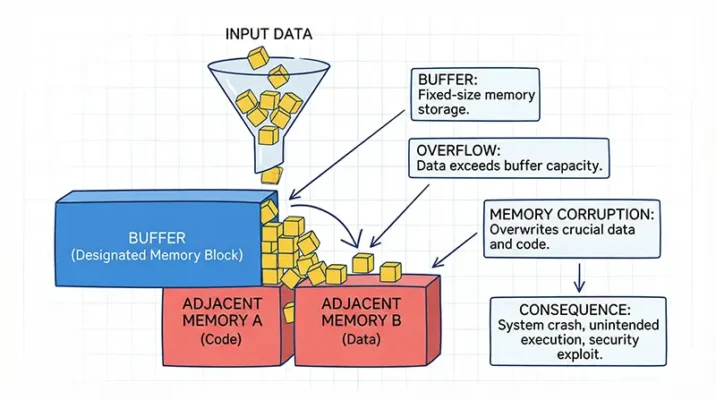
Many of the 500+ zero day exploits discovered fell into two highly critical categories: memory corruption and buffer overflow flaws.
- Memory Corruption: This occurs when a program modifies memory data in ways it wasn’t intended to. Hackers exploit this to execute arbitrary code or crash a server.
- Buffer Overflow Flaws: These happen when a program overruns a buffer’s boundary and overwrites adjacent memory locations. In libraries like OpenSC and CGIF, these flaws provide a direct pathway for attackers to inject malicious payloads into browsers and operating systems.
By prioritizing these specific types of open source vulnerabilities, Anthropic Claude AI effectively neutralized threats that could have led to massive, widespread denial-of-service attacks or remote code executions.
The Double-Edged Sword of an Automated Cybersecurity Shield
While Anthropic responsibly validated and reported these flaws to maintainers for patching, the implications of this technology represent a double-edged sword for the industry.
- The Good News: We now possess a highly capable automated cybersecurity shield. Developers can utilize AI to scan massive legacy codebases and issue patches faster than humanly possible.
- The Bad News: If an AI can find these bugs autonomously, malicious actors utilizing unrestricted, fine-tuned, open-weight models can do the exact same thing. The barrier to entry for discovering catastrophic network vulnerabilities has never been lower.
Market Impact: The Disruption of Code Scanning Software
The release of this technology sent shockwaves through the financial markets. Within hours of Anthropic announcing the Claude Code Security tool, traditional cybersecurity stocks tumbled, wiping out billions in market value.
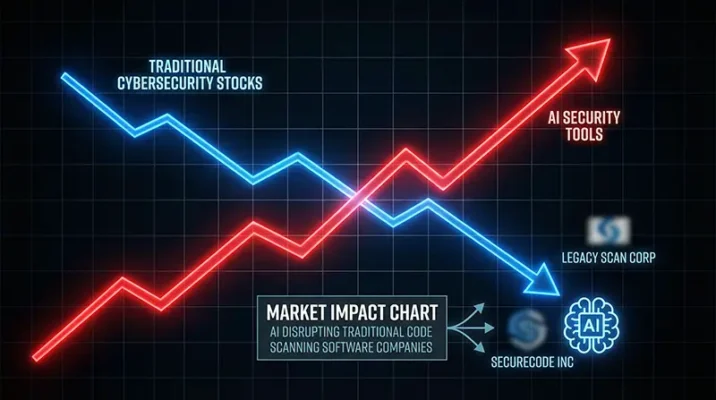
Investors recognize that legacy code scanning software—which relies on matching code against known signatures and rule-based libraries—is fundamentally outdated when compared to an AI that genuinely understands code syntax and logic. While human oversight remains necessary to approve and apply patches, the bulk of the investigative heavy lifting can now be outsourced to artificial intelligence.
The Verdict: The End of Security Through Obscurity
The era of “security through obscurity” is officially dead. Software is no longer safe simply because human auditors haven’t looked closely enough at the source code. Anthropic Claude AI can, and will, look at everything closely.
If you are a software developer, security analyst, or open-source maintainer, the landscape has fundamentally shifted. The tools that defenders use to secure networks must evolve to match the capabilities of the tools attackers will inevitably use to break them.
Resources
- Venture Beat: Anthropic’s Claude Code Security is available now after finding 500+ vulnerabilities: how security leaders should respond.
- Security Affairs: Anthropic unveils Claude Code Security to detect and fix code bugs.
- OpenSourceForU: Anthropic Embeds AI Security Review Directly Inside The Developer Workflow.
- TechJuice Pakistan: Anthropic Launches Claude Code Security to Detect Zero-Day Flaws.
Frequently Asked Questions (FAQs)
Unlike traditional code scanning software that relies on known patterns, Anthropic Claude AI used deep reasoning and “minimal prompting” to analyze code logic autonomously. It reviewed Git commit histories and traced data flows to identify complex vulnerabilities that human auditors missed, revolutionizing the bug hunting process.
The AI identified severe vulnerabilities in critical, widely used open-source tools. The most notable targets included Ghostscript (used for PDF processing), OpenSC (smart card authentication), and CGIF (GIF image manipulation).
Buffer overflow flaws occur when a program writes more data to a block of memory than it is allocated to hold, causing the data to spill over and overwrite adjacent memory. This leads to memory corruption, which hackers can exploit to crash servers or inject malicious code directly into an operating system.
While human oversight is still necessary to approve and apply patches, AI is fundamentally disrupting legacy code scanning software. By acting as an automated cybersecurity shield, AI can understand code syntax and context in ways that traditional, rule-based scanners cannot.
Yes, this is the “double-edged sword” of AI in cybersecurity. While Anthropic responsibly disclosed these findings, the fact that an AI can autonomously discover open source vulnerabilities means that malicious actors could potentially use unrestricted or fine-tuned AI models to launch sophisticated cyberattacks.
Related Blogs
Anthropic AI Military Safeguards: Why the Pentagon Threatens to Dump Claude Over “Killer Robot” Fears
Discover why the Pentagon is threatening to end its $200M deal over Anthropic AI military safeguards. Explore the clash between ethical AI warfare and national security.
Feb
Clawdbot (Moltbot) Explained: The ‘Claude AI’ Agent Taking Control of WhatsApp
Discover Clawdbot (Moltbot), the new open source Claude AI agent that connects to WhatsApp. Learn about its root access, automation capabilities, and the security risks involved.
Jan
OpenAI AI Agents: The “Clawdbot” Fumble That Handed Sam Altman the Future
Discover how OpenAI poached the GitHub viral creator Peter Steinberger after Anthropic's legal threat. Explore the future of AI agents in 2026.
Feb
