

News
THE “AI SLOP” UPGRADE: Nvidia DLSS 5 Promises Photorealism, But Ruins the Art
Mar
Every Pakistani PC gamer knows the relentless grind. You finally save up enough rupees to build a solid rig, hunting for the best GPU deals in the bustling corridors of Hafeez Center in Lahore or Naz Plaza in Karachi, only to watch the next generation of AAA games bring your system to its knees. For years, Nvidia has been our digital savior, using clever upscaling tricks to boost framerates so we can enjoy smooth gameplay without emptying our bank accounts. But at the recent GTC 2026 keynote, CEO Jensen Huang announced something that fundamentally shifts how games are made and played: DLSS 5.
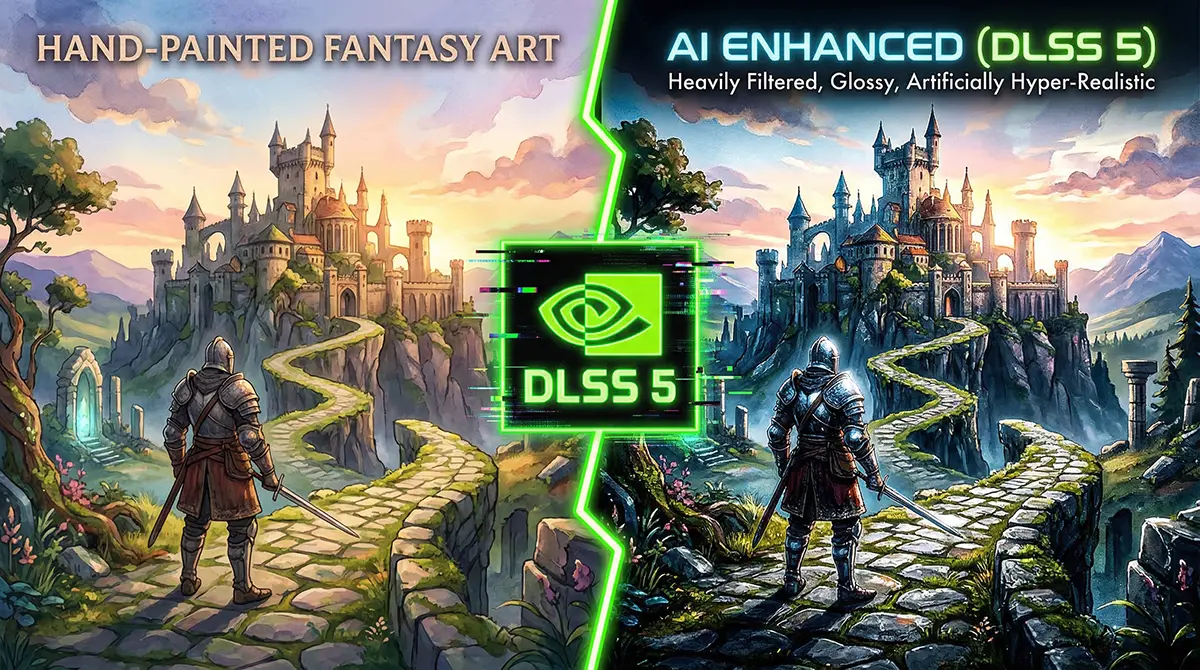
Billed boldly as the “GPT moment for graphics,” this highly anticipated upgrade promises absolute cinematic photorealism. Instead of just adding extra frames for performance, Nvidia DLSS 5 uses an advanced AI model to completely rebuild lighting, textures, and materials in real time. But there’s a massive, glaring catch. Gamers globally—and right here in the local Pakistani community—are furiously dubbing it an “AI slop” upgrade. Why? Because while it makes virtual worlds look incredibly realistic, it actively overwrites the original, handcrafted art style that developers spent years creating.
In this comprehensive deep dive, we are going to explore what Nvidia DLSS 5 actually does, unpack the massive controversy surrounding AI altered game graphics, and look at exactly what this means for the future of PC gaming graphics and your wallet.
The GTC 2026 Reveal: A GPT Moment for PC Gaming Graphics
The atmosphere at Nvidia’s GTC event on March 16, 2026, was electric. While the tech world anticipated new enterprise servers, gamers were blindsided by the announcement of Nvidia DLSS 5. The company is calling this its most significant breakthrough in computer graphics since the introduction of real-time ray tracing back in 2018. But this is not just another minor software patch; it is a paradigm shift.
What is Deep Learning Super Sampling 5?
To put it simply, Deep Learning Super Sampling 5 is an AI-powered neural rendering system. Older versions of the technology were primarily focused on performance—taking a low-resolution image and stretching it to fit your 1080p or 4K monitor. DLSS 5, however, takes the game’s basic geometric and color data and essentially “hallucinates” the finer visual details. It bridges the gap between the game engine’s strict mathematical limitations and real-world physics by predicting what a photorealistic world should look like.
Moving from Frame Generation to Neural Rendering
The core difference here lies in the battle of frame generation vs neural rendering. DLSS 4.5 was a masterclass in adding filler frames. It could generate up to 5 AI frames per rendered frame to eliminate stutter and keep your gameplay buttery smooth. Nvidia DLSS 5, on the other hand, is a 3D-guided neural rendering powerhouse. It doesn’t just guess the next frame; it semantically analyzes the entire scene 60 times a second to achieve perfect real-time photorealistic lighting.
How Nvidia DLSS 5 Fundamentally Changes Graphics
To truly understand why the internet is so deeply divided over this new technology, you have to look under the hood. Up until now, PC gaming relied heavily on traditional rasterization and path tracing. Both methods calculate how light behaves, but they require massive processing power.
The Magic of 3D-Guided Neural Rendering
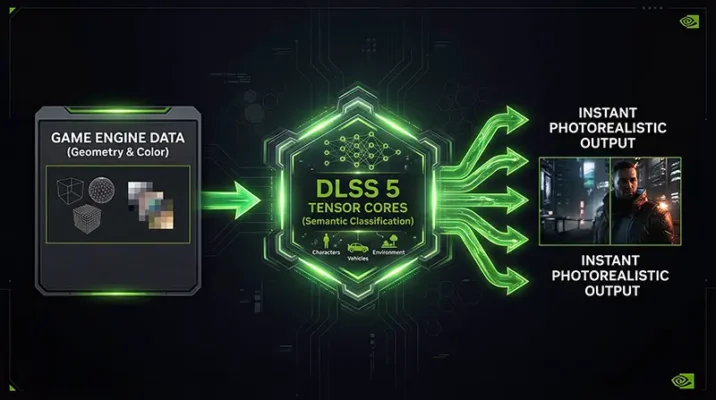
Instead of calculating every single photon of light step-by-step, the Nvidia DLSS 5 system intercepts the data pipeline. The game engine sends scene geometry, color data, and motion vectors to the GPU’s Tensor Cores. The AI model then takes over entirely, predicting and generating the final image based on its vast training data. It acts as a real-time path tracing alternative, delivering Hollywood-level visual fidelity in the 16-millisecond window required for a 60 FPS game.
Material Semantic Classification and Photorealistic Lighting
The true magic—and the source of the problem—is how the AI understands materials. The neural network detects if a surface is meant to be human skin, leather, water, or metal. It then applies advanced effects like subsurface scattering (how light glows under human skin) and contact shadows. If a character is wearing a damp cloth shirt, DLSS 5 will mathematically ensure that the shirt shines and reflects ambient light exactly as it would in the real world.
The “AI Slop” Backlash: When Algorithms Overwrite Art

Here is where the dream of perfect graphics turns into a nightmare for many purists. Game developers spend countless hours carefully crafting a specific visual tone. Think of the stylized, watercolor aesthetics of indie games, or the heavy, gothic shadows used in dark fantasy RPGs. Art is subjective, and its presentation is deliberate.
When Nvidia DLSS 5 takes over, it prioritizes pure, unfiltered photorealism above all else. This has led to a loud outcry from the community, coining the term “AI Slop.”
The Death of Handcrafted Artistic Intent
Gamers are frustrated that their favorite titles are being passed through a sterile, hyper-realistic AI filter that washes away the original artistic vision. Preserving artistic intent in games is quickly becoming the biggest battleground in the industry. The AI doesn’t understand context, sadness, or dramatic tension; it only understands materials and physics. If an artist deliberately gave a character exaggerated, harsh shadows to convey a depressing storyline, DLSS 5 might “correct” those shadows because they don’t align with photorealistic daylight mathematics.
Case Studies: Resident Evil Requiem and Hogwarts Legacy Face Changes
The backlash wasn’t born out of thin air; it came directly from Nvidia’s own GTC 2026 demonstrations. In the Resident Evil Requiem DLSS 5 footage, a character named Grace was shown with the tech turned on and off. Digital Foundry and Reddit users were quick to point out that the AI fundamentally altered her facial structure, removing her stylized grit and replacing it with a glossy, lifeless “Instagram filter” face.
Even worse, in a demo for Hogwarts Legacy, a young teenage character looked aged-up into a 40-year-old man because the AI miscalculated how photorealistic lighting should react on his specific skin textures. These aren’t minor graphical glitches; these AI altered game graphics are fundamental, unwanted alterations of the game’s identity.
The Hardware Reality for Pakistani Gamers

Let’s bring this technological reality home to Pakistan. Our local PC building community is incredibly passionate, constantly trading parts on platforms like PakGamers or local Facebook groups to squeeze every ounce of performance from our rigs. So, what is the reality of the Nvidia DLSS 5 release for us?
The Blackwell Barrier: Can We Afford the RTX 5090?
Currently, high-end GPUs are priced at an astronomical premium in Pakistan due to heavy import duties, fluctuating dollar parity (PKR to USD), and general supply chain markups. During the GTC presentation, Nvidia revealed that the Nvidia DLSS 5 early preview was running on not one, but two GeForce RTX 5090s. One GPU was rendering the game, and the second was entirely dedicated to running the heavy AI model!
While Nvidia has promised that the final release in Fall 2026 will be optimized for a single GPU, the RTX 5090 performance in Pakistan will come with a price tag that rivals the cost of a small car. If this technology is locked exclusively behind the bleeding-edge Blackwell architecture, a vast majority of local gamers will be entirely priced out of the experience on day one.
GeForce NOW and Cloud Gaming Alternatives in Pakistan
There is a silver lining to this imposing hardware wall. As Nvidia continues to push the boundaries of generative AI in video games, they are also expanding their GeForce NOW server infrastructure. For gamers in Pakistan equipped with stable fiber optic internet connections (like StormFiber or Nayatel), cloud gaming might become the primary—and most affordable—way to experience DLSS 5. Instead of dropping millions of rupees on a new rig, streaming an AI-rendered game from a remote server could be the great equalizer for our local community.
Developer Tools: Can Streamline SDK Tame the AI?
Nvidia isn’t turning a blind eye to the “AI slop” backlash. They know that if game directors hate the tool, they won’t implement it in their engines. To combat the narrative that DLSS 5 destroys art, Nvidia is heavily promoting its backend developer software.
Masking and Creative Control
The Nvidia Streamline SDK integration is designed to be the critical bridge between human developer intent and AI photorealism. Through this framework, developers from studios like Bethesda, Capcom, and Ubisoft are given granular control. They can adjust color grading, limit the intensity of the AI enhancements, and most importantly, use “masking.”
Masking allows a developer to tell Nvidia DLSS 5, “Enhance the background, calculate the water reflections, and fix the lighting on the buildings, but absolutely do NOT touch the main character’s face.” If major studios can master these controls in upcoming titles like Assassin’s Creed Shadows and The Elder Scrolls IV: Oblivion Remastered, we might get the best of both worlds: cinematic environments that don’t destroy the carefully crafted identity of the characters within them.
Quick Takeaways: The Nvidia DLSS 5 TL;DR
- A Monumental Leap: Announced at GTC 2026 Nvidia announcements, DLSS 5 launches in Fall 2026 and utilizes groundbreaking 3D-guided neural rendering to overhaul game visuals.
- The “GPT Moment”: Instead of just generating filler frames, the AI actively reconstructs lighting, textures, and materials to achieve real-time photorealism.
- The “AI Slop” Backlash: Gamers and critics argue that the hyper-realistic AI filter ruins handcrafted artistic intent, turning unique characters into soulless deepfakes.
- Massive Hardware Tax: Early demos required dual RTX 5090s, indicating massive financial costs for PC builders, especially in economically sensitive markets like Pakistan.
- Developer Safeguards: Nvidia provides the Streamline SDK, allowing developers to mask areas and tone down AI effects to preserve their original art style.
Conclusion: The Future of PC Gaming in an AI World
As we hurdle toward the Fall 2026 release window, the PC gaming landscape is standing at a major philosophical crossroads. Nvidia has undeniably engineered a technological marvel with DLSS 5. The ability to take basic game geometry and infuse it with Hollywood-level, photorealistic lighting in real-time solves the massive computational bottleneck of traditional rendering and shatters the boundaries of what virtual worlds can look like.
However, the “AI Slop” controversy is a highly valid and vital conversation. A video game is not just a sterile physics simulation; it is a piece of interactive human art. When generative AI overwrites the deliberate, passionate choices of human artists—smoothing out gritty textures or changing the emotional weight of a character’s face just to make it align with mathematical “reality”—we lose a vital piece of the game’s soul.
For the Pakistani gaming community, the immediate hurdle will be the prohibitive cost of the RTX 50-series hardware required to even boot up this tech. But whether you plan to save up for an upgrade, stick with your trusty current rig, or stream via the cloud, the core debate remains exactly the same: Are we willing to sacrifice unique, handcrafted art styles for mathematically perfect, AI-generated photorealism?
References:
- Kan, M. (2026). We Tried Nvidia’s DLSS 5: Is It Just an AI Image Filter, or the Future of PC Gaming?. PCMag.
- Thomas, J. (2026). Nvidia Announces DLSS 5, Injecting Even More AI Into Games. IGN Pakistan. Retrieved March 18, 2026.
- Digital Foundry (2026). Nvidia’s new DLSS 5 Brings Photo-Realistic Lighting To RTX 50-Series. Digital Foundry.
- Burnes, A. (2026). New DLSS 4 Games, Plus DLSS 5 Announced At GTC 2026. NVIDIA GeForce News.
- Indian Express (2026). NVIDIA’s GPT moment for graphics sparks backlash: Why gamers are calling DLSS 5 ‘AI slop’.
NVIDIA DLSS 4.5 Leak: Massive 6x AI Frame Gen & Performance Revolution
Verified leaks reveal NVIDIA DLSS 4.5 ahead of CES 2026! Discover the new 6x Dynamic Frame Gen, AI upscaling, and what this means for your gaming PC.
3 Comments
Jan
AMD AI Roadmap: Why RDNA 3.5 Graphics Are Here to Stay Until 2028
A massive AMD AI roadmap leak reveals RDNA 3.5 will power mainstream gaming laptops until 2029. Discover what this means for your next budget premium device.
Feb
AMD RDNA 5 Release Date: Rumored Delay to 2027 Could Be Disastrous for Gamers
New reports suggest the AMD RDNA 5 release date may slip to 2027, arriving after the NVIDIA RTX 60 series. Here is why "Medusa" might be too late.
Jan
Frequently Asked Questions (FAQs)
While DLSS 4.5 focuses on generating extra frames to improve performance and gameplay smoothness, Nvidia DLSS 5 focuses on rebuilding the visual quality of each individual frame. It utilizes 3D-guided neural rendering to create highly lifelike lighting, shadows, and materials.
Many gamers feel that DLSS 5 acts like an aggressive, uncontrollable AI filter that overwrites the original art style of the game. Critics point to GTC demo examples where the AI altered game graphics so drastically that characters’ faces—like in Hogwarts Legacy and Resident Evil Requiem—completely changed, losing their human touch.
Nvidia has stated that DLSS 5 relies heavily on advanced Tensor Cores. Given the massive computational requirements (demoed heavily on RTX 5090s), it is highly likely that the core real-time photorealistic lighting features will be locked to, or best experienced on, the upcoming Blackwell architecture GPUs.
DLSS 5 is scheduled for a global software release in Fall 2026. Pakistani gamers will have access to the software updates in titles like Starfield at the exact same time as the rest of the world, though acquiring the necessary RTX 50-series hardware locally will likely cost a severe premium.
Developers are utilizing the Nvidia Streamline SDK integration, which gives them granular control over the AI’s behavior. They can use “masking” techniques to prevent the AI from altering specific elements (like a protagonist’s face or a heavily stylized skybox), thereby preserving artistic intent in games.
What do you think? Is Nvidia DLSS 5 the ultimate graphics upgrade we’ve been waiting for, or are we entering a depressing era of soulless AI gaming? Drop your thoughts in the comments below, and don’t forget to share this article with your gaming squad on WhatsApp and Facebook! Let’s get the local community talking!
