

News
Shocking Shift: Google Pixel Production in Vietnam — Price Impact for 2026?
Jan
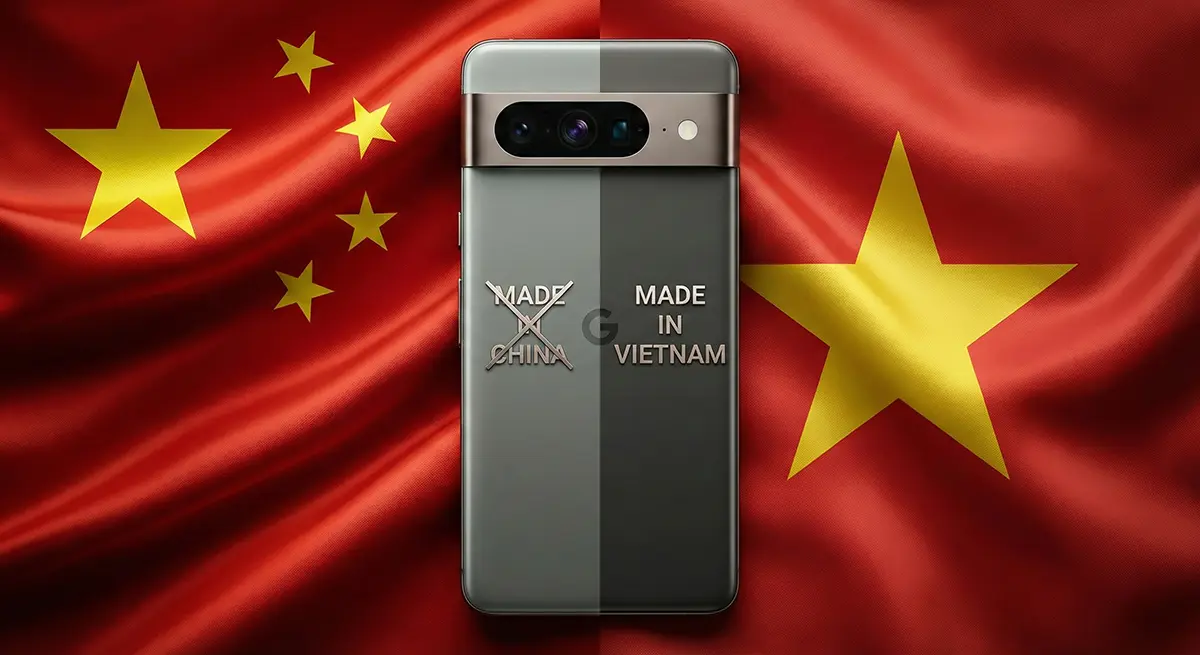
Google Pixel production in Vietnam is officially the new standard for 2026. If you are holding a Pixel 9 Pro or eagerly waiting for the Pixel 11, take a closer look at the back of your phone. For years, “Made in China” has been the stamp of approval for tech giants. But in a massive strategic shift confirmed this week, Google is officially breaking up with its Chinese manufacturing roots.
This isn’t just a change in geography; it is a total relocation of the “brain” of the operation. According to major reports from Nikkei Asia and Reuters, Google is moving the production and New Product Introduction (NPI) of its high-end Pixel phone lineup to Vietnam starting this year.
What does this mean for the Google Pixel 11 Pro, the next Google Pixel Fold, and most importantly, your wallet? Here is the comprehensive breakdown.
The Big News: Goodbye Google China
For the first time in its hardware history, Google will conduct its critical New Product Introduction (NPI) process for flagship devices outside of China. This is a monumental step. NPI isn’t just about assembling parts on a conveyor belt; it is the phase where engineers design blueprints, stress-test prototypes, and figure out how to mass-produce the phone efficiently.
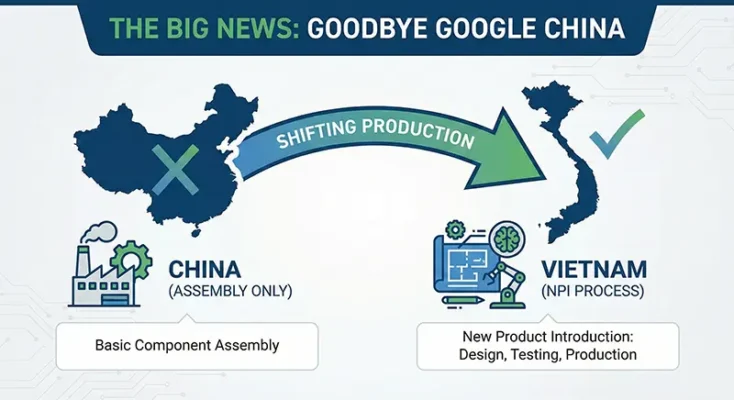
By moving this to Vietnam, Google is trusting Vietnamese engineers to build the next generation of phones “from scratch.” While the budget-friendly Pixel A-Series will likely remain in China for now to keep costs low, the premium Google Pixel lineup is leaving the nest.
Key Takeaway: The “Made in China” era for flagship Pixels is ending. The Google Pixel 11 will be the first major test of this new supply chain.
Why Vietnam? Escaping the US China Trade War
Google isn’t packing up its factories just to save a few dollars on labor. They are doing it to survive. The geopolitical landscape of 2026 is volatile, and tech companies are scrambling for safety.

1. Geopolitical Safety
With US China tariffs threatening to jump again under new US policies, Google is terrified of having its entire supply chain locked behind the Great Wall. The ongoing trade war has made manufacturing in China a financial liability rather than an asset. By diversifying to Vietnam, Google insulates itself from sudden political shocks.
2. The “Samsung” Model
Vietnam is already a proven hub for tech giants. Samsung currently manufactures nearly 50% of its global Galaxy phones in Vietnam. Google is essentially following the leader to a safer, more neutral territory. If Made in Vietnam is good enough for the world’s largest Android manufacturer, it is good enough for Google.
Which Devices Are Moving? (Pixel 11 & Fold)
The shift impacts the most expensive and complex devices in Google’s arsenal. If you are planning to upgrade in late 2026, your device will likely come from a Vietnamese factory.

-
Google Pixel 11: The standard flagship will be the primary test subject for this new manufacturing process.
-
Google Pixel 11 Pro: As the high-performance model, this requires precision engineering, putting immense pressure on the new Vietnamese supply chain.
-
Google Pixel Fold: Foldables are notoriously difficult to build. Moving the next Fold’s production away from the established lines in China is a bold, risky move.
Price Analysis: Will the Pixel 11 Be Cheaper?
This is the million-dollar question for every consumer. Logic suggests that “Cheaper Labor = Cheaper Phones,” right? Unfortunately, the reality for 2026 is the opposite.
The “Transition Tax”
Moving an entire supply chain is incredibly expensive. Google has to:
-
Ship massive testing equipment across borders.
-
Train thousands of new workers.
-
Build new logistics routes for components that are still made in China.
Verdict: Do not expect a price drop. Google might struggle to keep the price stable at $999 due to these startup costs.
The Component Crisis
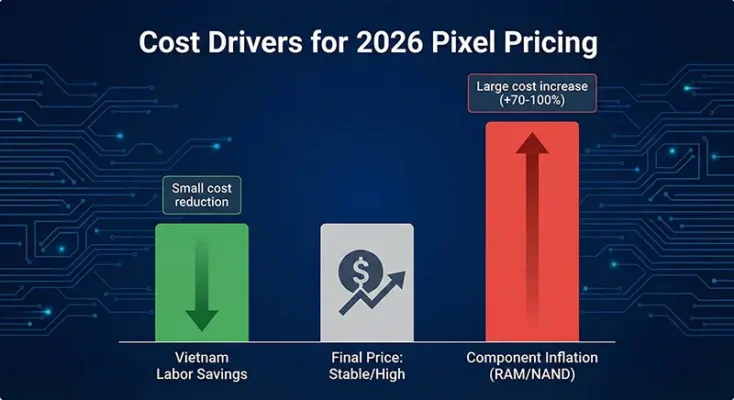
Even if Vietnamese labor is 50% cheaper than Chinese labor, the parts inside the phone are skyrocketing in price. As we covered in previous market analyses, the cost of smartphone RAM and NAND Flash has risen by 70-100% globally.
Prediction: The move to Vietnam might be the only thing stopping the Pixel 11 from costing $1,200. It is a defensive move to offset component inflation, not a strategy to lower the MSRP for you.
Quality Control: Can Vietnam Match China?
Vietnam has a solid track record with Samsung, but NPI is difficult. The first batch of Made in Vietnam Pixels might face the same Quality Control (QC) growing pains we saw when Apple moved some iPhone production to India.
-
The Risk: Early batches of the Google Pixel 11 Pro could have minor assembly variances as the new workforce gets up to speed.
-
The Advice: If you are a die-hard Pixel fan, it might be wise to wait for the second batch of production or read build-quality reviews closely before buying on launch day.
What This Means for Pakistan
For the Pakistani consumer, this shift is significant. The Google Pixel has gained a cult following in local markets, often imported via Dubai or the US.
-
Availability: Supply chains in Vietnam are closer to South East Asian hubs. This could eventually mean faster access to stock in the grey market, though official distribution remains up to Google.
-
Pricing in PKR: With the US China tariffs avoided, the dollar price of the Pixel might stabilize. However, given the local import duties and the “Transition Tax” mentioned above, Pakistani buyers should prepare for the Pixel 11 to remain a premium, high-cost device.
-
Repairability: As Vietnam increases production, spare parts might become more accessible in the Asian market, potentially lowering repair costs for Pakistani users in the long run.
Conclusion
Google’s exit from Google China manufacturing is a smart long-term play to protect your phone from the trade war. But for the average consumer in 2026, don’t expect a discount.
If anything, this move is Google fighting tooth and nail just to keep the price tag from exploding further. Whether you are eyeing the next Google Pixel Fold or the standard 11, the “Made in Vietnam” label represents a new era of safety, stability, and survival for the Pixel brand.
Resources
- NationThailand: Google Chooses Vietnam for High-End Smartphone Production.
- Reuters: Google to develop, manufacture high-end smartphones in Vietnam, Nikkei Asia says.
Frequently Asked Questions (FAQs)
Yes, according to recent reports from Nikkei Asia and Reuters, Google is moving the New Product Introduction (NPI) and manufacturing of the Pixel 11 and Pixel 11 Pro to Vietnam in 2026. This marks the first time flagship Pixels will be developed from scratch outside of China.
The primary reason is to avoid the escalating US China tariffs and trade war tensions. By diversifying its supply chain to Vietnam—similar to Samsung’s strategy—Google protects itself from potential sanctions and manufacturing lockdowns in China.
It is unlikely. While labor in Vietnam is cheaper, the high cost of moving supply chains (“Transition Tax”) and the global rise in smartphone RAM and component prices means the Pixel 11 price will likely remain stable or increase slightly, rather than drop.
There is no evidence of lower quality, as Vietnam is already a proven manufacturing hub for Samsung and Apple. However, since this is the first time Google is conducting the engineering phase (NPI) in Vietnam, early batches of the Pixel 11 may face minor quality control growing pains.
No, Google does not officially sell the Pixel series in Pakistan. Devices are typically imported via the grey market (US or Dubai variants). However, the shift to Vietnam might eventually lead to better spare parts availability in the Asian market for local repair shops.
