

News
The Great Downgrade: Why Future Flagship Phones Will Have LESS RAM

Dec
For the last decade, smartphone specifications have followed a predictable trajectory: bigger screens, faster processors, and significantly more memory. But as we look toward the horizon, smartphone RAM trends 2026 point to a jarring reversal.
We are facing the mobile industry’s first “Great Downgrade.” Credible leaks regarding upcoming flagship devices from major Android manufacturers suggest a shocking strategic pivot: reduced RAM phones are set to become the new baseline in an effort to slash manufacturing costs.
Here is why your next upgrade might technically be a downgrade—and how tech giants plan to sell it to you.
2026 Flagship Specs: The Return of 8GB
If you bought a mid-range or high-end phone in 2025, you likely enjoyed 12GB or even 16GB of RAM as a standard feature. This memory abundance allowed for seamless multitasking and kept dozens of apps open in the background without reloading.
However, the 2026 flagship specs paint a different picture. Manufacturers are reportedly scaling back base models to 8GB of RAM for their upcoming lineups. This reversal is significant because modern operating systems, particularly Android 16 and beyond, are becoming increasingly resource-heavy. Reverting to 8GB creates a potential bottleneck that power users haven’t felt in years.
The Economics: Why Go Backward?
Why would innovation reverse course? The answer lies in the volatile global silicon market.
A looming global shortage in DRAM (Dynamic Random Access Memory) and soaring production costs for next-generation LPDDR5X and LPDDR6 modules are forcing brands into a corner. Manufacturers face a binary choice:
-
Raise the base price of flagship phones by $150–$200 to cover the rising Bill of Materials (BOM).
-
Quietly cut specifications to maintain the psychological “$999” price point.
Most brands are choosing the latter. By shaving 4GB–8GB of RAM off millions of units, companies can save billions in production costs, even if it means delivering a theoretically inferior product.
The “Cloud AI” Excuse
How do you market a downgrade? You spin it as a futuristic feature.
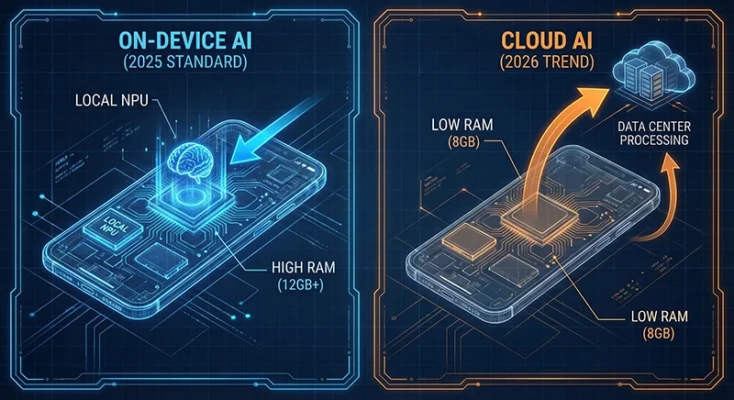
This is where the mobile AI downgrade comes into play. Over the last two years, the industry buzzword was “On-Device AI”—the ability to run Large Language Models (LLMs) directly on your phone’s NPU (Neural Processing Unit) for privacy and speed. However, On-Device AI is memory-hungry; it requires substantial RAM (often 12GB+) to function smoothly.
To justify the drop to 8GB, marketing teams are expected to pivot hard toward “Cloud AI.” By offloading processing power to server farms rather than your local hardware, they can claim your phone is “smarter than ever” while actually removing the local hardware required to think for itself. This shift conveniently covers up the hardware cuts while tethering users more tightly to subscription-based cloud services.
The “Pro” Premium Trap
This trend effectively kills the value of the “standard” flagship. If you refuse to settle for reduced RAM phones and demand the performance necessary for heavy gaming, 4K video editing, or local AI tasks, you will have no choice but to upsell yourself.
Expect 16GB and 24GB configurations to still exist, but they will likely be gated behind the most expensive “Ultra,” “Pro Max,” or “Fold” variants. The gap between the entry-level flagship and the top-tier model is about to become a canyon, forcing enthusiasts to pay a premium just to get specs that were standard a year ago.
Conclusion
The era of “specs only go up” is officially over. As 2026 approaches, consumers need to look past the marketing dazzle of Cloud AI and scrutinize the spec sheets. If the base model of your next phone struggles to keep three apps open, you’ll know exactly why: the Great Downgrade has arrived.
Frequently Asked Questions (FAQs)
The primary drivers are rising component costs and global shortages of DRAM chips. By reducing RAM in base models, manufacturers can keep retail prices stable without sacrificing their profit margins.
For casual users (web browsing, social media), 8GB will likely remain sufficient. However, for power users, gamers, and those who rely on heavy multitasking, 8GB may cause apps to close in the background more frequently and result in slower performance compared to 12GB models.
On-Device AI processes data directly on your phone’s hardware, which is faster and more private but requires lots of RAM. Cloud AI sends data to a remote server for processing. Moving to Cloud AI allows manufacturers to use less RAM in the phone, but it requires an internet connection to work.
Leaks suggest this trend will primarily affect the “Base” and “Plus” models of major Android flagship series. The top-tier “Ultra” or “Pro” models are expected to retain higher RAM capacities (12GB–16GB) but at a higher price point.
RAM stores the game’s assets (textures, levels, audio) while you play. Lower RAM means the phone cannot keep as much game data ready for instant access, which can lead to longer loading times, stuttering, or the game crashing if you switch to another app to reply to a message.
