

News
THE LOG IN TAX: Sony is Secretly Charging Players Different Prices on the PlayStation Store

Mar
As if keeping up with the soaring exchange rates and buying digital gift cards in Pakistan wasn’t stressful enough, a new controversy has hit the gaming community. If you own a PS5, you might be falling victim to what gamers are dubbing the “Log In Tax.” Recent investigations and widespread player reports have revealed that Sony is secretly showing different prices for the exact same digital games on the PlayStation Store, depending on whose account is logged in—or if you’re logged in at all.
Imagine spotting a massive discount on Spider-Man 2, buying a US PSN gift card with your hard-earned Rupees, logging into your account to make the purchase, and watching the price suddenly jump. This isn’t a glitch; it is a calculated pricing experiment. Over the past few months, the Japanese tech giant has been testing dynamic, account-based pricing across dozens of regions and hundreds of games.
In this comprehensive guide, we will dive deep into how this secret pricing model works, why it is happening, the specific games affected, and most importantly, how tech-savvy players in Pakistan can outsmart the system to ensure they are always getting the best possible deal on the PlayStation Store.
What is the PlayStation Store “Log In” Tax?
For years, digital storefronts operated on a simple premise: a game costs what it costs. If there is a seasonal sale, everyone gets the same discount. However, a major shift is quietly happening on the PlayStation Store. The “Log In Tax” refers to the frustrating phenomenon where players see a heavily discounted price while browsing the web anonymously, only to see a much higher price (a smaller discount) the moment they sign into their PlayStation Network account.
How Dynamic Pricing Works on PSN
According to extensive tracking data gathered by the price-monitoring website PSPrices, Sony has been running a massive A/B testing experiment since November 2025 [1]. This isn’t your standard seasonal sale. Instead of applying a flat 50% discount to everyone, the algorithm might offer you a 25% discount while offering your friend a 56% discount for the exact same title. The system tracks your digital footprint, your purchase history, and likely your engagement metrics to determine what price you are willing to pay.
The Discovery: How Gamers Caught Sony Red-Handed
The secret unravelled on Reddit when a user noticed a bizarre discrepancy while trying to buy Red Dead Redemption 2 [2]. On his main account, the game was listed at $19.99. But on his wife’s account—on the exact same console, in the exact same region—it was listed at $14.99. Soon after, another user reported that Assassin’s Creed Unity was showing a deep discount of £3.74 when logged out, but the price “jumped” to £9.99 the second they signed in [3].
Unique Insight: What is truly fascinating—and slightly terrifying—is that this marks the end of transparent digital ownership. We are moving from a “fixed retail” mindset to an “airline ticket” mindset, where the price of a digital asset fluctuates based on invisible backend analytics.
Why is Sony Charging Different Players Different Prices?
To understand why this is happening, we have to look at the business strategy behind modern digital storefronts. As hardware sales for the PS5 begin to plateau, Sony is aggressively looking for ways to maximize the Average Revenue Per User (ARPU) from its existing player base.
The A/B Testing Strategy Explained
This practice is known as A/B testing or price elasticity testing. The goal is to find the mathematical “sweet spot” of consumer demand. By randomly placing users into control and test groups, Sony can gather massive amounts of data. If they offer a game at $40 to Group A and $50 to Group B, and both groups buy it at the exact same rate, the publisher learns that they never needed to offer the deeper discount in the first place. Over time, the algorithm learns exactly how little of a discount it takes to trigger your “buy” reflex based on your personal PlayStation gaming community habits.
Targeted Discounts vs. Surge Pricing
It is important to correct a common misconception: Sony is not raising the base MSRP (Manufacturer’s Suggested Retail Price) of games beyond their standard $70 ceiling. Instead, they are manipulating discounts. If you are a hardcore gamer who buys every major release on day one, the algorithm might decide you don’t need a 50% discount to be convinced; a 15% discount will suffice. Conversely, a casual player who hasn’t bought a game in six months might get a massive 60% targeted discount to entice them back into the ecosystem. While corporate analysts call this “targeted marketing,” gamers on the receiving end of the smaller discounts naturally view it as a penalty for their loyalty.
The Impact on Pakistani Gamers: A Currency Nightmare
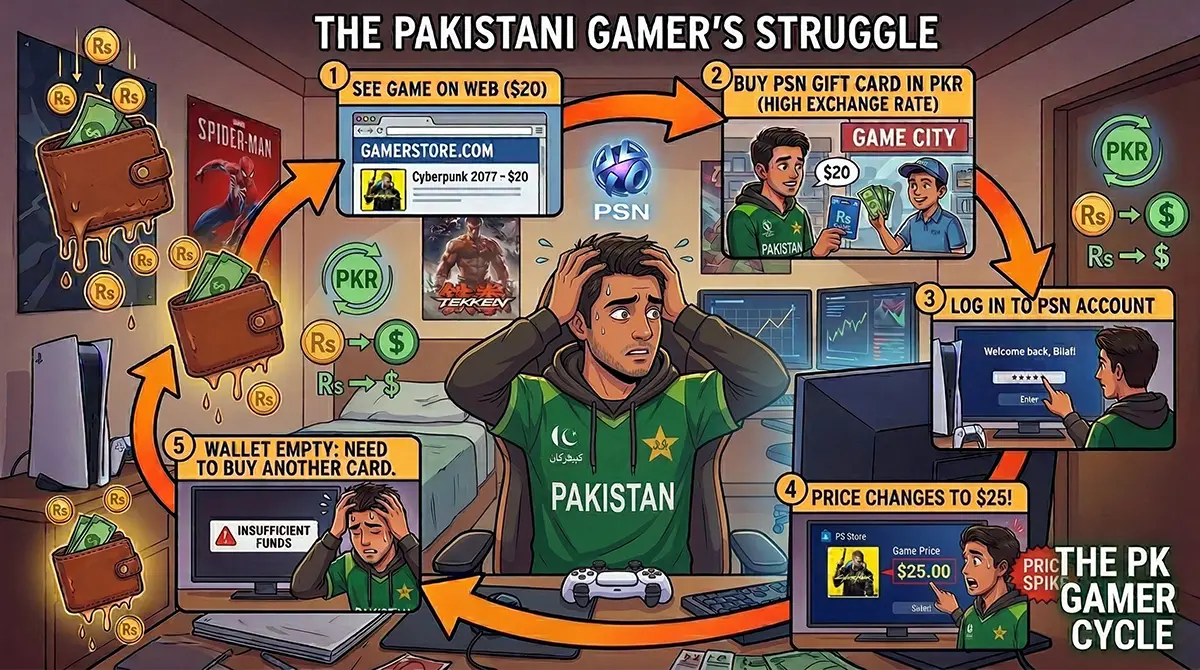
While dynamic pricing is annoying for a gamer in New York, it is a localized financial crisis for a gamer in Karachi or Lahore. Because Pakistan does not have an official, localized PlayStation region, our experience with the PS5 digital storefront is already heavily compromised.
Buying PSN Gift Cards in PKR
Almost all Pakistani players rely on creating US, UK, or UAE accounts. Because our local debit and credit cards are rarely accepted on these foreign storefronts, we are forced to buy PSN cards in Pakistan through third-party vendors. This process involves battling volatile PKR exchange rates and paying vendor markups.
Let’s say you see a game on the web advertised at $20. You calculate the exchange rate, transfer funds to a local vendor, and receive your $20 digital code. You redeem it, log into your PlayStation network account to buy the game, and suddenly the algorithm decides you belong to the higher pricing tier, asking for $25. Your gift card balance is now useless for that purchase, and you are forced to go back and buy a $5 top-up card at terrible conversion rates.
Which PSN Regions are Affected?
According to data analysts, this experiment has rapidly expanded from 30 regions to over 68 regions worldwide [1]. Whether you are using a US account, a UK account (like the Assassin’s Creed example), or a European account, you are in the crosshairs of these hidden algorithmic changes. For the Pakistani audience, this unpredictability makes budgeting for digital gaming nearly impossible.
Sony vs. Xbox: A Tale of Two Pricing Models
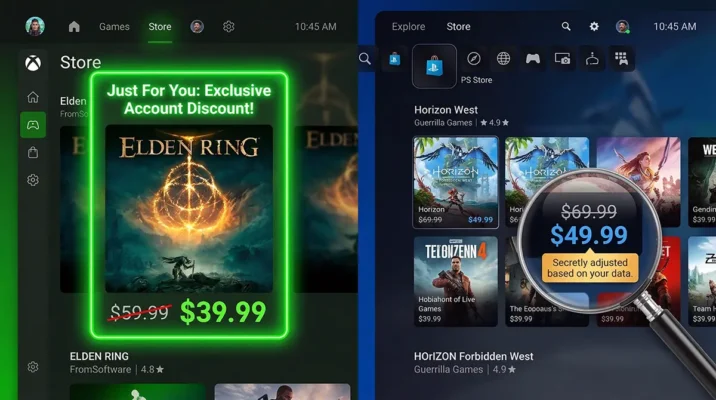
The concept of targeted pricing isn’t entirely new to the gaming industry, but the execution makes all the difference. When we compare how Sony and Microsoft handle this, the root of the current internet outrage becomes very clear.
Microsoft’s Transparent “Just For You” Deals
Microsoft has actually been utilizing personalized discounts on the Xbox store since around 2021. However, they use a highly transparent system. If the Xbox algorithm decides to offer you a special price, the game is placed in a clearly marked “Just For You” section [4]. It explicitly tells the user, “Hey, because of your play history, here is a special, exclusive discount.” It feels like a reward, a bonus for being in the ecosystem.
Why Sony’s Secretive Approach is Sparking Outrage
Sony, on the other hand, chose stealth. There are no “Just For You” banners. The price you see simply replaces the standard store price with zero context or transparency. This lack of communication is what led to accusations of Sony anti-consumer practices. When a company quietly alters a price tag depending on who is looking at it, it erodes trust. It transforms the PS5 digital storefront from a reliable retail environment into a casino where the house is constantly adjusting the odds.
Which Games Are Affected and Is This Legal?
As of March 2026, what started as a small test on older third-party titles has ballooned into a massive experiment involving major blockbusters.
First-Party AAA Titles Included
Data trackers have confirmed that the A/B testing now involves over 150 games, including Sony‘s own crown jewels [1]. Titles caught in this web include God of War Ragnarök, The Last of Us Part 2, Helldivers 2, and Marvel’s Spider-Man 2. In one notable instance, some users received a standard 25% discount on Helldivers 2, while the lucky “test group” saw a massive 56% discount.
The Legal Grey Area
Is video game surge pricing or targeted discounting legal? Unfortunately for consumers, yes. According to European Union consumer protection rules, dynamic pricing is not illegal as long as it does not discriminate based on protected classes (like race, gender, or nationality) [3]. Because the PlayStation algorithm bases its prices on purchasing behavior, regional market elasticity, and randomized A/B groupings, it falls comfortably within legal boundaries. It may feel ethically questionable, but it is standard corporate practice in industries like travel, retail, and ride-sharing.
How to Avoid Paying More on the PlayStation Store
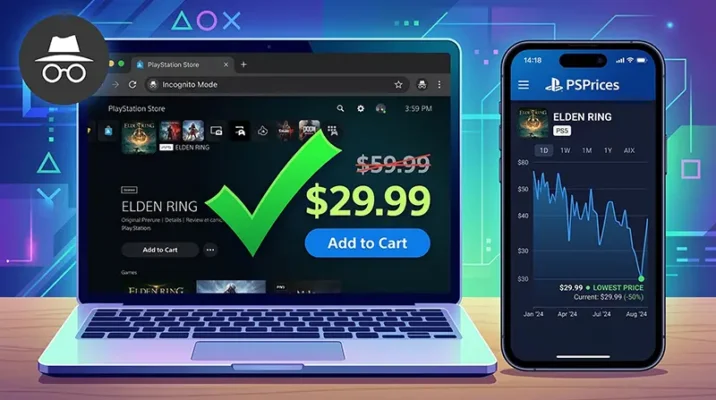
Now that we know the “Log In Tax” is real, how can you protect your wallet? Here are a few actionable strategies to ensure you are getting the true lowest price.
1. The “Incognito Mode” Trick
Before you decide to buy a game, open a private or Incognito window on your web browser. Go to the PlayStation Store website without logging in. Search for the game you want. Note the price. Then, log into your account and see if the price changes. If your logged-in price is higher, you are in the unlucky A/B test group.
2. Rely on Price Tracking Websites
Never buy a game based solely on the PSN Store front page. Bookmark sites like PSPrices or DekuDeals. These platforms track the historical low of every game and can flag unusual pricing structures. Sony recently added a feature showing the lowest price a game has hit in the last 30 days, but external trackers are much more reliable for spotting long-term trends and PS prices comparison.
3. Coordinate with Friends (Game Sharing)
If you have a trusted friend or family member, check the price on their account. As proven by the Reddit users, one account might have a 15% better discount. You can purchase the game on the cheaper account and use the PS5’s “Console Sharing and Offline Play” feature to play it on your main profile.
Quick Takeaways
- The Log In Tax is Real: Sony is actively A/B testing prices, meaning different users are seeing different discounts for the exact same digital games.
- It’s Not a Base Price Hike: The base $70 MSRP isn’t increasing; instead, Sony is offering smaller discounts to users it believes will buy the game anyway.
- Massive Scale: The experiment currently covers over 150 games across 68 regions, including huge titles like Spider-Man 2 and God of War.
- Pakistani Gamers Suffer More: Because we rely on buying PSN gift cards in foreign currencies, unpredictable price jumps can render our wallet balances insufficient at the last second.
- Beat the System: Always check game prices in an Incognito web browser (logged out) or use price-tracking websites before finalizing a purchase.
Conclusion
The gaming landscape is evolving rapidly, and the digital future we were promised is looking increasingly complicated. The discovery that Sony is quietly altering PlayStation Store prices based on user data is a stark reminder that in a digital-only ecosystem, the platform holder holds all the power.
For the general and tech-oriented audience of Pakistan, where every Rupee counts against a punishing exchange rate, this “Log In Tax” is more than just a minor inconvenience—it is a direct threat to our gaming budgets. While the practice of dynamic pricing and targeted discounts may be legally sound, the secretive manner in which Sony has rolled it out feels undeniably hostile to the consumer.
As we move closer to an inevitable, fully digital PS6 era, maintaining consumer awareness is our best defense. Always cross-reference prices, use incognito modes to check the baseline discounts, and don’t let the algorithm pressure you into a bad deal.
References
- Vice News (2026). Sony Testing Dynamic PS5 Game Pricing – Some Players Pay More for the Same Game.
- Reddit, r/PlayStation (2025). User discovers Red Dead Redemption 2 price discrepancy between family accounts.
- Kotaku (2026). PlayStation 5 Is Showing Players Different Prices For Same Game.
- GAMINGbible (2026). PlayStation Has a Dynamic Pricing Problem, Pay More For Same Game.
The End of Sony PC Ports? Why Wolverine is PS5 Exclusive
Are Sony PC ports coming to an end? Discover why Sony is reportedly pulling single-player exclusives like Marvel's Wolverine from PC to boost PS5 sales.
Feb

PS6 Specs Leak: Shocking 30GB GDDR7 Memory Revealed (Speed Over Width)
Discover the latest PS6 specs leak! Sony's next gen console targets a massive 30GB GDDR7 memory with a unique Clamshell architecture. Read the full analysis on price and performance.
Feb
Frequently Asked Questions (FAQs)
No. Sony is not raising the standard base price of games (MSRP) beyond the established maximums. What they are doing is altering the discount percentage during sales based on your specific account, meaning you might get a 20% discount while someone else gets 50%.
Because Pakistan lacks an official localized PSN store, players buy digital gift cards in USD, GBP, or AED using local currency. If a game’s price dynamically increases upon logging in, a pre-purchased gift card balance might fall short, forcing the player to buy another card at poor conversion rates.
Currently, no. Under regulations like the EU Consumer Protection rules, dynamic pricing and A/B testing are legal business practices as long as they don’t discriminate based on protected personal characteristics (like race or gender).
The easiest method is to open a private/incognito browsing window, go to the PlayStation Store web page, and search for the game without logging in. Compare that anonymous public price to the price you see when you sign in on your console or browser.
Yes and no. Microsoft does offer personalized, account-based discounts, but they are transparently labeled in a “Just For You” section on the Xbox dashboard. Sony’s approach is controversial because it changes the main store price secretly without notifying the user that it is a targeted offer.
What are your thoughts on this? Have you ever noticed a game’s price change when you logged into your PSN account? I would love to hear your experiences—drop a comment below and share this article with your co-op buddies so they don’t end up overpaying for their next game!
