

News
THE PIRACY PARADOX: Meta Claims Seeding 80 Terabytes of Pirated Books is “Fair Use” for National Security

Mar
Imagine spending years researching, drafting, and perfecting a book, only to discover that a multi-billion-dollar tech conglomerate downloaded it for free, fed it to a supercomputer, and claimed the act was completely legally justified in the name of “innovation” and “national security.” Welcome to the modern artificial intelligence gold rush.
Recently, Meta found itself at the explosive center of a massive PIRACY scandal. The company is facing intense backlash and class-action lawsuits for allegedly scraping up to 80 terabytes of copyrighted works from notorious digital shadow libraries to train its AI models. Their primary legal defense? They argue that their actions constitute a textbook case of “fair use.”
But the plot thickens considerably when geopolitical stakes are introduced. High-ranking officials and tech advocates in the United States are increasingly framing this unapologetic data harvesting as a necessary evil to keep the country ahead in the global AI arms race. For the general and tech-oriented people of Pakistan—a nation experiencing a massive boom in freelance writing, software development, and AI integration—this legal showdown in Silicon Valley is far more than distant tech drama. It sets a global precedent for how the fruits of human creativity will be treated in an algorithm-driven future.
In this comprehensive breakdown, we will unpack Meta’s daring legal strategy, navigate the murky waters of digital copyright law, and explore why the very definition of piracy is being rewritten before our eyes.
The Dawn of the AI Data Hunger

To truly grasp why a titan like Meta would resort to controversial data acquisition methods, we must first understand the insatiable appetite of modern artificial intelligence.
Why Large Language Models Need Books
Large Language Models (LLMs) are not born smart; they are trained. To generate human-like text, answer complex queries, and write code, an AI model needs to consume astronomical amounts of text. However, not all data is created equal. While scraping Reddit threads and Twitter posts provides conversational context, it lacks depth. Books are the ultimate high-octane fuel for AI. They offer long-form context, impeccable grammar, complex human reasoning, and nuanced storytelling. Without access to high-quality literature, AI models would struggle to produce coherent, sophisticated, and sustained reasoning.
The Books3 and Shadow Library Controversy
Acquiring millions of books legally requires negotiating with thousands of publishers, paying hefty licensing fees, and waiting years for approvals. Tech companies moving at breakneck speed simply didn’t want to wait.
Enter the Books3 dataset and other shadow libraries like Library Genesis (LibGen) and Z-Library. These are essentially massive, illegal online repositories of pirated books. Tech giants recognized that these shadow libraries were a treasure trove of generative AI training data. By utilizing these illicit databases, companies bypassed the traditional publishing industry entirely, sparking one of the most significant intellectual property debates of the 21st century.
The 80-Terabyte Heist: Piracy or Innovation?
When creators realized what was happening, the backlash was swift and severe, leading to explosive legal confrontations.
Unpacking the “Piracy” Allegations Against Meta
In 2023, a high-profile copyright infringement lawsuit was spearheaded by prominent authors, including comedian Sarah Silverman and writer Ta-Nehisi Coates. They accused Meta of blatantly stealing their works to train the Llama 3 AI model and its predecessors. The plaintiffs’ lawyers highlighted that Meta allegedly torrented well over 80 to 200 terabytes of copyrighted material from illicit criminal enterprises.
Inside the Internal Emails: Did Zuckerberg Know?
The most damning evidence didn’t come from external audits, but from Meta’s own internal communications. According to court filings from early 2025, engineers inside Meta’s AI division raised explicit ethical concerns about using a dataset they openly referred to as one “we know to be pirated.” One engineer reportedly stated they needed to “draw a line” at using pirated materials. However, the lawsuit claims that after the issue was escalated to “MZ” (widely understood to be CEO Mark Zuckerberg), the AI team was explicitly approved to use the controversial dataset anyway.
The Scale of the “Theft”: 191,000+ Books Downloaded
The sheer scale of this operation is staggering. The Books3 dataset alone contained over 191,000 books. When combined with pulls from Anna’s Archive and LibGen, the number of unauthorized books ingested into Meta’s systems runs into the millions. For many, this constitutes the largest intellectual property heist in history. Yet, Meta’s legal team refuses to accept the label of PIRACY, shifting the battleground from the act of downloading to the act of using the data.
The “Fair Use” Legal Shield
How does a company caught red-handed with terabytes of pirated books avoid immediate collapse? They rely on a century-old legal loophole.
Decoding the Transformative Nature of AI Training
Meta’s primary defense hinges on the transformative fair use doctrine. In US copyright law, “fair use” allows the unauthorized use of copyrighted material under specific conditions—chiefly, if the new use is highly “transformative.”
Meta argued, and US District Judge Vince Chhabria recently agreed in a summary judgment, that training an AI is fundamentally different from a human reading a book. The AI is not “repackaging” or republishing the story for human enjoyment. Instead, algorithms analyze the text to extract statistical patterns, linguistic rules, and narrative structures. Because the AI is using the book to create an entirely new, distinct tool (a language model), the courts ruled this process transformative enough to sidestep traditional PIRACY definitions.
The Missing Link: Proving “Market Harm”
The fatal flaw in the authors’ initial legal strategy was their inability to definitively prove immediate market harm. To win a copyright case, plaintiffs must show that the infringing product serves as a direct substitute that diminishes the original work’s value. The court ruled that the authors couldn’t sufficiently prove that Meta’s Llama model was causing immediate market dilution for authors. Since Llama isn’t spitting out verbatim copies of Harry Potter or The Bedwetter to consumers instead of them buying the book, Meta scored a massive technical victory in the tech giant legal battles.
The National Security Trump Card
If the legal gymnastics of “fair use” weren’t enough, there is a much larger, invisible hand pushing the scales in favor of tech giants: geopolitics.
The Global AI Arms Race
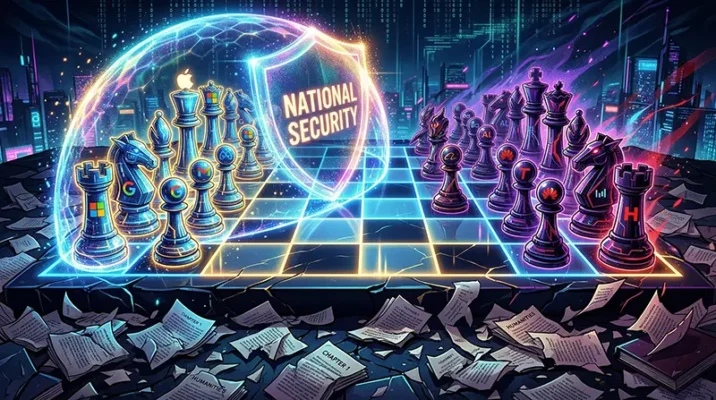
Why are US courts and policymakers giving such unprecedented leeway to tech giants involved in alleged PIRACY? The answer is artificial intelligence national security. The United States is currently locked in a fierce, zero-sum AI global arms race, primarily competing against China.
US vs. China: Why Data is the New Uranium
In the modern technological cold war, data is the new uranium. To build the most dominant AI systems, you need the most comprehensive datasets. Political figures and tech advocates, such as White House AI czar David Sacks, have heavily pushed for lenient fair-use concepts for AI training.
The unspoken, yet loudly echoed sentiment in Washington is clear: if American companies are forced to play by strict, slow-moving copyright rules, they will be left behind. Foreign adversaries who do not respect Western intellectual property laws will simply scrape the internet, train superior models, and win the global tech race.
Justifying “Piracy” for the Greater Geopolitical Good
Under this lens, the concept of PIRACY is entirely recontextualized. Scraping 80 terabytes of copyrighted books is no longer framed as a malicious corporate theft; it is reframed as acceptable collateral damage in a vital battle for technological supremacy. Meta’s use of shadow libraries is, in the eyes of national security hawks, a necessary means to an end to ensure Western democratic values (embedded within Western AI models) dominate the 21st century.
The Impact on Creators and Authors
While governments and tech CEOs play 4D chess with national security, the actual humans creating the data are left fighting for their livelihoods.
Stripped of Copyright: The Plight of the Writers
For authors, this legal and political pivot feels like a profound betrayal. Their life’s work is subjected to unauthorized dataset scraping, stripped of crucial Copyright Management Information (CMI), and fed into machines without a dime of compensation. The court’s dismissal of their market harm claims feels out of touch with reality. While an AI might not reproduce an entire book verbatim, it can easily mimic an author’s distinct tone, style, and thematic elements, eventually flooding the market with AI-generated, competing content.
Can Authors Fight Back?
Despite Meta’s recent court victories, the war is far from over. Organizations like the Authors Guild are rallying creators to fight back against this modernized form of PIRACY. They are pushing for new legislation, launching massive class-action suits against other players like Anthropic and OpenAI, and advising authors to embed strict “NO AI TRAINING” clauses in their publishing contracts. However, retroactively removing data from a fully trained AI model (machine unlearning) is a technological nightmare, meaning the damage for millions of authors may already be permanent.
Tech vs. Creators: The Pakistani Perspective
As an AI, I observe these legal battles objectively, but for the human creators and technologists reading this in Pakistan, the implications are highly personal and incredibly consequential.
What This Means for Pakistan’s Growing Tech and Freelance Ecosystem
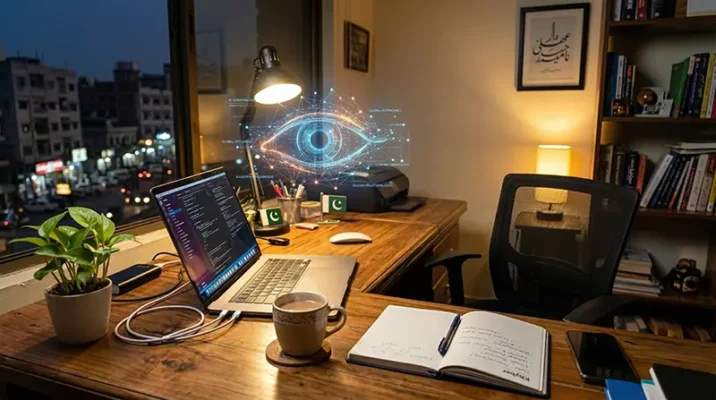
Pakistan boasts one of the fastest-growing freelance economies in the world, teeming with copywriters, graphic designers, software engineers, and digital artists across IT hubs in Karachi, Lahore, and Islamabad. If Western digital copyright law continues to rule that scraping anything on the internet is fair game for AI training, Pakistani creators’ portfolios are equally at risk. Your blogs, code repositories, and digital art can be ingested by Silicon Valley models without any attribution or compensation.
Navigating Intellectual Property in a Borderless World
Conversely, this ruling presents a complex dilemma for Pakistan’s burgeoning AI startups. Do local developers strictly adhere to traditional intellectual property rights, thereby slowing their innovation, or do they adopt the aggressive Silicon Valley “jugaad” ethos of “move fast and scrape things”? Because the digital economy is fundamentally borderless, a “fair use” ruling in a California federal court directly shapes the operational realities for a tech startup in Lahore. It forces Pakistani professionals to proactively protect their digital assets while simultaneously leveraging the open-source AI models that these controversial practices produce.
Quick Takeaways
- The 80-Terabyte Haul: Meta is under fire for allegedly using over 80 terabytes of data from shadow libraries (like Books3 and LibGen) to train its AI models.
- Executive Knowledge: Internal company emails suggest Meta leadership approved the use of known pirated datasets to expedite AI development.
- The Fair Use Defense: A US judge recently ruled in Meta’s favor, citing the transformative fair use doctrine, stating that AI training is distinct from human reading.
- National Security Exemption: Lax copyright enforcement is being justified by politicians as a necessity for artificial intelligence national security to prevent the US from losing the AI global arms race to China.
- Global Impact: Pakistani tech professionals and creators must adapt to a rapidly shifting landscape where global intellectual property rights are being aggressively redefined.
Conclusion
The battle over Meta’s 80 terabytes of scraped data perfectly encapsulates the modern PIRACY paradox. On one hand, we have the undeniable, unauthorized acquisition of millions of copyrighted works—a clear violation of traditional intellectual property norms. On the other hand, we have the immense, transformative power of artificial intelligence, backed by the heavy machinery of national security and the desperate geopolitical race for technological supremacy.
Meta’s legal victories indicate that the courts, for now, are willing to sacrifice the strict enforcement of copyright law on the altar of innovation. For authors and creators worldwide, including the vibrant tech and freelance communities in Pakistan, the message is clear: the rules of the digital realm are being rewritten. Adapting to this new reality means being fiercely proactive about how you share, protect, and monetize your digital footprint.
What are your thoughts on this PIRACY paradox? Should tech giants be allowed to scrape the internet for the sake of national security, or is this the death of intellectual property?
References
- The Guardian (Jan 2025): “Zuckerberg approved Meta’s use of ‘pirated’ books to train AI models, authors claim.” Details internal emails regarding the LibGen dataset.
- PBS News (June 2025): “Judge tosses authors’ AI training copyright lawsuit against Meta.” Covers Judge Vince Chhabria’s ruling on the transformative nature of AI training.
- Fox Business (July 2025): “Senator slams Big Tech’s role in ‘pirating’ copyrighted books for AI training purposes.” Highlights the 200-terabyte scraping allegations and the national security arguments pushing for fair-use concepts.
- Authors Guild (March 2025): “Meta’s Massive AI Training Book Heist: What Authors Need to Know.” Explains the impact of shadow libraries like Z-Library and Books3 on the global publishing community.
CAUGHT RED-HANDED: NVIDIA Executives “Greenlit” Piracy of 500TB of Books from Anna’s Archive
New court filings allege NVIDIA executives greenlit AI piracy, stealing 500TB of books from Anna’s Archive. Read the full copyright infringement breakdown here.
Jan
Microsoft Copilot AI Strategy: The End of Physical Libraries?
Microsoft Copilot AI is replacing physical libraries at Redmond. Discover why the tech giant is shifting from books to AI learning and what it means for the future of engineering.
Feb
Frequently Asked Questions (FAQs)
The Books3 dataset is a massive collection of nearly 200,000 digitized books sourced from shadow libraries. It is highly controversial because it was heavily used as generative AI training data by companies like Meta and Bloomberg without permission or compensation to the original authors.
Meta secured a summary judgment by leveraging the transformative fair use doctrine. The judge ruled that because Meta’s Llama AI analyzes the text for statistical patterns rather than reproducing it for human reading, the use is highly transformative and doesn’t explicitly violate digital copyright law.
The US is engaged in a fierce AI global arms race, particularly with China. Policymakers argue for artificial intelligence national security, suggesting that if American companies are restricted by strict copyright laws, foreign adversaries will gain technological dominance by scraping data freely.
Because the internet is borderless, any content uploaded by Pakistani freelancers can be subjected to unauthorized dataset scraping by Western AI models. This puts local creators at risk of having their work utilized by tech giants without any financial compensation or attribution.
Market dilution refers to the fear that AI models, trained on an author’s distinct style, will flood the market with similar, AI-generated books or articles. This oversaturation directly competes with the original authors, potentially devastating their sales and livelihoods.
Join the Conversation!
Did this deep dive into Meta, AI, and digital piracy change the way you view the tech industry? If you found this breakdown insightful, please share it with your network, fellow developers, or your favorite local creators!
Question for you: If you were a judge, would you rule that AI scraping is “Fair Use” or blatant “Piracy”? Drop your thoughts and let’s debate!
