


Mar
Hey there, fellow gamers and tech enthusiasts! Have you ever been stuck on a grueling boss fight in Elden Ring or Lies of P, dying for the 50th time, wishing someone could just take the controller and finish it for you? Well, the future is now. The recently uncovered Microsoft Xbox patent suggests that an AI (or a human expert) might soon do exactly that.
Welcome to the auto-pilot era of gaming. We are officially moving from simple text-based walkthroughs and YouTube tutorials to literal in-game interventions. In this comprehensive breakdown, we will dive deep into how this Microsoft Xbox patent works under the hood, what it means for the future of console gaming, and how it specifically impacts our vibrant, fast-growing gaming community here in Pakistan. We will explore the mechanics of this cloud-based helper system, compare it to the already-announced Xbox Gaming Copilot, and unpack the fiery debate around whether AI takes over gameplay ruins the “soul” of gaming. Grab your favorite energy drink, settle in, and let’s get into the mechanics of your next digital co-op partner!
Unpacking the “Helper System”: What Exactly is the New Microsoft Xbox Patent?
For decades, when gamers got stuck on a frustratingly difficult level, the ritual was always the same: pause the game, pull out your smartphone, and search YouTube for a walkthrough. The newly revealed Microsoft Xbox patent, formally titled “State Management for Video Game Help Sessions,” completely eliminates that immersion-breaking middle step.
How the AI or Human Helper Takes Control
Instead of tabbing out, this AI-powered Xbox helper system continuously monitors your gameplay state. It detects when you are struggling—perhaps after multiple failed attempts at the same checkpoint—or simply allows you to summon help manually via a quick menu prompt. A notification appears on your screen asking if you want a “helper” to step in.
If you accept, control of your character is temporarily handed off. The helper, which can be a highly trained AI model or a verified human expert, literally plays the game for you. It defeats the boss, solves the complex puzzle, or finds that perfectly hidden item, and then seamlessly hands the control back to you. Imagine being stuck on a notoriously difficult Forza Horizon track and letting an AI cleanly drift through the hardest corners for you, all while you watch and learn.
The Mechanics of the Hand-Off
From a data processing perspective, the hand-off is a fascinating technical achievement. The system essentially captures your exact “game state”—your location, inventory, health, and enemy positions—and temporarily overrides your local controller inputs with inputs generated by the cloud AI or remote player.
Cloud-Based Seamless Integration
What makes this cloud-based Xbox system revolutionary is the backend infrastructure. Microsoft is leveraging its massive Azure cloud network to pass controller telemetry and game states back and forth without noticeable lag.
Why Azure Cloud Makes It Work in Pakistan
For us in Pakistan, where internet routing and ping can sometimes be unpredictable, relying heavily on cloud infrastructure might sound daunting. However, because this system only transfers lightweight telemetry (X/Y coordinates, button presses, and game state data) rather than streaming an entire 4K video feed like Xbox Cloud Gaming, it requires significantly less bandwidth. This means even on standard local fiber connections, the feature should feel responsive and fluid.
Unique Insight: Building these systems requires massive datasets of human inputs. By observing millions of players get stuck and analyzing how human experts solve the problem, Microsoft is essentially training its next-generation neural networks to understand spatial navigation and complex problem-solving in virtual 3D environments. It is a brilliant way to crowdsource reinforcement learning.
Say Goodbye to Rage-Quitting: Why Xbox is Pushing for AI Assistance
We’ve all been there: the dreaded “You Died” screen pops up, you grip the controller a little too tightly, and you try one more time to beat the boss. But frustration eventually sets in. So, why is Microsoft investing millions into researching and patenting video game help sessions?
The Frustration with Traditional Walkthroughs
The traditional method of finding help is outdated. Scrubbing through a 20-minute YouTube video just to find the 10-second clip showing how to dodge a specific boss attack breaks your immersion and pulls you out of the gaming ecosystem. By introducing assistance directly into the console environment, Xbox keeps your eyes on their screen. You don’t leave the game, you don’t look at ads on other websites, and you maintain the flow of your gaming session. It is a massive retention strategy. If players don’t rage-quit, they keep playing, keep subscribing to Game Pass, and remain loyal to the platform.
Enhancing Accessibility for All Gamers
Beyond business metrics, there is a genuine and highly commendable accessibility angle here. Not every gamer has the fine motor skills or rapid reaction times to perfectly parry an attack in a hyper-fast action RPG. For gamers with disabilities or motor impairments, getting stuck can mean permanently abandoning a game they paid full price for. This AI gaming assistant ensures that everyone gets to experience the entire narrative of a game, regardless of their physical abilities.
Unique Insight: There is a well-known concept called the “Zone of Proximal Development.” It states that learners grasp concepts best when guided by someone slightly more skilled than them. If this AI helper can be tuned to visually show you how to win, rather than just doing it instantly—acting as a digital mentor—it could revolutionize interactive education and skill-building in gaming.
Gaming Copilot vs. The Auto-Pilot Patent: What’s the Difference?
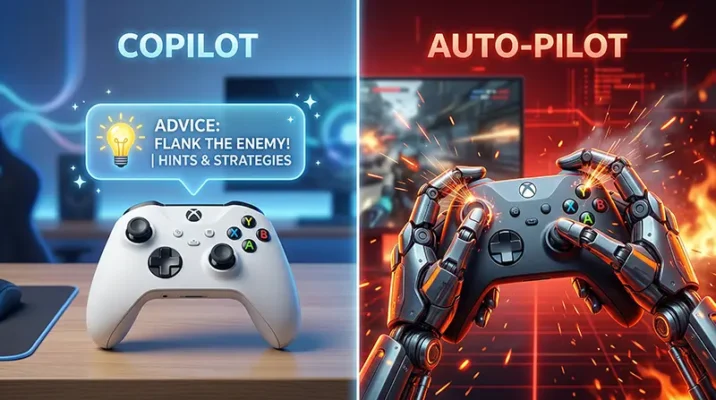
It’s easy to get confused between the AI features Microsoft has already released and what’s coming next in this Microsoft Xbox patent. Let’s clearly define the difference between the currently available Copilot and the newly revealed auto-pilot tech.
Gaming Copilot: Your Voice-Activated Sidekick
Late in 2025, Microsoft launched the Xbox Gaming Copilot in beta for PC and mobile users. Think of this as your smart, conversational buddy. Powered by advanced language models and integrated with Bing search, Gaming Copilot watches your screen and answers questions. If you ask, “How do I beat this enemy?”, Copilot uses voice mode to give you tactical advice, pull up your inventory, or suggest a different weapon based on your current build. It’s an interactive guide, but it strictly does not press the buttons for you.
Auto-Pilot: Handing Over the Controller
The new Microsoft Xbox patent, however, is a massive leap forward from advice to direct action. Instead of telling you how to beat the boss for you, the system physically takes control of your character and executes the commands. This is the fundamental difference between a driving instructor giving you verbal tips from the passenger seat, and the instructor physically grabbing the steering wheel to swerve out of danger.
Unique Insight: Executing real-time physics-based commands in a 3D environment requires an entirely different architecture than text-based language models. Gaming Copilot relies on semantic understanding and natural language processing, while the auto-pilot requires spatial awareness, timing, and reinforcement learning. Microsoft is essentially building two separate, highly specialized AI “brains” for your Xbox ecosystem.
Will This Ruin the “Soul” of Gaming? The Community Reaction
The moment news of this Microsoft Xbox patent hit global forums and Pakistani gaming Facebook groups, the community response was incredibly polarized. Is having an AI take over gameplay a revolutionary quality-of-life update, or does it completely ruin the very essence of playing video games?
The Debate Over Challenge vs. Convenience
Hardcore gamers argue that the entire point of a video game is to overcome challenges. The dopamine rush you get after finally defeating a boss after countless attempts is what makes gaming so rewarding. Some players feel that an “auto-win” button dilutes the prestige of earning achievements. What’s the point of unlocking a Platinum trophy or a rare achievement if an AI earned it for you?
On the flip side, many casual gamers—especially professionals in Pakistan juggling long work hours, university studies, and family responsibilities—just want to experience the story. They simply do not have the free hours required to memorize a boss’s 15-hit combo attack pattern. For them, this Microsoft AI gaming patent is a blessing that respects their limited time.
Sony’s Similar “Ghost Player” AI
Interestingly, Microsoft isn’t the only tech giant exploring this controversial territory. Sony recently filed a similar patent for a Sony Ghost player AI. Sony’s version offers a “Guide Mode” where an AI ghost visually shows you the path, and a “Complete Mode” where it literally takes the wheel and plays for you. This proves that the auto-pilot era isn’t just an experimental Xbox gimmick; it is rapidly becoming the definitive future of console gaming.
The Leadership Shift: Asha Sharma’s Vision for Xbox and AI
You cannot fully grasp Xbox’s AI ambitions without understanding the massive recent leadership shake-up at Microsoft. In February 2026, veteran Phil Spencer retired, and Asha Sharma stepped in as the new Asha Sharma Xbox CEO. Her background isn’t strictly in traditional game development—it’s heavily rooted in cutting-edge AI and product leadership at tech giants like Meta.
“No Tolerance for Bad AI”
Naturally, the gaming community was initially worried. Would Xbox abandon beautifully crafted traditional games for cheap, AI-generated content? Sharma quickly addressed these concerns in her first major interviews, stating firmly that she has “no tolerance for bad AI” and promised not to flood the ecosystem with “soulless AI slop”. Her vision is to use AI as an invisible, highly efficient tool to enhance the player experience, not to replace the human creativity inherent in game design.
Focusing on Real Value for the Ecosystem
This leadership context is crucial for understanding the Microsoft Xbox patent. The patent isn’t about letting AI design a lazy game; it’s about using sophisticated machine learning to solve a very real user friction point. Furthermore, Microsoft has clarified that development studios won’t be forced to include AI tools if it doesn’t fit their specific artistic vision for a game.
How This Impacts the Pakistani Gaming Community
Let’s bring this home. What does this Microsoft Xbox patent mean for gamers in Lahore, Karachi, Islamabad, and across Pakistan? Our local gaming ecosystem has unique challenges and strengths that make this technology particularly intriguing.
Overcoming Connectivity and Ping Issues
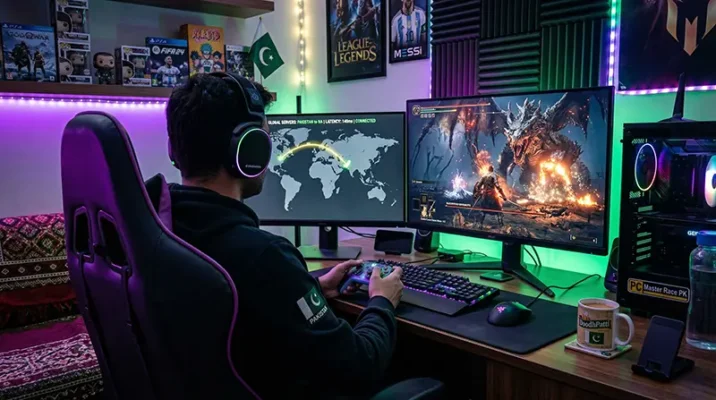
Pakistani gamers often struggle with high ping and routing issues since we don’t always have geographically close gaming servers. If you are playing a competitive multiplayer game, handing control over to a cloud-based AI-powered Xbox helper system could theoretically be ruined by a 150ms delay. However, for single-player narrative games, the AI can process the game state asynchronously via the cloud or even locally on next-gen console processors, making it highly feasible even on standard local broadband connections.
The Rise of Local “Human Helpers”
The patent explicitly mentions human helpers taking over your game session. This could birth an entirely new micro-economy! Imagine a highly skilled Tekken 8 or Dark Souls player in Pakistan getting paid via micro-transactions to jump into a Western gamer’s session and beat a boss for them. Pakistan already has a massive, world-class esports talent pool. This system could allow local pros to monetize their skills officially through the Xbox ecosystem, acting as verified “mercenary” players for those in need.
Unique Insight: In Pakistan, gaming is a highly social, communal activity. We often physically pass the controller to an older sibling or friend when a level gets too hard. This Microsoft Xbox patent essentially digitalizes the “bhai, yeh level pass kar do” (brother, pass this level for me) experience, scaling it to a global, cloud-based network!
Quick Takeaways
- Direct Intervention: The new Microsoft Xbox patent goes far beyond giving advice; it allows an AI or human expert to temporarily take over your game to beat difficult sections.
- Cloud-Powered Efficiency: The cloud-based Xbox system seamlessly transfers controller inputs and game state data, requiring less bandwidth than full video streaming.
- Distinct from Copilot: Unlike the existing Xbox Gaming Copilot, which only gives voice and text advice, this auto-pilot patent physically executes gameplay.
- Industry-Wide Trend: Sony has a similar Sony Ghost player AI patent, signaling that having an AI takes over gameplay is an inevitable industry shift.
- Driven by New Leadership: Under the new Asha Sharma Xbox CEO, Microsoft is prioritizing “good AI” that solves player frustration without ruining the artistic integrity of games.
- Opportunities for Pakistan: The human-helper aspect of the patent could allow highly skilled Pakistani gamers to monetize their expertise by assisting global players.
Conclusion
The revelation of this Microsoft Xbox patent marks a definitive turning point in the history of interactive entertainment. By allowing an AI gaming assistant or a remote human expert to step in and literally beat the boss for you, Microsoft is prioritizing accessibility, player retention, and continuous immersion over traditional, punishing difficulty spikes. While gaming purists may argue that it dilutes the inherent challenge of the medium, the reality is that providing optional tools to prevent players from rage-quitting is a net positive for the industry’s growth.
As we look toward the future of console gaming, especially under the AI-focused leadership of Asha Sharma, it is clear that our consoles are transforming from mere rendering boxes into intelligent, proactive companions. For Pakistani gamers, this could mean less frustration during load-shedding-interrupted sessions, a smoother experience despite ping challenges, and even exciting new avenues for our local esports talent to earn by becoming certified digital “helpers.” The auto-pilot era is arriving, and it is going to change how we play forever.
References
- Tech4Gamers. (2026, March 3). Microsoft Patents Reveal AI-Powered Xbox Helper System That Can Play Games for You. Retrieved from Tech4Gamers.
- CNET. (2025, September 23). Microsoft’s Gaming Copilot AI Now Can Help You Beat That Tough Boss on PC. Retrieved from CNET.
- IGN. (2026, February 21). ‘No Tolerance for Bad AI’: New Xbox Boss Responds to Concerns Around Her Microsoft Background. Retrieved from IGN.
- Futurism. (2026, January 8). Sony Patents AI That Plays Video Games for You If You Get Stuck. Retrieved from Futurism.
Microsoft Copilot+ PC Gaming Review: A Serious Rig or Just Hype?
Microsoft claims the new Microsoft Copilot+ PC is a "serious gaming rig." We analyze the performance, Snapdragon ARM issues, and pricing to see if you should buy or build.
Feb
AI Automation Crisis: Microsoft CEO Warns White-Collar Jobs Will Vanish by 2027
Microsoft AI CEO Mustafa Suleyman predicts AI automation will replace most white-collar work within 18 months. Read the full analysis and survival strategies here.
Feb
Frequently Asked Questions (FAQs)
No. The Microsoft AI gaming patent is designed strictly as a temporary help session. Control is only handed over to an AI-powered Xbox helper system or a human expert to help you get past a specific difficult segment, after which control is promptly returned to you.
The Xbox Gaming Copilot acts as an interactive guide, providing text and voice tips on strategies and game mechanics. The new auto-pilot patent actually executes the actions, literally pressing the digital buttons to beat the boss for you.
While Microsoft hasn’t officially detailed the final software implementation, related patent documents suggest they actively track who earns the achievements. It is highly likely that if the AI or a human helper clears a boss, the specific achievement for that boss might be disabled for the primary player to maintain fairness and community prestige.
Yes! Sony has filed a highly similar patent for a Sony Ghost player AI. It features a “Complete Mode” that actively takes over your PlayStation character to navigate hurdles on your behalf, confirming this is an industry-wide push.
Because the cloud-based Xbox system primarily transfers lightweight game state data and controller inputs rather than streaming high-resolution video feeds, it should be much lighter on your bandwidth. This makes it highly viable and responsive for gamers in Pakistan, even on standard broadband connections.
Let’s Hear From You!
The auto-pilot era of gaming is bound to shake up everything we know about how we play. Are you excited to have an AI step in when things get too tough, or do you believe that struggling through a boss fight is the whole point of gaming?
Drop your thoughts in the comments below! If you found this breakdown helpful, please share it with your gaming squad on Facebook, Twitter, and WhatsApp. Let’s get the debate started!
