Hardware
AMD AI Roadmap: Why RDNA 3.5 Graphics Are Here to Stay Until 2028

Feb
AMD AI advancements are shifting the landscape of mobile computing, but if you were hoping that AMD integrated graphics would keep making massive generational leaps every year, you might want to lower your expectations.
According to a newly leaked internal roadmap surfacing this week, Team Red appears to be settling into a controversial new strategy: “If it ain’t broke, don’t fix it.”
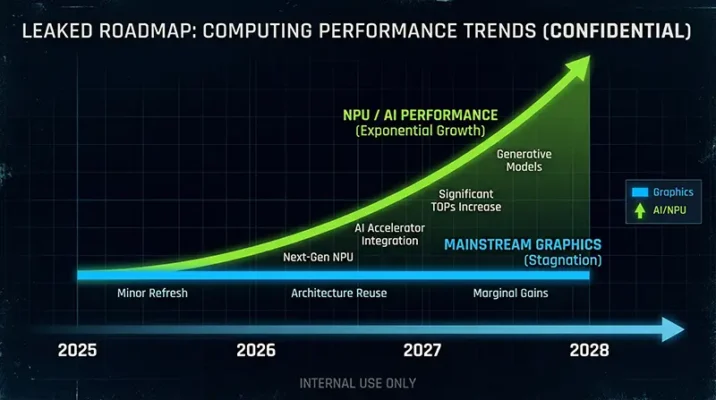
The leak suggests that the current RDNA 3.5 architecture—the same one powering today’s Ryzen AI 300 series—is set to remain the “mainstream” standard for mass-market laptop devices and budget handhelds all the way through 2028 and potentially 2029.
Here is a comprehensive look at why AMD is bifurcating its lineup and what it means for your next future purchase.
The Strategic Split: Mainstream vs. Premium
Historically, when AMD released a new architecture (like RDNA 2 or 3), it eventually trickled down to everything in their product stack. The leaked roadmap suggests a fundamental change in this philosophy. AMD is reportedly splitting its Integrated Graphics strategy into two distinct tiers to better target different consumer needs.
The “Good Enough” Tier (RDNA 3.5)
- Target: Mainstream laptops, budget handhelds, and mass-market office PCs.
- The Plan: This architecture will serve as the workhorse for years. It is power-efficient, cheap to manufacture, and handles basic gaming and Artificial Intelligence tasks well enough for 80% of users.
- The Vibe: Remember how long AMD kept using the “Vega” architecture? We might be seeing “Vega 2.0″—a reliable architecture that sticks around forever to keep costs down.
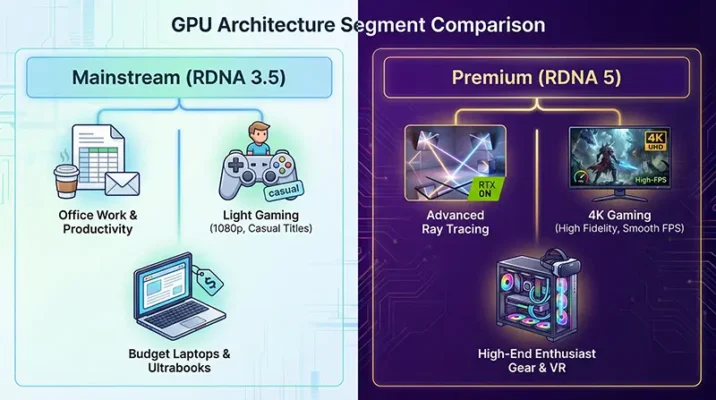
The “Premium” Tier (RDNA 5)
- Target: Halo mobile chips, top-tier handhelds (think “ROG Ally 3 Pro” or “Steam Deck 2″ successors), and specialized SoCs.
- The Plan: If you want cutting-edge features—better Ray Tracing, next-gen upscaling, and raw power—you will have to pay for it. RDNA 5 is strictly reserved for the high-end premium market.
Why is AMD Recycling Graphics Architecture?
It essentially comes down to Cost and Artificial Intelligence.
Manufacturing cutting-edge 3nm and 2nm chips is becoming incredibly expensive. Redesigning the graphics block every single year for a $500 laptop simply doesn’t make financial sense if the old architecture still plays popular titles like League of Legends or Counter-Strike 2 at 60FPS.
By recycling RDNA 3.5, AMD can keep the silicon area small and the yields high. This ensures that entry-level devices remain affordable, a critical factor for markets like Pakistan where price sensitivity is high.
The AI Pivot: NPU vs. GPU
The most significant driver of this change is the industry-wide obsession with Artificial Intelligence.
AMD is pouring its R&D budget into NPU (Neural Processing Units) for AI workloads and Zen 6/7 CPU cores. As operating systems like Windows 11 integrate more local AI features (like Copilot+), the demand for strong NPU performance is outpacing the demand for stronger integrated graphics in the mainstream sector.
Graphics for everyday users have hit a point of diminishing returns. For the average user who browses the web and streams video, RDNA 3.5 is already overkill. AMD is betting that consumers will care more about how fast their AI assistant responds than whether they can run Cyberpunk 2077 on Low settings.
Impact on the Steam Deck and Handheld Market
This is the most critical takeaway for handheld enthusiasts. The Steam Deck sparked a revolution, but if this roadmap holds true, the “budget” handheld market (the $300-$400 range) might stagnate graphically for the next 2-3 years.

- The Future: Expect cheap handhelds in 2027 to perform roughly the same as the Strix Point handhelds of 2025.
- The Upside: Developers will optimize heavily for RDNA 3.5 since it will be the “lowest common denominator” for millions of devices. This could lead to more stable games and better optimization, similar to how consoles benefit from fixed hardware.
- The Premium Gap: High-end devices like the next-gen ASUS ROG Ally or a potential Steam Deck 2 Pro might utilize RDNA 5, creating a massive performance gap between entry-level and flagship handhelds.
What This Means for Gamers in Pakistan
For our readers in Pakistan, this news is actually a mixed bag with some positive aspects. The cost of importing electronics has skyrocketed, making premium laptops out of reach for many students and professionals.
If AMD sticks with RDNA 3.5 for mainstream chips:
- Stable Pricing: We shouldn’t see a massive price hike in mid-range laptops (HP Victus, Lenovo LOQ, etc.) caused by expensive new graphics tech.
- Better Availability: Mature manufacturing nodes mean better supply chains, which can help keep local prices competitive.
- Longer Relevance: If you buy a Ryzen AI 300 series laptop today, it won’t feel obsolete next year. It will remain the “standard” spec for a long time.
Conclusion
AMD is essentially saying that for the average person, RDNA 3.5 is “mission accomplished.”
While enthusiasts might be disappointed that the tech isn’t trickling down faster, this strategy ensures that affordable laptops stay affordable—even if they aren’t getting any faster at gaming. The bifurcated strategy allows AMD to chase high margins in the premium sector with RDNA 5 while securing their dominance in the budget sector with reliable, cost-effective silicon.
For now, if you are planning to buy a future proof machine, paying extra for the highest tier might be the only way to ensure next-gen graphical performance.
Resources
- WindowsCentral: AMD leak suggests RDNA 3.5 extended to 2029 — RDNA 5 reserved for “premium” devices, raising big questions for future laptops and handhelds.
- TechPowerup: AMD to Use RDNA 3.5 iGPU Until 2029, RDNA 5 Only on “Premium” SKUs.
- SportsKeeda Tech: AMD will reportedly keep using RDNA 3.5 iGPUs till 2029, with RDNA 5 reserved for high-end iGPUs.
Frequently Asked Questions (FAQs)
The leaked internal roadmap suggests that AMD will continue using the RDNA 3.5 architecture for mainstream gaming laptops and budget devices until 2028. Instead of yearly graphics upgrades, AMD is prioritizing Artificial Intelligence (AI) performance and cost efficiency for the mass market.
Yes, for most users. RDNA 3.5 is designed as a “good enough” solution for 1080p gaming in popular titles like League of Legends, Valorant, and Overwatch. However, for AAA gaming with high Ray Tracing settings, you will likely need the premium RDNA 5 tier or a dedicated GPU.
While not officially confirmed, the roadmap implies a split. Budget handhelds will likely stick with RDNA 3.5 to keep prices affordable. A potential “Pro” version or the Steam Deck 2 might utilize the premium RDNA 5 architecture, but likely at a much higher price point.
The industry is pivoting toward AI. Manufacturing costs for 3nm and 2nm chips are high, so AMD is “recycling” the proven RDNA 3.5 graphics to save silicon space for powerful NPU (Neural Processing Units) that power features like Windows Copilot+.
Based on this leak, you should feel comfortable buying now. Since the integrated graphics performance for mainstream laptops isn’t expected to jump significantly in 2026 or 2027, a current Ryzen AI 300 series laptop will remain relevant and “future-proof” for several years.
Related Blogs
AMD RDNA 5 Release Date: Rumored Delay to 2027 Could Be Disastrous for Gamers
New reports suggest the AMD RDNA 5 release date may slip to 2027, arriving after the NVIDIA RTX 60 series. Here is why "Medusa" might be too late.
Jan
NVIDIA DLSS 4.5 Leak: Massive 6x AI Frame Gen & Performance Revolution
Verified leaks reveal NVIDIA DLSS 4.5 ahead of CES 2026! Discover the new 6x Dynamic Frame Gen, AI upscaling, and what this means for your gaming PC.
3 Comments
Jan

GPU Shortage 2.0? NVIDIA Reportedly Cutting Consumer Production by 40%
Is GPU Shortage 2.0 imminent? We break down explosive reports that NVIDIA is slashing consumer production by 40% heading into 2026. Discover why the company is shifting priority to AI, which RTX 50-series cards will be hit hardest by stockouts, and why analysts predict a 20% price hike by February.
Dec
NVIDIA AMD GPU Price Hikes: RTX 5090 Nightmare Scenario ($5,000?)
The hardware market is facing a potential collapse. A viral report from South Korea indicates that NVIDIA and AMD are preparing "creeping" monthly price hikes due to skyrocketing memory costs. With the flagship RTX 5090 potentially reaching a staggering $5,000 by year's end, we break down the nightmare scenario for gamers.
Jan