

Hardware
The Ultimate Portable Upgrade? Lenovo Legion Rollable Concept Stuns CES 2026
Jan
If you are a serious gamer or a professional video editor, you know the dilemma: Laptops give you freedom, but they often feel restrictive compared to your dual-monitor setup at home. While they will never truly replace the dedicated monitors on your desk, the gap between “desktop power” and “mobile convenience” is shrinking.
At CES 2026, Lenovo unveiled a vision of the future that attempts to bridge this gap perfectly.
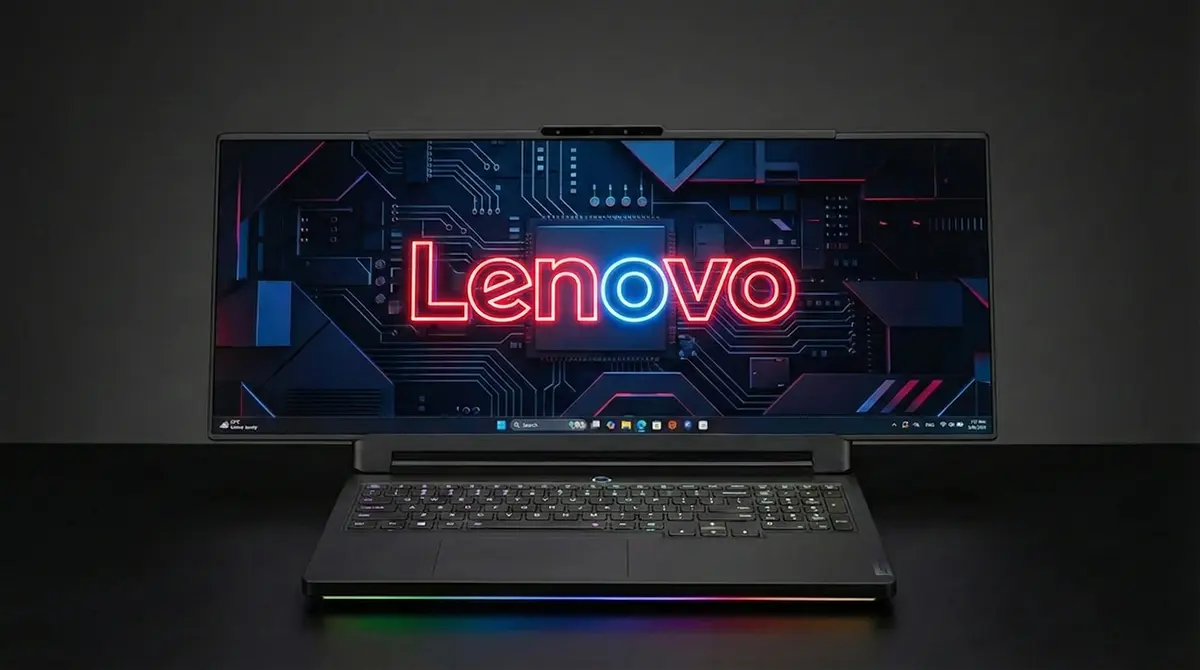
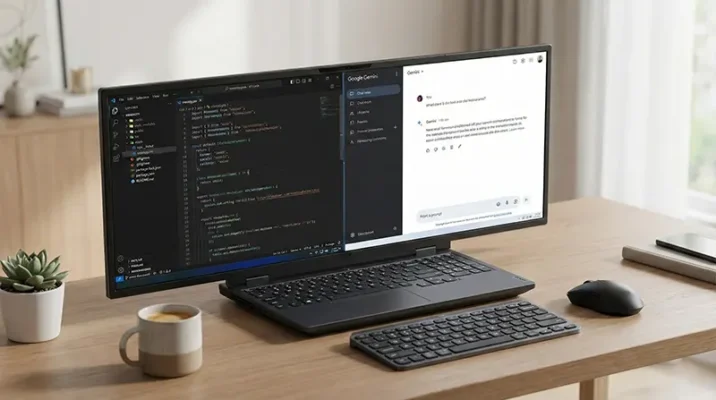
In a demo that captured the attention of the tech world, the company revealed the Lenovo Legion Rollable concept—a device that transforms from a standard laptop into an ultra-wide workstation. It isn’t trying to kill the monitor; it’s trying to give you a taste of that desktop experience wherever you go.
Here is everything you need to know about this innovative “Transformer” of the PC world.
A New Standard for Portable Gaming
The Lenovo Legion Rollable is not designed to make you throw away your desktop setup. Instead, it reimagines what a portable rig can achieve when you are away from home. At first glance, the device looks like a standard, slightly thicker gaming laptop with a 16-inch screen (16:9 aspect ratio). It fits into your backpack just like any other Lenovo laptop.
However, with the push of a button, dual motors inside the chassis activate. The screen physically unrolls horizontally, extending the display like a futuristic scroll. This expands your view significantly, offering an ultra-wide canvas that mimics a multi-monitor feel without the bulk of external peripherals.
For users in Pakistan and globally who travel for esports or creative work, this concept addresses a major pain point: getting big-screen productivity in a small-screen package.
Key Takeaway: This device is the ultimate travel companion, offering a “mini-desktop” experience that you can deploy in a hotel room or coffee shop.
The “Magic” Scroll: How It Works
How do you fit a 24-inch experience into a 16-inch chassis? The secret lies in flexible display technology. Unlike traditional rigid glass, this Lenovo Legion concept uses a specialized polymer-based OLED panel.
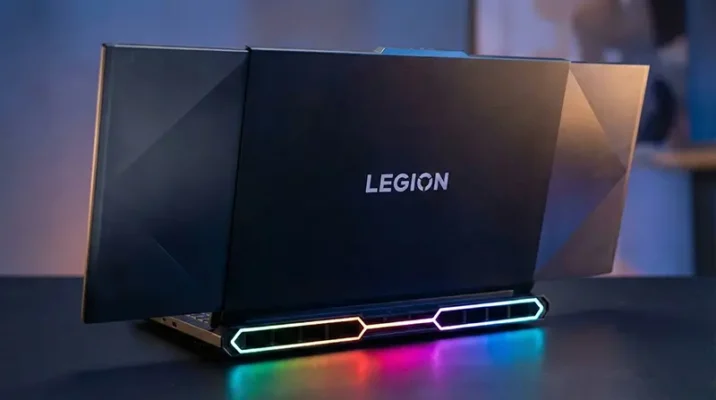
When in standard mode, the extra screen real estate is neatly rolled up inside the laptop’s body, hidden from view. When you need more space, a “tension-based system” extends the screen, keeping it flat and stable.
Why Not Foldable?
We have seen foldable devices, but “rolling” offers a distinct advantage for gaming. Foldables often have a visible crease. By rolling the screen around an internal axis, Lenovo creates a smooth, uninterrupted surface that is perfect for immersion.
Three Distinct Modes for Every User
This device is a true transformer, designed to adapt to your environment and workflow. It features three distinct modes:
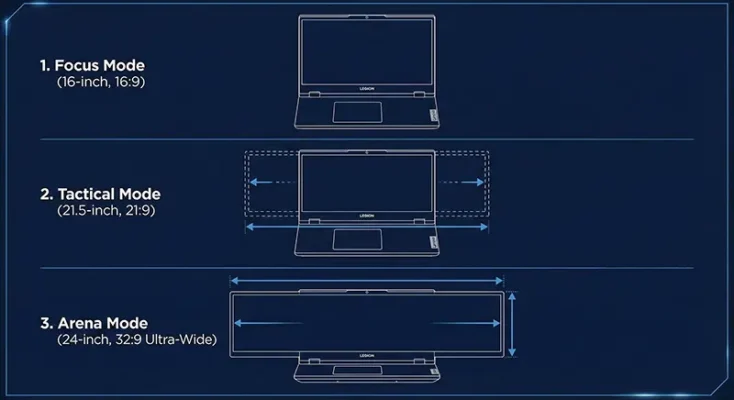
1. Focus Mode (16-inch)
- Aspect Ratio: 16:9
- Best For: Competitive FPS gaming, web browsing, and use in tight spaces (like airplane trays).
- Why Use It: When space is limited, it functions exactly like a premium 16-inch Lenovo laptop.
2. Tactical Mode (21.5-inch)
- Aspect Ratio: 21:9
- Best For: Video editing, coding, and immersive RPGs.
- Why Use It: This mode widens your peripheral vision, giving you extra horizontal space for timelines in Premiere Pro or wider field-of-view in games, bridging the gap between laptop and desktop.
3. Arena Mode (24-inch)
- Aspect Ratio: 32:9 (Ultra-Wide)
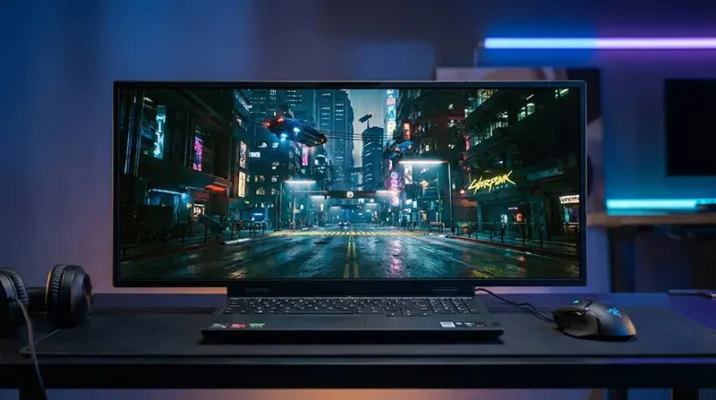
- Best For: Racing simulators, flight sims, and massive multitasking.
- Why Use It: The screen stretches to a massive 23.8 inches. It delivers an “Ultra-Wide” experience that allows you to have multiple full-sized windows open side-by-side, perfect for productivity on the road.
Unmatched Power: RTX 5090 and OLED Tech
Driving a wider screen requires serious power, and this concept doesn’t compromise. It is built to deliver desktop-class performance in a mobile form factor.
According to CES 2026 briefings, the concept unit features:
- GPU: The powerful RTX 5090 (Mobile). This chip ensures that even when the screen is fully expanded, your frame rates remain high.
- Display: A flexible OLED panel (likely “PureSight”) with a 120Hz+ refresh rate. The OLED tech guarantees deep blacks and vibrant colors, essential for both high-end gaming and color-accurate video editing.
- Durability: The mechanism is tested for thousands of cycles to ensure reliability.
Prototype Status: What to Expect
A Glimpse into the Future
It is important to manage expectations. Lenovo has labeled this a “Proof of Concept.” Unlike the standard Lenovo Legion models available in stores today, the Rollable is not ready for mass production just yet.
Why It’s Not “The End of Monitors”
While impressive, this technology is expensive and complex. Raw materials like flexible OLED panels and the RTX 5090 drive costs up significantly—analysts estimate a retail version could cost over $4,500. Additionally, dedicated desktop monitors still offer superior size, refresh rates, and longevity without moving mechanical parts.
This device isn’t here to replace your home setup; it’s here to make sure you don’t miss it quite so much when you leave the house.
Verdict: The Future of Travel Gaming
This innovation is one of the highlights of CES 2026. In a market often saturated with minor upgrades, it is refreshing to see a company pushing the boundaries of form factor.
At best, this will be the ultimate upgrade for laptop users and “digital nomads” who demand excellence on the go. It won’t kill the monitor market, but for the traveling gamer, it might just be the best companion you could ask for.
Sources
- Lenovo: Lenovo Levels Up CES with Legion Pro Rollable Concept and Latest Gaming Devices
Frequently Asked Questions (FAQs)
Currently, Lenovo has officially labeled this device as a “Proof of Concept,” meaning it is not ready for mass production yet. While there is no official release date, industry experts estimate similar technology could reach consumers around 2027 or 2028.
Because the technology uses cutting-edge flexible OLED panels and the new NVIDIA RTX 5090, it is expensive to manufacture. If sold today, analysts predict the price would be upwards of $4,500 to $5,000.
No. Unlike foldable devices that hinge in the middle, the Lenovo Legion Rollable uses a “tension-based system” that physically unrolls the screen from inside the chassis. This mechanism ensures the flexible OLED panel stays flat and wrinkle-free when expanded.
The concept unit displayed at CES 2026 is a powerhouse. It features the mobile NVIDIA GeForce RTX 5090 GPU and a flexible OLED display (likely PureSight) with a refresh rate of 120Hz or higher.
No, this specific concept device is not available for purchase in Pakistan or globally as it is a prototype. However, standard Lenovo Legion gaming laptops with high-end specs are currently available at major tech retailers across Karachi, Lahore, and Islamabad.
