


Feb
Welcome to the cutting edge of visual artificial intelligence! If you’ve been following the AI space, you know how quickly things evolve. Just when we thought AI image generation couldn’t get any better or faster, Google DeepMind dropped a massive update. Enter Nano Banana 2, the highly anticipated successor to the viral AI image model that took the internet by storm last year.
In this comprehensive guide, we are diving deep into everything you need to know about Nano Banana 2. Whether you are a tech enthusiast in Lahore, a freelance graphic designer in Karachi, or a digital marketer in Islamabad, this article will show you how Google’s latest text-to-image powerhouse is shifting the paradigm. We will explore the underlying technology (officially known as Gemini 3.1 Flash Image), review its standout features like 4K resolution and pinpoint text rendering, and explain how it perfectly balances lightning-fast speed with studio-level quality.
Ready to transform how you create visual content? Let’s explore why Nano Banana 2 is the only AI image editing platform you’ll want to use this year.
What is Nano Banana 2? The Tech Behind the Name
If the name sounds playful, the technology behind it is anything but a joke. Nano Banana 2 is Google’s brand-new, state-of-the-art image generation and editing model. But what exactly powers this beast?
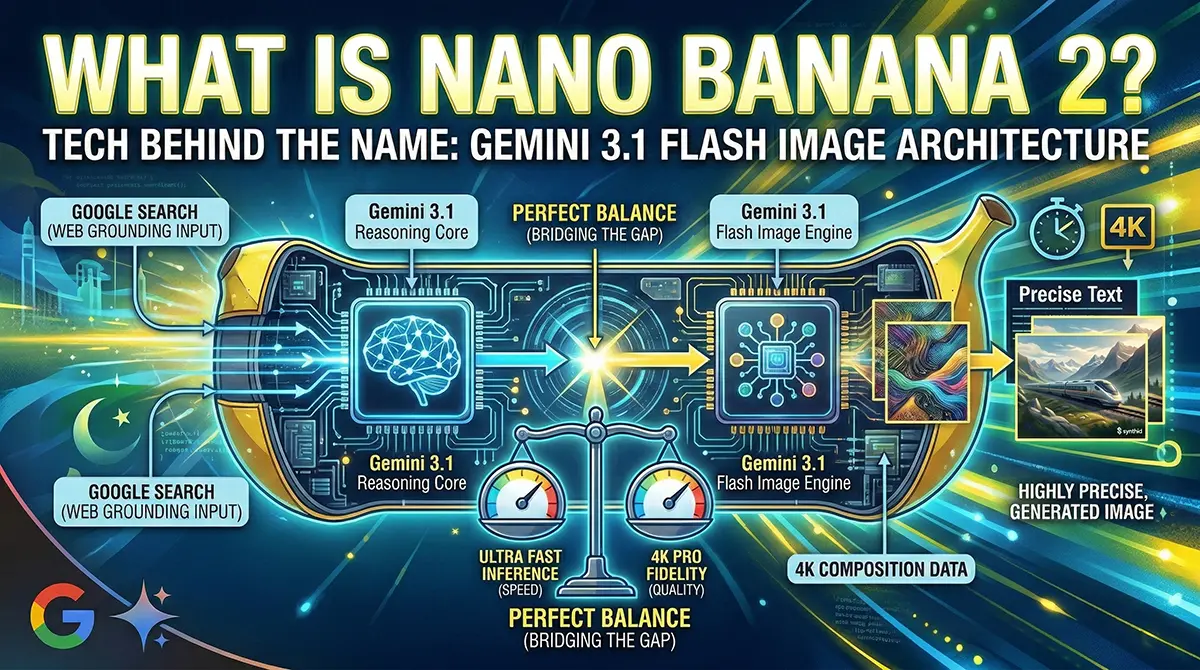
Gemini 3.1 Flash Image Explained
Under the hood, Nano Banana 2 is technically named Gemini 3.1 Flash Image [1]. While previous models were either built for raw speed (often sacrificing fine details) or heavy reasoning (which took much longer to process), this new architecture brings the deep, intelligent reasoning of Gemini Flash to visual creation. It essentially acts as a multi-modal engine that understands not just the objects in your prompt, but the context of how they should interact in a 3D space.
For developers and tech enthusiasts, this means you get a model that understands complex, multi-layered prompts. If you ask it to “create a photorealistic image of a vintage car driving through a neon-lit street in rainy weather with a glowing sign saying ‘Future’,” the Gemini 3.1 Flash Image engine computes the lighting, reflections, and typography simultaneously.
Speed vs. Quality: Bridging the Gap
One unique insight about the evolution of text-to-image AI tools is the historical trade-off between speed and fidelity. In the past, if you wanted a 4K image with complex textures, you had to wait minutes, burning through expensive computing credits. Nano Banana 2 collapses this trade-off [2].
By optimizing the inference process, Google has made it possible to rapidly iterate. You can generate a base image, realize the lighting is slightly off, and type, “Change the lighting to Golden Hour,” getting a refreshed, high-quality output almost instantly. For a creative director or a social media manager running a fast-paced campaign, this speed is nothing short of revolutionary.
Top Features That Make Nano Banana 2 a Game Changer
So, what exactly can you do with this new model that you couldn’t do before? Let’s break down the flagship features that are making headlines in the AI world.
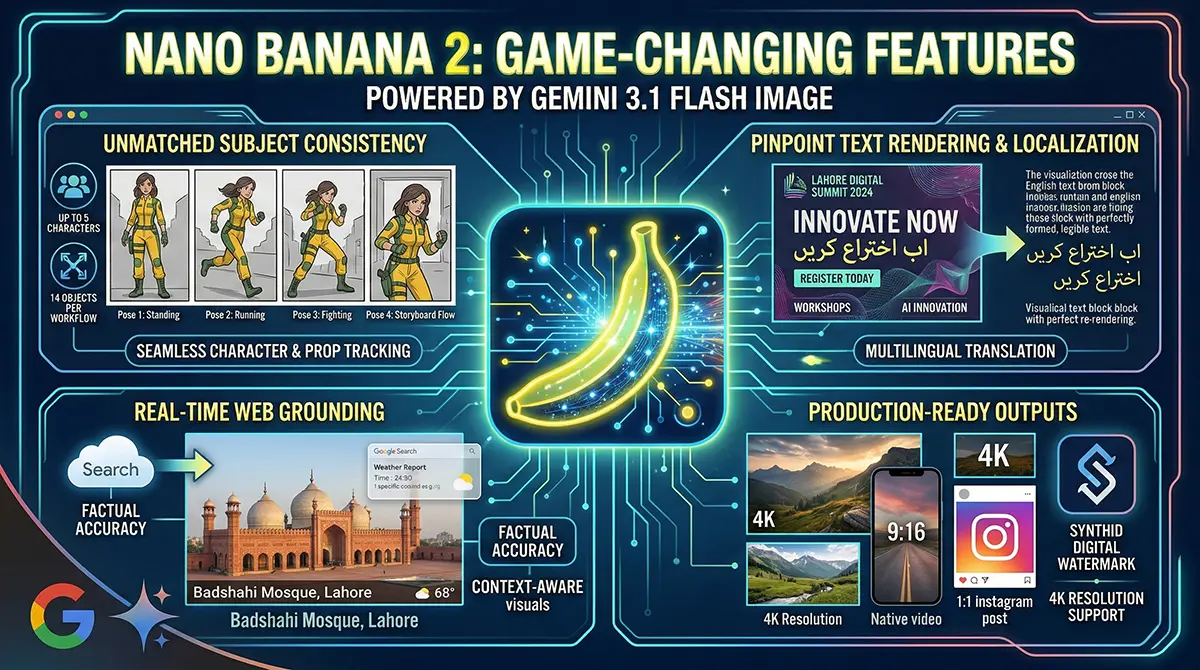
Unmatched Subject Consistency
Anyone who has used an AI image generator Google or otherwise knows the ultimate frustration: you generate a fantastic character, but when you try to put them in a different pose or setting, they look completely different.
Nano Banana 2 solves this with native consistent AI characters tracking [3]. You can maintain the exact resemblance of up to five distinct characters and 14 specific objects within a single creative workflow. Imagine you are creating a comic book or a storyboard for a TV commercial. You can introduce your hero in panel one, and in panel two, instruct the AI to “show the same character running away from an explosion,” and their facial features, clothing, and proportions will remain perfectly intact. This level of semantic editing—without needing messy manual masking—is a massive leap forward.
Pinpoint Text Rendering and Translation
Historically, AI models have struggled with typography, often spitting out alien-looking symbols instead of actual letters. Nano Banana 2 introduces near-perfect text rendering in AI images. Whether you are designing a digital greeting card, a sleek minimalist logo, or a complex flat-lay infographic, the text is crisp, clear, and perfectly integrated into the lighting and perspective of the scene.
But Google didn’t stop there. They integrated live translation capabilities. You can generate an ad mockup with an English slogan, and then simply prompt the AI to “translate the text in the image to Urdu.” The AI not only translates the text but re-renders it flawlessly into the design.
Real-Time Web Grounding for Accuracy
Here is a unique perspective that separates Nano Banana 2 from competitors like Midjourney: it has real-time access to the internet. Because it relies on the Gemini ecosystem, it utilizes real-time web information to ground its images in reality [1].
If you prompt it to generate an image of the “current skyline of Dubai during today’s weather,” it actually queries Google Search, checks the live weather data and recent architectural updates, and generates an image reflecting reality. This feature, showcased in Google’s “Window Seat” demo, ensures that your visuals aren’t just aesthetically pleasing, but factually accurate. Furthermore, all outputs include SynthID digital watermarking to ensure transparency regarding AI-generated content [4].
How Nano Banana 2 Empowers Pakistani Creators and Businesses
Pakistan has a booming gig economy, a rapidly growing e-commerce sector, and a vibrant community of digital creators. Here is how Nano Banana 2 directly impacts the local market.
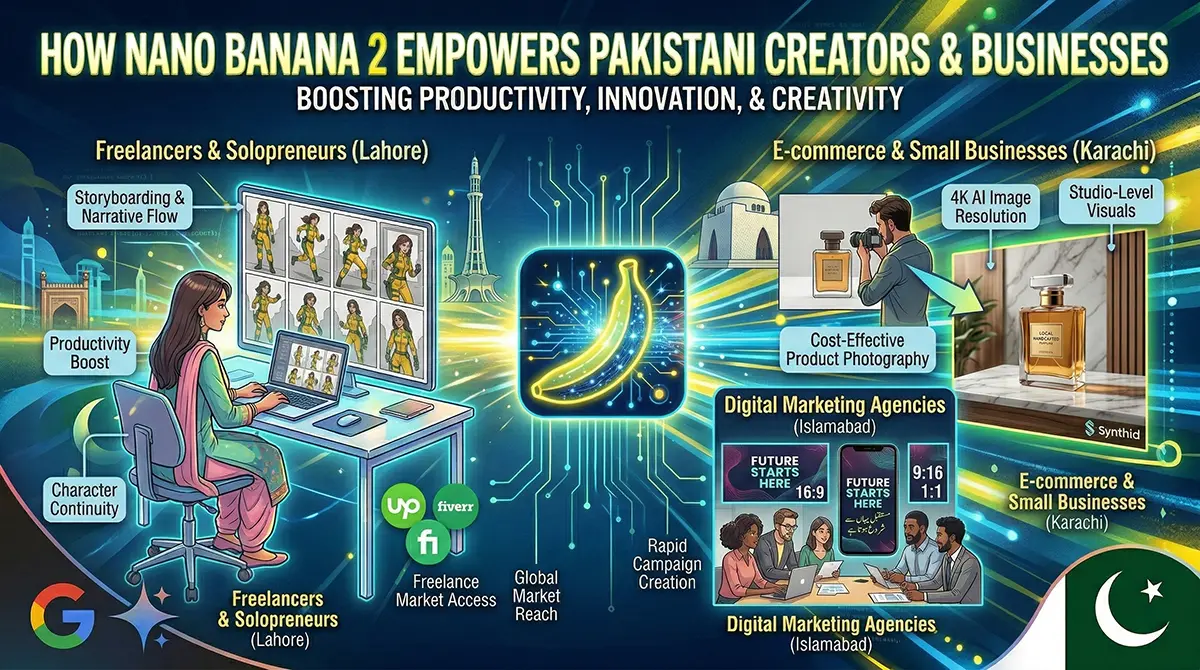
Revolutionizing E-commerce and Social Media Marketing
Running an e-commerce store on Daraz or Shopify? High-quality product photography is notoriously expensive. With Nano Banana 2, you can take a basic snapshot of your product and use the “Context-Aware Editing” to transport it anywhere. You can prompt, “Place this perfume bottle on a marble podium with a soft pink background and natural window light,” and get a professional-grade shot in seconds. Because it supports native aspect ratios and 4K AI image resolution, you can seamlessly export vertical formats for Instagram Reels or TikTok, and widescreen formats for web banners.
From Freelancers to Software Houses: A Productivity Boost
Pakistan consistently ranks among the top countries for freelancing. Designers and marketers on platforms like Fiverr and Upwork can use these free AI tools for freelancers (available in basic tiers) to dramatically speed up their workflow. Instead of spending three hours searching stock photo sites for the perfect corporate image, a freelancer can generate exactly what the client wants in three minutes.
Furthermore, software houses building apps can leverage the Google Vertex AI API to integrate these image generation capabilities directly into their own local products, opening up new avenues for content creation AI Pakistan [4].
Step-by-Step Guide: How to Access and Use Nano Banana 2 Today
You don’t need a Ph.D. in computer science to start generating stunning visuals. Google has democratized access across multiple platforms.
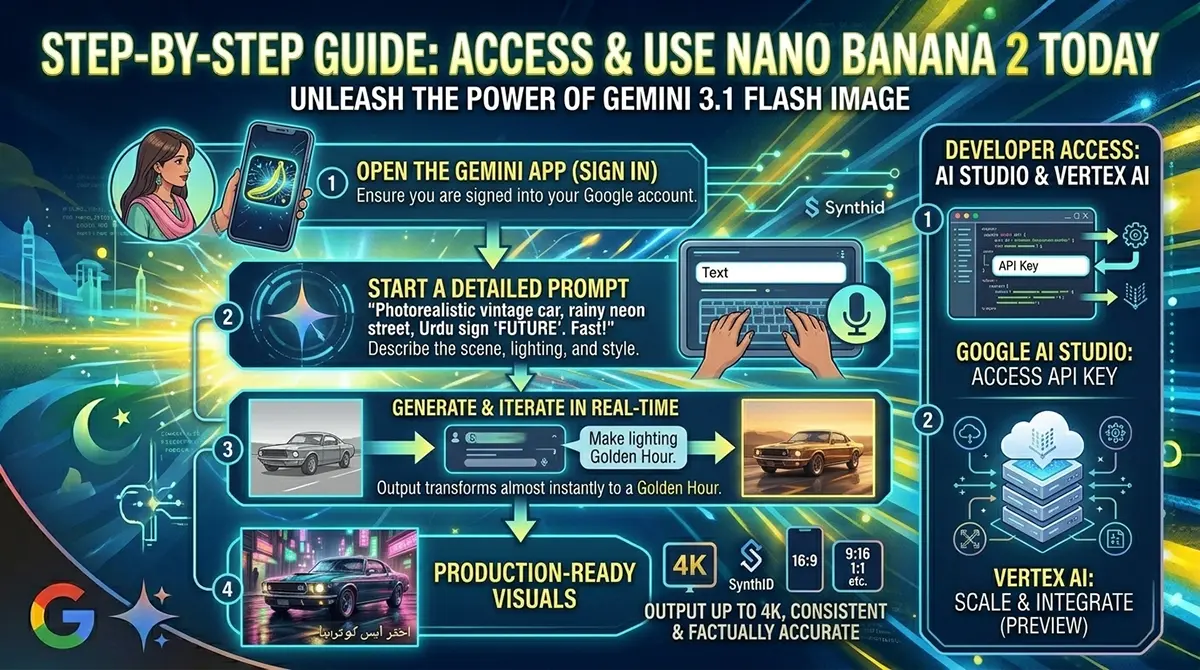
Using it via the Gemini App
The easiest way for the general public to generate images in Gemini is through the official app or web interface.
- Open the Gemini App: Ensure you are signed into your Google account.
- Start a Prompt: Click the “Create Image” icon (often represented by a banana or a sparkle icon).
- Be Descriptive: Type a detailed prompt. For example: “Create a 16:9 4K image of a futuristic bullet train traveling through the mountains of Gilgit-Baltistan during autumn.”
- Iterate and Edit: Once the image is generated, you can converse with the AI to tweak it. Say, “Make the train sleek silver instead of white,” and watch the magic happen in real-time.
For Developers: AI Studio and Vertex AI
For the tech-oriented crowd looking to build apps, Nano Banana 2 is available in preview via Google AI Studio and the Google Vertex AI API [1]. You can write scripts that pass natural language instructions along with up to 14 reference images to achieve highly complex compositing, style transfer, and semantic editing programmatically.
Nano Banana 2 vs. Nano Banana Pro: Which One Do You Need?
If you are confused by the naming conventions, you aren’t alone. Let’s clear up the Nano Banana vs Nano Banana Pro debate.
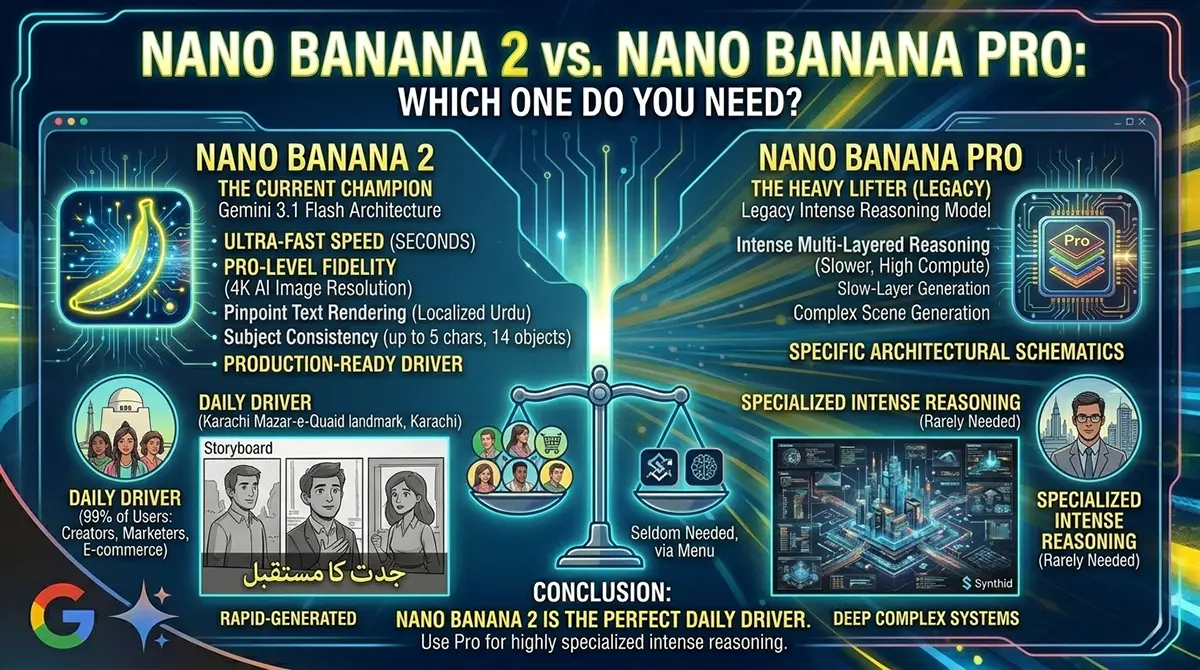
- Nano Banana (Original): The viral sensation from last year. Fast, fun, but struggled with complex anatomy (like hands) and accurate text.
- Nano Banana Pro: Launched a few months later. It acted as the “heavy lifter,” providing incredible 4K detail, deep reasoning, and complex scene generation, but it was slower and consumed more compute power.
- Nano Banana 2: The current champion. It replaces the original model by taking the Pro-level features (text accuracy, 4K resolution, world knowledge) and running them on the ultra-fast Gemini 3.1 Flash architecture [5].
For 99% of users, Nano Banana 2 is the perfect daily driver. If you require intense, multi-layered reasoning for a highly specific architectural schematic, AI Pro/Ultra subscribers can still access the old Pro model via the Gemini app’s three-dot menu, but you will rarely need to.
Conclusion
The release of Nano Banana 2 marks a pivotal shift in the generative AI landscape. It is no longer just about creating funny, surreal images for social media; it’s about deploying production-grade, photorealistic visuals at scale. By combining the blistering speed of the Gemini Flash engine with Pro-level fidelity, Google has handed creators a tool of unprecedented power.
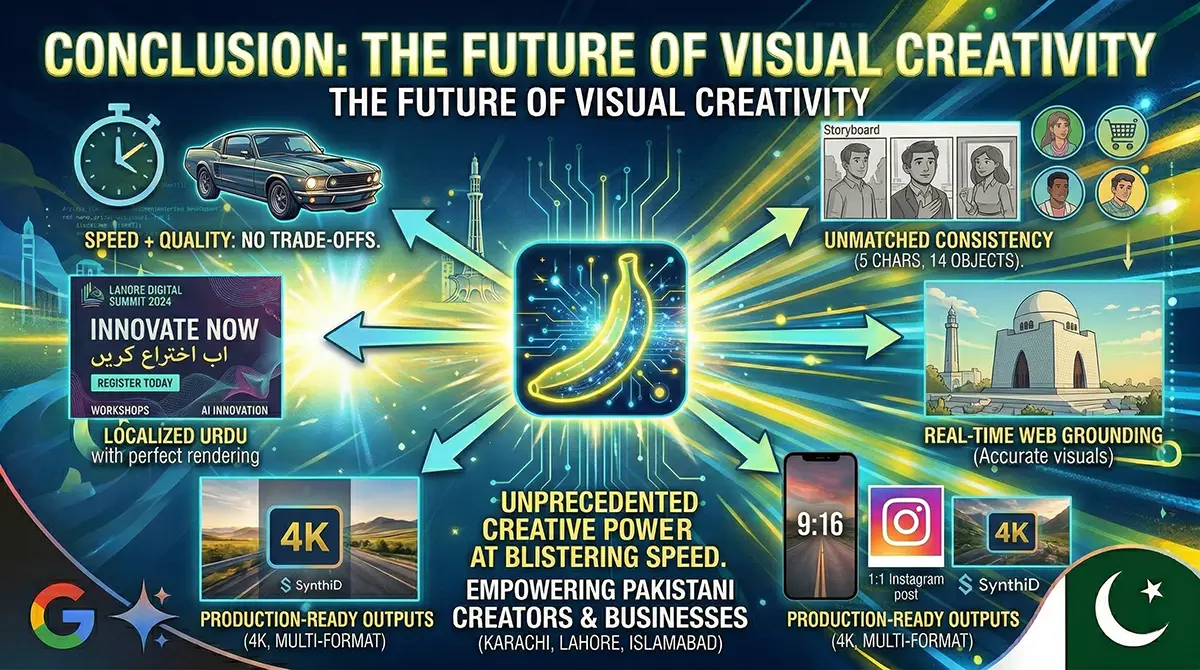
From unparalleled subject consistency that allows for robust storyboarding, to flawless text rendering and real-time web grounding, this model solves the pain points that have plagued digital artists and marketers for the last two years. For the tech-savvy professionals and ambitious freelancers in Pakistan, adopting this technology early offers a massive competitive advantage on the global stage.
Don’t let the AI revolution pass you by. Log into your Google account today and start experimenting with the future of visual creativity.
Quick Takeaways
- Lightning Fast & High Quality: Nano Banana 2 uses the Gemini 3.1 Flash Image architecture to deliver Pro-level image fidelity in mere seconds.
- Unmatched Subject Consistency: You can now maintain the exact look of up to 5 characters and 14 objects across multiple generated images—perfect for storyboarding.
- Flawless Text Rendering: Say goodbye to gibberish AI text. The new model creates highly accurate, legible text for logos, flyers, and infographics.
- Real-Time Web Grounding: It pulls live information from Google Search (like current weather or specific landmarks) to generate highly accurate and context-aware visuals.
- Built-in Localization: Easily translate and render text in multiple languages directly inside the generated image.
- Production-Ready: Supports resolutions up to 4K and native aspect ratios (16:9, 9:16, 1:1, etc.) for every social media or print need.
- Wide Availability: Access it today via the Gemini App, Google Workspace, Google Ads, and Vertex AI.
References
- [1] Google Blog. (2026, February 26). Build with Nano Banana 2, our best image generation and editing model. Retrieved from Google AI Developers Blog.
- [2] Financial Content. (2026, February 27). Nano Banana Multi-Model AI Image Platform Launched as Nano Banana 2 Pushes Image Generation Into the Production Era.
- [3] PCMag. (2026, February 27). Google Rolls Out Nano Banana 2, Borrows 2 Notable Features From Pro Model.
- [4] Google Cloud Blog. (2026, February 27). Bringing Nano Banana 2 to enterprise.
- [5] CNET. (2026, February 26). Nano Banana 2 Is Here: What Changed in Google’s Popular AI Image Tool.
Frequently Asked Questions (FAQs)
Yes, basic usage is available for free within the standard Gemini app for users 18 and older. However, access to higher 4K AI image resolution and increased daily quotas may require a premium Google One AI Plus or Ultra subscription.
Unlike older models, it features advanced text rendering in AI images. It can generate crisp, accurate typography for posters and logos, and even supports in-image localization to translate text into multiple languages seamlessly.
Absolutely! The new AI image editing platform allows you to upload up to 14 reference images. You can use natural language prompts to perform semantic edits, style transfers, or combine elements from different photos.
Its integration with Google Search gives it a unique edge. Using real-time web information, it can accurately render real-world locations, weather, and landmarks, resulting in less hallucination and higher factual accuracy.
Google takes responsibility seriously. All outputs generated by Nano Banana 2 include SynthID digital watermarking and C2PA Content Credentials. This creates a transparent, traceable history proving the image was AI-generated, protecting digital authenticity.
Join the Conversation
We’d love to hear how you are using these cutting-edge tools! Have you tried generating any local Pakistani landmarks or translating text into Urdu using the new AI?
Drop a comment below sharing your most creative Nano Banana 2 prompt, and don’t forget to share this article with your fellow designers and tech enthusiasts on LinkedIn and Twitter!
What will you create first with Nano Banana 2?
