

Hardware
NVIDIA DLSS 4.5 Leak: Massive 6x AI Frame Gen & Performance Revolution

Jan
If you thought the RTX 50 series launch couldn’t get more controversial, buckle up. Just ahead of the official CES 2026 keynote, massive details have leaked regarding the next leap in AI graphics technology: NVIDIA DLSS 4.5.
For gamers in Pakistan and across the globe, this leak represents a potential paradigm shift in how we perceive performance and visual fidelity. According to verified insiders, NVIDIA is preparing to unveil a “2nd Generation Transformer Model” and a new “Dynamic Multi-Frame Generation” feature. These tools could push gaming frame rates higher than ever before. But, as always, there is a catch.
Here is everything we know about the NVIDIA DLSS 4.5 announcement scheduled for tomorrow and how it impacts the future of your gaming PC.
The Headline Feature: Dynamic 6x Frame Generation
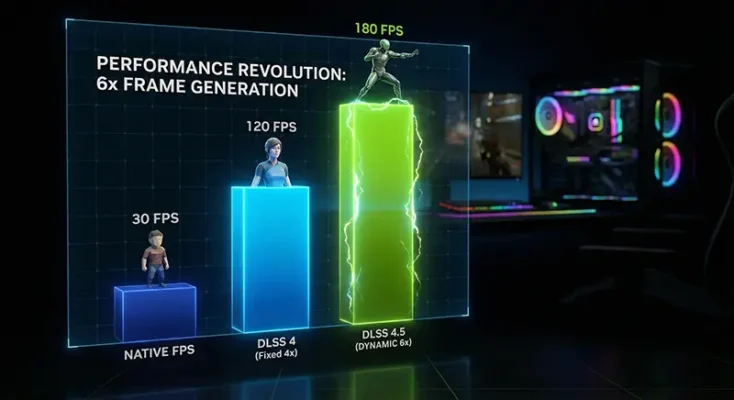
The absolute headline grabber of this leak is the aggressive evolution of Frame Generation. Since its inception, AI-driven frame generation has been the secret sauce behind the dominance of the NVIDIA graphics card.
Currently, DLSS 4 allows for a fixed 4x frame multiplier. This means the GPU generates three synthetic frames for every one real frame rendered by the game engine. However, NVIDIA DLSS 4.5 is reportedly unlocking a massive upgrade: Dynamic Multi-Frame Generation (MFG) with a variable range of 3x to 6x.
Why “Dynamic” Matters
In previous iterations, the multiplier was static. If you set it to 4x, it stayed at 4x, regardless of whether the scene was simple or complex.
The new NVIDIA DLSS 4.5 changes the game. It utilizes an advanced AI algorithm to analyze your gameplay and system overhead in real-time. If there is computational headroom, the system can dynamically push up to 5 synthesized frames between real frames.
The Result: A strictly next-gen title running at a native 30 FPS could theoretically display at a blistering 180 FPS on a high-refresh-rate monitor.
How Dynamic Multi-Frame Generation Works
To understand the magnitude of this shift for your gaming PC, we have to look at the technology under the hood. The new “Dynamic” approach relies heavily on the architecture expected in the upcoming RTX 50 series.
-
Real-Time Analysis: The GPU constantly monitors the “optical flow” data—the movement of pixels between frames.
-
Adaptive Workloads: In scenes with little movement (like staring at a landscape), the AI ramps up generation to 6x for maximum smoothness.
-
Latency Management: In fast-paced combat where input latency matters, the system may intelligently scale back to 3x or 4x to ensure your mouse clicks register instantly.
This fluidity suggests that NVIDIA is trying to bridge the gap between “visual smoothness” and “responsive feel,” a common critique of previous Frame Generation technologies.
The 2nd Gen Transformer: Solving Visual Artifacts
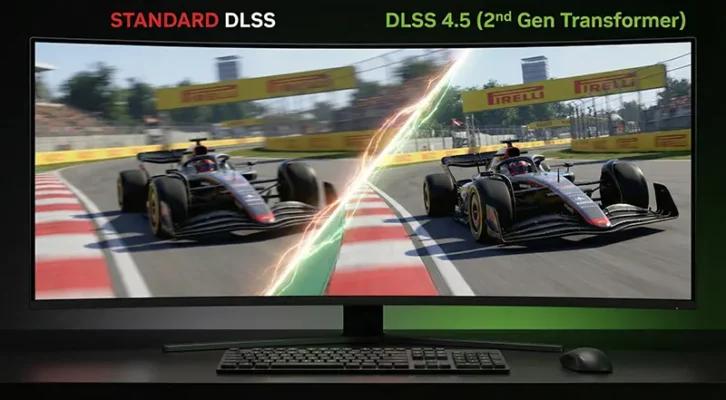
For enthusiasts who care more about pristine image quality than raw numbers, this section is the real news. NVIDIA DLSS 4.5 introduces a “2nd Generation Transformer Model” for its reconstruction algorithm.
Many users of current NVIDIA graphics cards have noted issues with “ghosting” or shimmering on fine details. NVIDIA claims this new model addresses the biggest complaints of the current generation.
Key Visual Improvements:
-
Better Temporal Stability: Significant reduction in shimmering on thin objects like chain-link fences, power lines, or distant foliage.
-
Reduced Ghosting: Fast-moving objects (like racing cars or birds in the sky) should no longer leave that faint “smear” trail behind them.
-
Cleaner AA (Anti-Aliasing): Sharp edges are preserved without the introduction of digital noise or artifacts common in lower-resolution upscaling.
This improvement in AI upscale technology ensures that even at lower native resolutions, the final image looks crisp, arguably better than native 4K in some scenarios.
Hardware Compatibility: The Good and The Bad
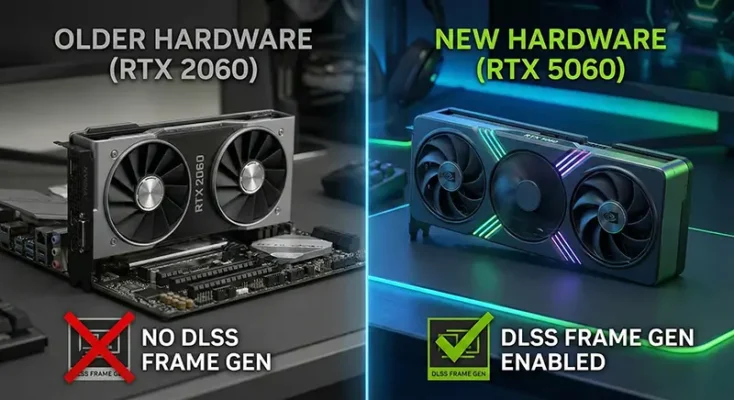
NVIDIA is continuing its controversial trend of segmenting features by hardware generation. This is where the news becomes a mixed bag for existing GPU owners.
The Good News
The 2nd Gen Transformer Model—the purely visual fix for image quality—will reportedly be available on ALL RTX GPUs immediately.
Whether you are still rocking a trusty RTX 2060 or a high-end RTX 4090, your games are about to look cleaner. This is a massive win for the longevity of older cards, proving NVIDIA hasn’t completely abandoned its legacy user base.
The Bad News
The headline feature, Dynamic Multi-Frame Generation (3x-6x), is launching as an exclusive to the RTX 50 Series.
This suggests the feature relies on specific hardware acceleration—likely related to the new “Blackwell” architecture—that older cards simply lack. Furthermore, while the visual updates launch immediately, the Dynamic MFG feature is slated for a Spring 2026 release.
Impact on the Pakistani Gaming Market
For the gaming community in Pakistan, these leaks carry significant weight. The fluctuation in GPU prices and the high cost of importing components make every upgrade decision critical.
1. Value for Budget Gamers
The fact that the visual improvements of NVIDIA DLSS 4.5 are coming to older cards is excellent news for Pakistani gamers. If you own an RTX 3060 or 4060—popular cards in the local market—you will get a free visual upgrade without spending a rupee. This extends the life of your current gaming PC.
2. The Cost of 6x Performance
However, the exclusivity of the 6x Frame Gen to the RTX 50 series presents a hurdle. High-end video cards are already expensive in Pakistan due to import duties and exchange rates. Gamers will need to decide if the jump to 180 FPS is worth the premium price tag of a next-gen card, or if their current performance is sufficient for 1080p and 1440p gaming.
What to Expect at CES 2026
The official announcement is expected to drop tomorrow during NVIDIA’s presentation at CES 2026.
Leaks suggest NVIDIA will showcase side-by-side video comparisons demonstrating the new “Dynamic” fluidity against the static 4x mode. We also expect to hear more about AI integration in creative workflows, potentially leveraging the new transformer models for 3D rendering and video editing.
Critical Questions We Need Answered:
-
Latency: Does 6x generation introduce input lag that makes competitive gaming impossible?
-
Power Consumption: Will the RTX 50 series require a new power supply standard to handle these AI workloads?
-
Pricing: Will the new cards be accessible to the average gamer, or strictly for enthusiasts?
Conclusion
NVIDIA DLSS 4.5 shapes up to be a double-edged sword. On one hand, the AI advancements in image reconstruction are a gift to every RTX owner. On the other, the locking of the revolutionary 6x Frame Generation to the RTX 50 series feels like another artificial wall to force upgrades.
If the 6x generation works without introducing massive input latency, it could be a game-changer for single-player titles like Cyberpunk 2077 or Black Myth: Wukong. However, until we see real-world benchmarks on a gaming PC, skepticism remains healthy.
Stay tuned for our full coverage of the CES 2026 keynote tomorrow.
Frequently Asked Questions (FAQs)
Yes and no. The new “2nd Generation Transformer Model,” which improves image quality and fixes ghosting, will reportedly work on ALL RTX GPUs (20, 30, and 40 series). However, the massive “Dynamic 6x Frame Generation” feature is leaked to be exclusive to the upcoming RTX 50 series cards.
NVIDIA is expected to officially announce DLSS 4.5 at CES 2026 (January 2026). While the visual quality updates are expected to launch immediately with a driver update, the Dynamic Multi-Frame Generation feature is rumored to arrive in Spring 2026.
This is the biggest concern. While generating 5 fake frames for every 1 real frame usually increases latency, leaks suggest NVIDIA’s new “Dynamic” system adjusts in real-time to minimize lag during fast-paced combat. We need to wait for independent reviews on a high-performance gaming PC to confirm this.
DLSS 3.5 focused on “Ray Reconstruction” for better lighting. DLSS 4.5 focuses on two things: fixing visual artifacts (ghosting/shimmering) for everyone, and introducing “Dynamic Multi-Frame Generation” (up to 6x FPS) for next-gen hardware.
If you are playing competitive games or are happy with 1080p/60FPS, your current card is likely fine. However, given the high GPU prices in Pakistan, upgrading to the RTX 50 series will only be “worth it” if you have a high-refresh-rate monitor (144Hz or 240Hz) and want to play future AAA titles at maximum settings.
